
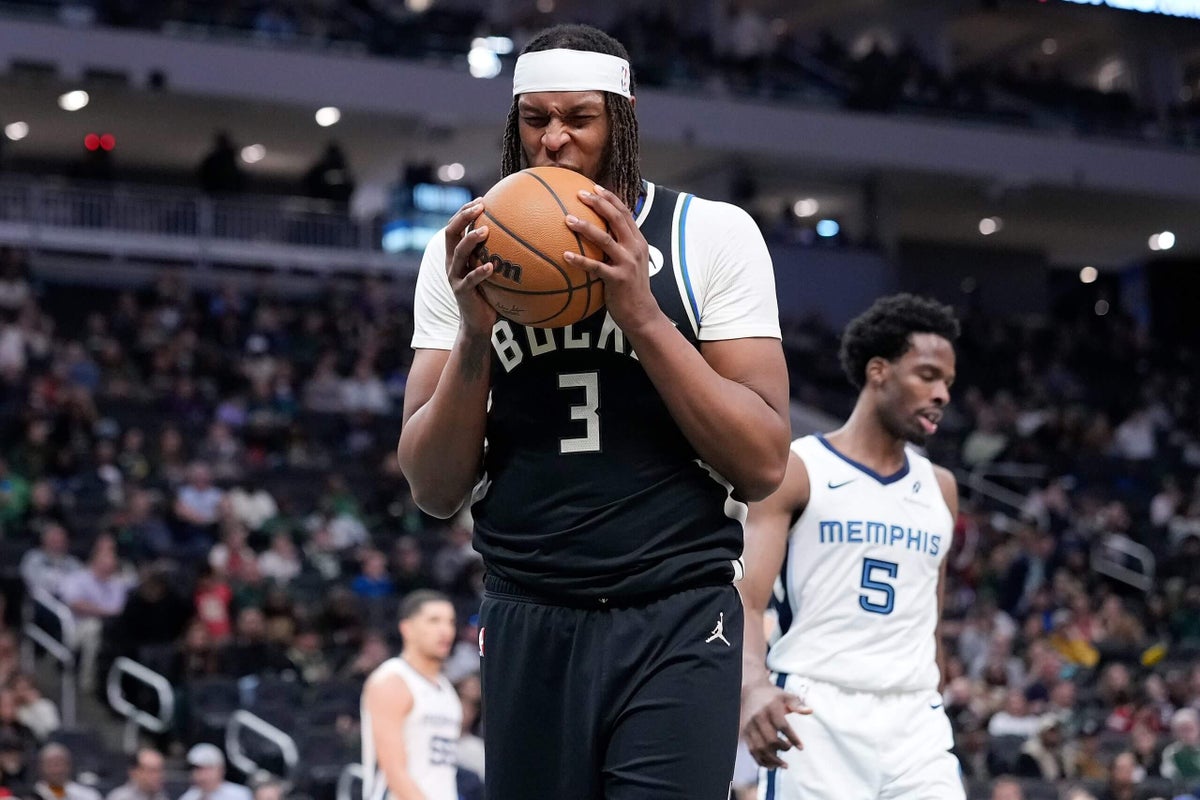
The Milwaukee Bucks pulled off arguably the most significant NBA offseason move in July when they waived and stretched the contract of Damian Lillard to create enough cap space to sign Myles Turner, one of the top free agents on the market.
Turner had helped the Indiana Pacers make their first run to the NBA Finals since 2000, and the Pacers were a win away from winning their first NBA title.
However, when star point guard Tyrese Haliburton tore his right Achilles tendon in Game 7 of the finals, everything changed for the Pacers’ offseason.
The opportunistic Bucks took a chance on the center from the team that had eliminated them in the first round in each of the last two postseasons, signing Turner to a four-year, $108.9 million deal.
Coach Doc Rivers and general manager Jon Horst sold reporters at the NBA Summer League on Turner’s fit with two-time NBA MVP Giannis Antetokounmpo, saying it’s strong enough to help the Bucks keep competing at a high level.
Turner’s first season in Milwaukee, however, did not go that way.
Injuries limited Antetokounmpo to 36 games on the season, the fewest he’s played in a season, and the Bucks missed the playoffs for the first time since 2016. Individually, Turner averaged 11.9 points, 5.3 rebounds and 1.6 blocks in 26.9 minutes.
Those averages were Turner’s lowest since his rookie season. The rebound average was the lowest of his career. Turner also took just 9.1 shots per game, which was the lowest since his rookie season.
“It was definitely a rude awakening,” Turner said in an interview with The Athletic and Milwaukee Journal Sentinel before the end of the regular season. “It was difficult throughout the year, obviously, with all the injuries and whatnot. But one thing I was really encouraged by was, honestly, the spirit of all of the guys, man.
“I feel like, especially on the players’ side, guys had the right approach, and that’s made it more easy to go about the days for myself. It’s obviously been a rough adjustment, but I think that kind of just comes with anything new.”
After acquiring Pascal Siakam in January 2024, the Pacers became one of the NBA’s best teams and reached the Eastern Conference finals that season. They followed that with an NBA Finals appearance. With Haliburton running the show, Indiana had one of the NBA’s most unique offenses and managed to do just enough defensively with Turner serving as Indiana’s primary rim protector.
While slightly chaotic and untraditional, Indiana was consistent and came into every game with a clear plan. With injuries disrupting this season from the very first game, the Bucks never found that consistency. That had a significant impact on Milwaukee’s biggest free-agent addition.
“I know myself, as a player, I’ve always been a guy that thrives in situations where I know I can impact winning,” Turner said. “A lot of that comes in, some people call it rim protection, some people call it floor spacing. To me, they’re systematic things. … I think we were more in an experimental year than just a firm system.”
In his career, Turner has never been a player who creates many of his own shots. Last season with the Pacers, 90 percent of his made shots were assisted. According to Cleaning the Glass, that number dipped below 80 percent in only two of his 10 seasons in Indiana.
With the Bucks’ best playmakers missing large portions of the season with injuries, Turner never found his place on the offensive end.
“It was never a steady dose of one thing,” Turner said. “I think that consistency, that continuity, is what I’ve had in the past, and that obviously made it a lot easier when I was there. But when you come into a new year, in this league, you have to adjust.
“I’m not really in the business of making excuses. I’ve never been a fan of that. You can try to blame your circumstances. You can try to blame the people around you. But at the end of the day, players are the ones that have to go out there and get it done.”
As the season progressed and the Bucks’ top playmakers missed more games, the team simplified Turner’s offensive package. It made him nearly exclusively a 3-point shooter, knowing his gravity would provide space for an offense in need of anything consistent.
In his first season with the Bucks, Turner made 38.3 percent of his shots from 3-point range on 5.4 attempts per game. However, he also took 54 percent of his shots from 3, besting his previous career high of 44 percent in his final season with the Pacers, per Cleaning the Glass.
Camping out behind the 3-point line meant Turner took only 23 percent of his shots at the rim, a career low for any season, and 22 percent of his shots from the midrange, the second-lowest percentage in a season in his career.
“I think one thing I provide is floor spacing, and with our lack of playmaking, me being able to kind of keep guys honest, (keep them) on the perimeter, it opened up the paint for us a lot more for any potential playmakers to actually get going downhill,” he said. “That’s one thing I was asked (to do) more.
“(There was) a lot more standing around than what I have been used to or a lot less time with the ball in my hands. Again, as a screen setter, most guys are switching me. In the past, I was able to kind of take the switch, roll and post up, whereas here, that’s clogging up the paint. So, it’s two different ways of looking at it.”
After this interview, it was revealed that Rivers would step down as the head coach in Milwaukee, meaning the veteran big man will work with a different coach next season. But while reflecting on his first season in Milwaukee, Turner found himself thinking he should have done more to advocate for his role and usage within the offense.
“It wasn’t easy,” Turner said. “I don’t want to throw Doc under the bus and say he said, ‘Myles, you’re not allowed to do this,’ or, ‘Myles, you’re not allowed to do that.’ I think a lot of it was me, maybe being a little passive and kind of acquiescing to others when I could’ve stepped up in a different role quicker for myself.
“But I do think there is a push and pull. It goes both ways. You could put me in a better position to be successful, and then I could be a little more assertive in ways that I have been in the past. There was definitely a lot of frustration on both ends. I think the frustration came more from not figuring it out fast enough, kind of just sinking.”
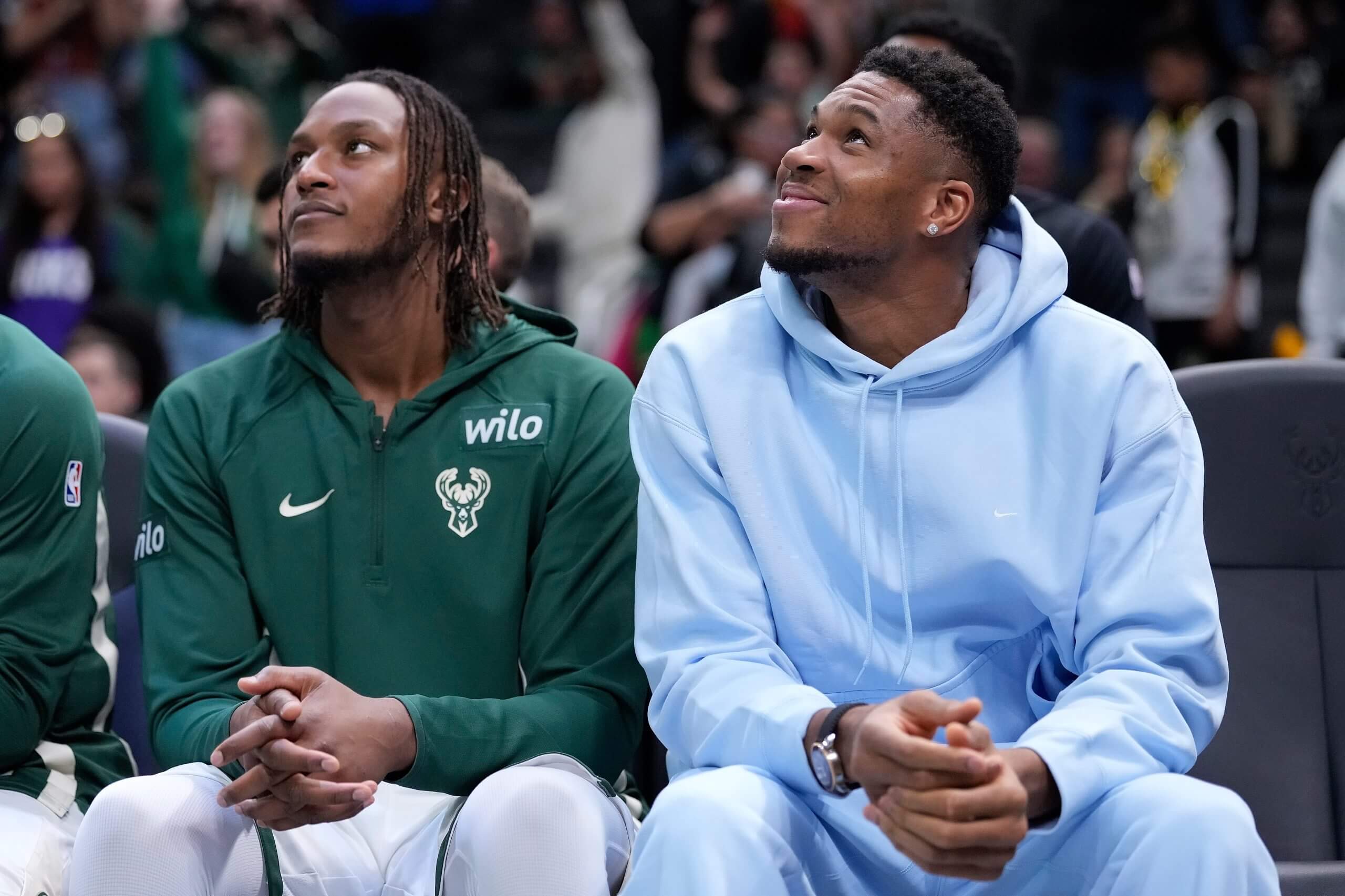
Due to injuries, Myles Turner and Giannis Antetokounmpo only played together in 34 games for the Bucks this season. (John Fisher / Getty Images)
While his first season in Milwaukee did not go as planned, Turner still believes in what could be, especially in terms of pairing with the Bucks’ two-time MVP.
Antetokounmpo and Turner played together in only 34 games, but the time they spent this season only strengthened Turner’s belief in what they could do if given a chance to play together for a full season.
“The potential is absolutely there,” Turner said. “We do complement each other. I’ve seen what he’s been able to do with Brook (Lopez) and their success, and I’m able to do similar things as him. So, I definitely still see a vision, but it would be nice to actually feel the vision, actually be able to play it out.
“A lot of questions are left to be answered with where we’re going in the future. It’s my responsibility as a player to just keep growing my game. Obviously, I was able to kind of see what the situation was this year, but I pride myself on being able to adapt, being able to change. So now that I got a year under my belt, it’s a matter of just making a proper adjustment on my end, because I don’t want to be sitting here with the same sentiment next year.”
According to Cleaning the Glass, the Bucks posted an offensive rating of 122.4 (93rd percentile) and a defensive rating of 114.3 (65th percentile) in the 1,433 possessions (693 minutes) that Antetokounmpo and Turner shared on the floor this season. The pairing works, but for them to further explore it, both players will still need to be in Milwaukee — and Turner admitted that will be a question hanging over this offseason.
“There needs to be direct clarity, you know what I’m saying?” he said. “I think that no one really knows what we’re gonna do right now. I think that’s not taboo. I think that’s a universal thing that the organization, the coaches, we gotta kind of figure out what direction we want to go in the future. A lot of questions obviously will be answered this summer, depending on what direction the organization wants to go, whether it’s the Giannis thing or whether what’s going on with players, our coaches. I think a lot of that will provide me a lot more clarity going into next season when that happens.
“But for me personally, you gotta be as professional as possible and just roll with it. I did sign a four-year deal, and with that being said, I plan to honor it, that commitment. All I can do is kind of sit here and wait for direction and go out there and voice my opinion during exit meetings and whatnot. I think we’re in wait-and-see-what-happens mode right now as opposed to what can happen.”