
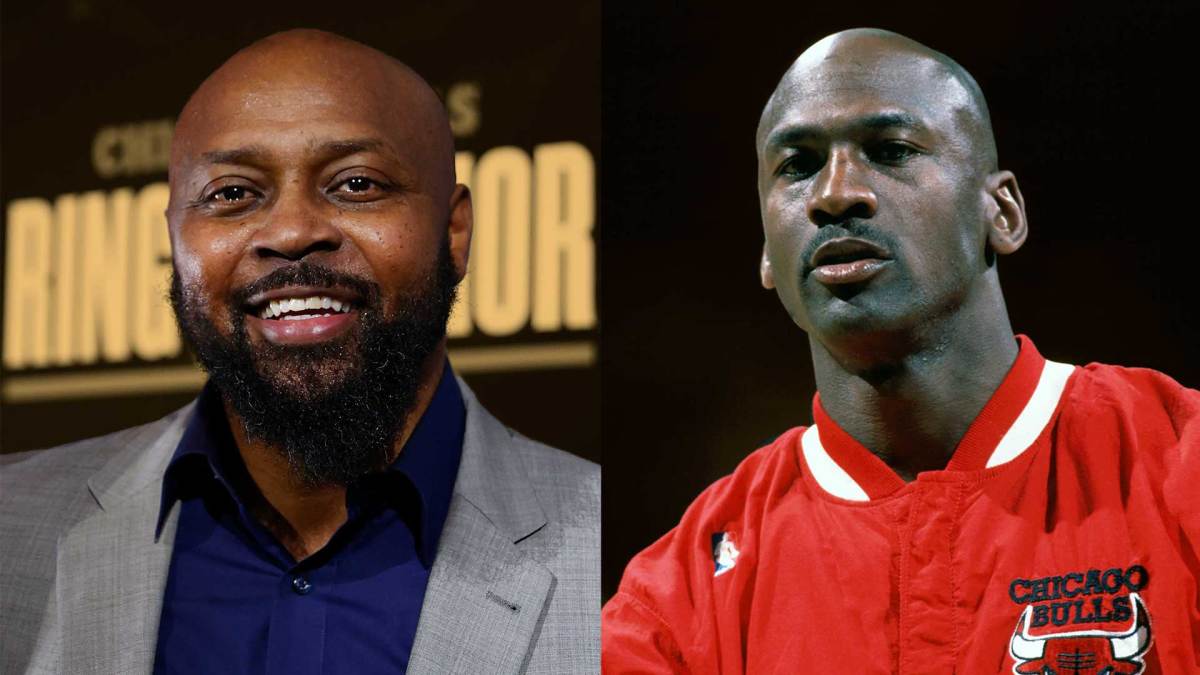
“They are having fun with MJ. But we knew MJ was thinking about” – Horace Grant reveals the psychological traps Michael Jordan set for rivals originally appeared on Basketball Network.
In the ’90s, it was all Michael Jordan and the Chicago Bulls. A red-and-black era built on dominance, cold-blooded execution and an icon with no off-switch. Every time the Bulls stepped on the hardwood, it felt like the floor tilted toward one man.
Advertisement
Jordan imposed the game. And those who came laughing left limping. Playing against the Bulls icon required much more than effort and talent on the court — a lot of talented and hardworking players were left scrambling against the six-time NBA champion.
Jordan’s edge
A big part of the Bulls’ stranglehold on the decade was MJ’s unrelenting edge. His aura was psychological warfare. Opponents would smile at him before tipoff — a fatal mistake that former Bulls big man Horace Grant saw for what it was.
Grave weakness.
“If we see the captain of the other team shake his hand and smile and laugh, we know we had that game,” Grant said, recalling Jordan’s devious mind games. “Because they are having fun with MJ. But we knew MJ was thinking about putting the boot on your throat.”
Advertisement
And he always did. Because he never forgot how it felt to be on the other end of the beatdown. “Mr. Air” showed absolutely no mercy to anyone — he didn’t receive any before his dominant championship years. He had to claw his way out from under the Detroit Pistons. The infamous “Bad Boys” era bruised him — physically, emotionally, and professionally.
For three straight years, Detroit pushed Chicago out of the playoffs with a blueprint built on pain: Jordan Rules. Hard fouls. Closed lanes. Body checks. That Pistons resistance turned MJ into something sharper, colder. And when he finally pushed through in 1991, he took the crown and couldn’t stop winning.
The teams that lined up against him weren’t lightweights. They were monsters in their own right. That first ring in ’91 came against Magic Johnson — still commanding the Los Angeles Lakers with poise and pedigree. In ’92, it was Clyde Drexler and the Portland Trail Blazers who had been neck and neck with Chicago all season. The Bulls didn’t flinch.
Then came 1993, when Charles Barkley was the league MVP. His Phoenix Suns were the top seed. They had the size, the tempo and the swagger. Jordan took it personally. He averaged 41 points per game across that series. Phoenix never stood a chance.
Advertisement
The best
When Jordan stepped away after his first three-peat, the league took a breath. It was the only window Hakeem Olajuwon needed. In ’94 and ’95, the Houston Rockets claimed both titles — but never had to see “His Airness” in the Finals.
By 1996, the Bulls icon was back, hungrier, meaner, and loaded with a new supporting cast that included a mature Grant now on the opposing side. The Seattle SuperSonics boasted Gary Payton and Shawn Kemp — defense, speed and athleticism. None of it mattered.
Advertisement
Then came Utah. Twice. Karl Malone and John Stockton — two Hall of Famers with pristine résumés. Still, Jordan broke them, too. Back-to-back Finals. Back-to-back heartbreaks. Game after game, it was always the same story: MJ as the closer, the killer, the absolute truth.
“I knew he was one of the best leaders that ever played the game,” Grant said. “He taught me how to be competitive.
Across six Finals appearances, every opposing leader had accolades. But only one led his team out of the tunnel with both the burden and brilliance of greatness. That was Jordan. The Bulls never lost a Finals. Never let a Game 7 happen. Because the five-time MVP didn’t let up — not at the tip, not at halftime, not when the smile came from the opposing captain.
Jordan had a perfect record on the biggest stage, and that psychology wasn’t lost on his teammates. They saw it, felt it, and fed off it. By the time “Mr. Air” reached his peak, the Bulls weren’t just a talented team but a cult of mentality—a unit with one brain and one target.
Advertisement
This story was originally reported by Basketball Network on May 30, 2025, where it first appeared.