
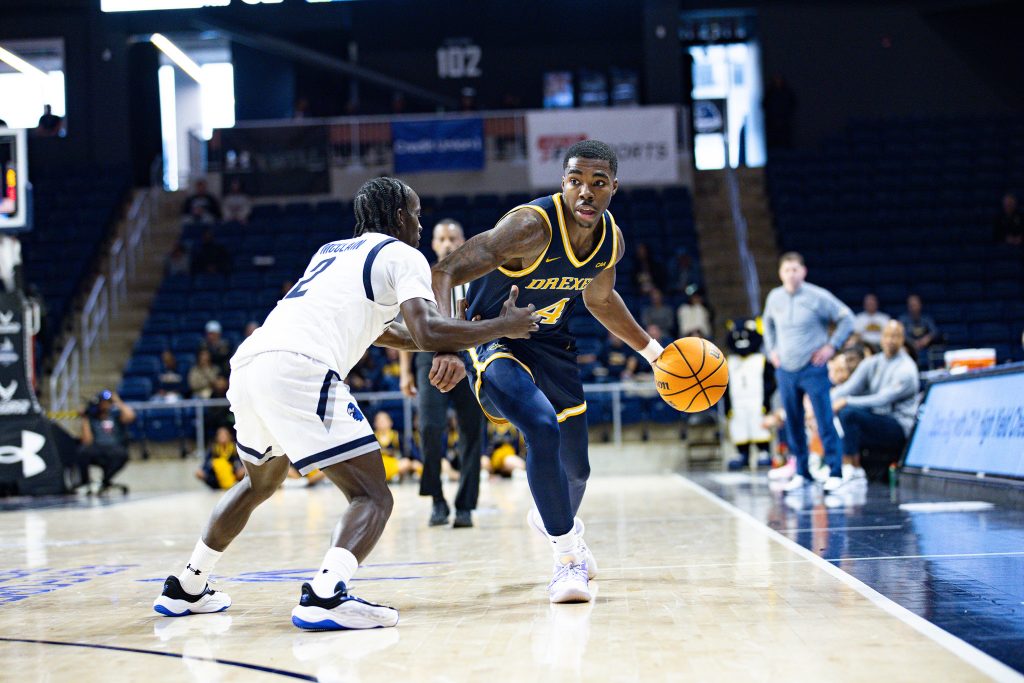
 Photo by Kasey Shamis | The Triangle
Drexel University’s men’s basketball program is once again facing the realities of the modern college basketball landscape, as two key contributors — junior guards Shane Blakeney and Kevon Vanderhorst — have entered the transfer portal.
Blakeney’s departure is the most impactful. The guard emerged as Drexel’s leading scorer this past season, averaging 14.2 points, 5.1 rebounds, and 2.5 assists. His journey through the program reflected Drexel’s development program: redshirted his first season, a rotational bench player his second year, sixth man role last season, and finally became a breakout starter and leader in 2025-26.
Blakeney contributed defensively as well, averaging 1.1 steals and 0.7 blocks a game, showing his versatility on both ends of the floor. With his production and size, he is already drawing interest from major programs like the University of South Carolina, highlighting how quickly standout mid-major players can garner national attention.
Vanderhorst started all 33 games this season, providing a constant presence in the backcourt. He averaged 9.3 points and 2.9 assists.
One of his most memorable moments came in a buzzer-beating layup to defeat North Carolina A&T, a play that earned the No. 3 spot on the Sportscenter Top 10. In his decision to enter the portal, Vanderhorst emphasized personal growth, noting that he is looking for “a place that’ll push [him]” as he continues to develop as a player.
This is no new concept for head coach Zach Spiker and his Dragons. After losing four players from last season in the transfer portal, Drexel continues to suffer from the trend of heavy turnover that most mid-majors have experienced as a result of the new transfer portal and NIL.
The portal has reshaped roster building across college basketball, often making it difficult for mid- to low-major programs to retain breakout players. At the same time, it offers opportunities for retooling through incoming transfers.
After losing both of its starting guards, the future looks uncertain for Drexel during the offseason, with numerous questions on how they will overcome this: who will fill the void left behind? Will the coaching staff be able to compensate for the losses through recruiting and the transfer portal? How will they still be able to remain somewhat competitive within the CAA? One thing does remain clear: constant change is now the norm in college basketball, and Drexel must adapt quickly to stay competitive.
For 100 years, The Triangle has operated as a financially and editorially independent student newspaper.
In order to continue this legacy, The Triangle relies on the generosity of our alumni, family, and friends. Please
consider donating to The Triangle
in order to secure the future of student-journalism at Drexel.