
Cooler heads prevailed in the NBA on Thursday… mostly.
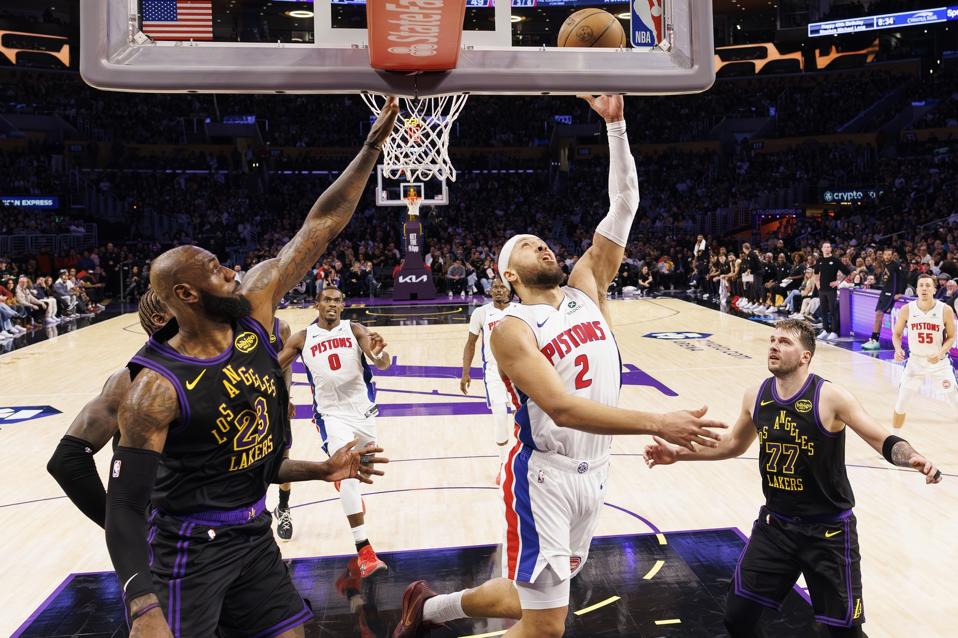
The NBA and National Basketball Players Association announced that Los Angeles Lakers guard Luka Dončić and Detroit Pistons guard Cade Cunningham are both eligible for all end-of-season awards despite playing in fewer than 65 games this season. However, Minnesota Timberwolves guard Anthony Edwards, who played in 61 games, is not eligible.
Advertisement
Timberwolves head coach Chris Finch seemed vexed by that decision.
“It sure would be nice to hear an explanation as to why Anthony was denied his 65 games, particularly when you look at the history of Anthony, who plays all the time and has played all the time,” Finch told reporters Thursday. “I’m not sure why we have a rule if we have an appeals process which is overturned in two-thirds of the cases that were held before it. It feels more like a suggestion than a rule.
“Again, those guys (Dončić and Cunningham) are super deserving, and their injuries are legitimate. It has nothing to do with them. But so are Anthony’s and Anthony’s situation. We’ve never rested him. That’s not how he’s been. It just feels a little unfortunate that he was the only one left out.”
Finch has a point. The NBA’s statement noted that Edwards’ extraordinary circumstances challenge went to an independent arbitrator, who ruled against him. It did not explain why the arbitrator ruled against him, though.
Advertisement
Dončić and Cunningham are both highly deserving of any end-of-season honors coming their way. Both are locks for the All-NBA team, and Dončić was even on the fringes of the MVP race behind Nikola Jokić, Victor Wembanyama and Shai Gilgeous-Alexander.
Edwards would have been an All-NBA lock if he was eligible, too. That’s what makes the NBA’s lack of an explanation about his challenge so confounding.
Where’s The Actual Line For Games Played?
The NBA’s latest collective bargaining agreement requires players to play in at least 65 games—and play at least 20 minutes in 63 of them—to qualify for end-of-season awards such as Most Valuable Player, Defensive Player of the Year and the All-NBA teams. Dončić played in 64 qualified games, Cunningham played in 63 and Edwards played in 60.
Advertisement
In Dončić’s case, the league very well could have given him an exception for the two games he missed for the birth of his child in Slovenia. That alone would have pushed him over the 65-game requirement.
Cunningham’s case is more complicated.
Cunningham missed 11 games because of a collapsed lung that he suffered in mid-March. He had played in 61 of the Pistons’ first 68 games to that point, although he played in only five minutes in the game where he suffered the injury, so that game wouldn’t count for awards purposes.
Cunningham returned with three games left in the regular season to shake off some rust before the playoffs began. That left him with 63 qualified games when the season wrapped up. If not for the collapsed lung, Cunningham would have breezed past the 65-game minimum.
Advertisement
Edwards missed four games early in the season due to a hamstring strain, six games in December and January because of foot soreness and 11 games in March and April because of a knee injury. Because he played in only three minutes against the Indiana Pacers in late October (which didn’t qualify that game for awards purposes), he officially became ineligible for awards when he missed the Wolves’ game against the Detroit Pistons on April 2. He proceeded to play in only two of their final six games.
All three of Dončić, Cunningham and Edwards filed Extraordinary Circumstances challenges, which requires players to prove that “due to extraordinary circumstances, it was impracticable for him to play in one (1) or more of the regular-season game(s) that he missed.” They also must prove that “as a result of the extraordinary circumstances, and taking into account the totality of the circumstances, including whether the player did not play in other regular-season games in which he could have played during such season, it would be unjust to exclude the player” from awards eligibility.
Here’s where it gets interesting.
According to ESPN’s Tim Bontemps, the NBA and NBPA came together and agreed to allow Dončić and Cunningham to be eligible for awards despite not playing in 65 games.
Advertisement
“Rather than those cases going to an arbitrator, both the NBA and NBPA agreed to waive the rule for both players,” he added.
There’s also no explanation for why the NBA and NBPA agreed to not send all three of Dončić, Cunningham and Edwards’ cases to an arbitrator, other than common sense prevailing for Dončić and Cunningham. Edwards’ agent did raise an interesting question, though.
“Anthony and I appreciate the PA appealing his case,” Edwards’ business manager, Justin Holland, said in a statement to ESPN. “For me personally, I’m a bit confused at the clemency for Cade, who missed time for something that happened on the court, and not Ant, who missed time for an infection. But ultimately you already know Ant isn’t trippin’ over it AT ALL.”
Does The NBA Owe Fans An Explanation?
The 65-game rule is taking fire left and right these days. The least the NBA could do is offer more transparency about how it reached its respective decisions for Dončić, Cunningham and Edwards.
Advertisement
Why was Edwards forced to take his case to an arbitrator while the NBA and NBPA agreed to settle Dončić and Cunningham’s challenges before they even got to that point? What does and doesn’t qualify as an extraordinary circumstance? Was Cunningham treated differently because he suffered a medical issue while other players are just managing the bumps and bruises of a long season?
Edwards still has three guaranteed years on his contract, and he signed a 30% max deal since he made All-NBA in 2023-24. Missing out on an otherwise well-deserved All-NBA nod won’t cost him financially. But it could look like an egregious oversight in due time, and All-NBA appearances often do factor into discussions about legacy and the league’s all-time hierarchy.
Would the NBA have ruled in Edwards’ favor had he played in a few more meaningless games down the stretch? If he was nursing an actual injury, it wouldn’t want him resting to get as close to 100% as possible for the playoffs? What’s more important—the quality of the postseason or the quality of the regular season?
Fans, players, coaches and other employees of the league deserve to know the answer to that question. That would allow them to set their expectations and priorities accordingly.
Advertisement
Unless otherwise noted, all stats via NBA.com, PBPStats, Cleaning the Glass or Basketball Reference. All salary information via Spotrac and salary-cap information via RealGM. All odds via FanDuel Sportsbook.
Follow Bryan on Bluesky.
This article was originally published on Forbes.com