
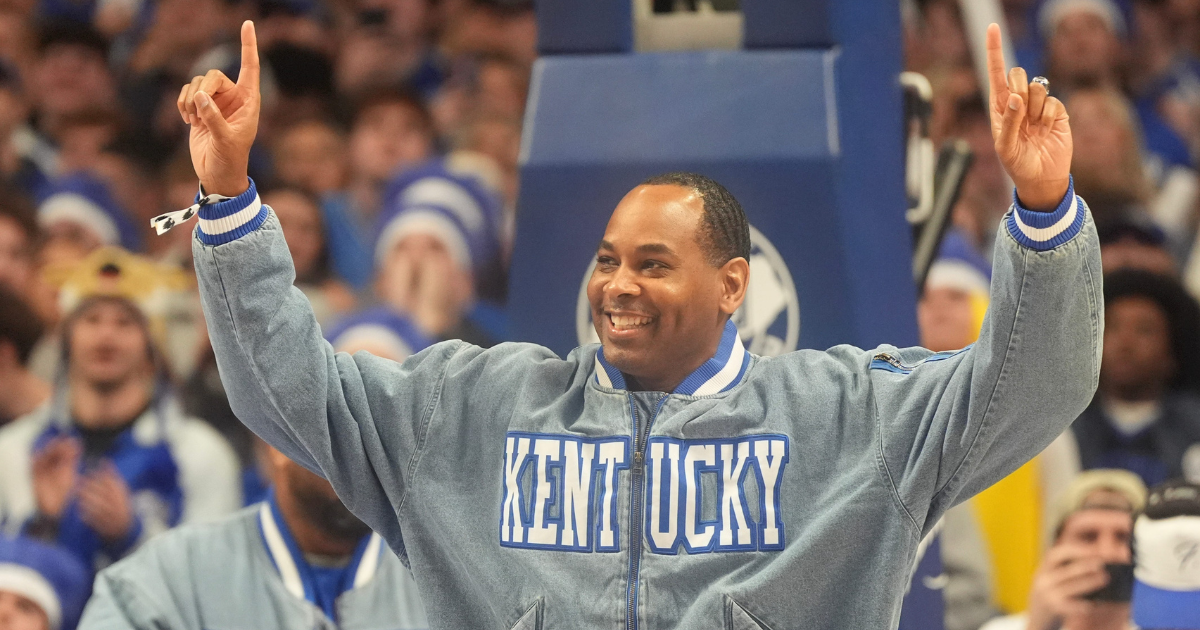
When Mark Pope took the job at Kentucky two years ago, he brought the 1996 team with him — literally. Pope’s old teammates came off the bus with him at his introductory press conference and have been fixtures around the program since, reuniting at his first Big Blue Madness and the 30th anniversary of their national championship. Several of them were on the sidelines in Atlanta to see Pope and the Cats beat Rick Pitino and St. John’s in the CBS Sports Classic, mobbing their old team captain after he knocked off their old head coach.
The 1996 team, aka “The Untouchables,” set the standard of excellence for a generation of college basketball. So, what do they think of how the program has fared so far under Pope? One of the stars of that squad, Derek Anderson, didn’t shy away from the question during an appearance on KSR this morning at Whiskey Thief Distilling Co.
The 1996 team group chat has become famous, with Pope mentioning on more than one occasion how his former teammates roast him. Anderson said the group chat is still very active and Pope is still a part of it, although “he gets ghosts sometimes,” meaning people will type something then delete it in fear of being too “brutal.” Anderson, Cameron Mills, and Wayne Turner are the most active participants. Anderson is now a Player Wellness Counselor for the National Basketball Players Association (NBPA), so he often chimes in with his perspective from working with elite high school players.
“Everybody gives it, but I just think we’re just more — like, I’m more passionate about it, because I see the game differently, because I work with the NBA guys, top 100 high school kids, so I see the evolution of how the IQ game is not there, and I’m trying to get them to understand that the teacher part.”
As someone who works with the type of players Pope is recruiting and coaching, Anderson doesn’t think Pope has a problem relating to guys; however, there may be a disconnect when it comes to the mentality needed to succeed at Kentucky.
“I don’t know what his speeches are,” Anderson said. “He can relate to the guys because he’s a great guy. When it’s time for Xs and Os, it’s time to change, it’s time to do things, I think that’s when we don’t know what he’s actually done, because it’s a new situation.
“When you’re at BYU, you get to kind of run and play, and it’s a different style when you’re in the SEC and Kentucky thing. We were coming for your throat, and that’s a different mentality. Is he teaching that mentality? Because he’s never been that rah rah guy anyway. You saw when we played, I’m dancing when I dunk on you. He’s just like this, ‘Good play, DA. Go sit down.’ Like, that’s a great guy, but that’s not Kentucky. Like, I was taught to dominate players whenever I played, and that was a mentality.”
What is Anderson’s biggest piece of advice to his good friend? Practice like it’s a game so that when the game starts, habits are second nature. He used Pope’s method of having everyone in the gym be silent while the team practices free throws as an example of something he would do differently.
“Our minds were different, our thought process and our anticipation were, we have to do the job that [Rick Pitino] taught us in practice. And I would tell Mark, like when he does this thing in practice. I love him, but he does a free-throw thing. He wants everybody quiet. We wanted everybody loud. If I’m at the free throw line, I need to hear noise so I know it at the end of the game, when there’s crazy going on, I gotta concentrate. One, shoot it, hold my follow-through, 1, 2, 3, and the ball goes in. But if you don’t teach that, and when it happens in a game, how am I prepared? I’m not.”
“I think that is just what I would tell him, is you’ve got to practice a different way to get a better result in the game.”
Injuries held Kentucky back from its potential this past season, but Anderson also noted another big issue: basketball IQ, or lack thereof.
“It was IQ,” Anderson said, doubling down when Matt Jones asked if it was a lack of talent instead. “Yes. 100%. That was the difference. And you watch how we lost the game, it was IQ. We didn’t know how to play basketball. It was literally, we couldn’t throw a bounce pass. I could bounce a fake pass here and bounce it. Guys would do this and look at him, and the whole defense was looking at it. I know where you’re throwing the ball. Dude, pump fake. If you’re in a 2-3 zone and you did this, the whole defense goes. We don’t need to teach that. And then the assistant coaches, when guys shoot a free throw, they do this and walk off the line. You know what the assistant coaches would do? Nothing. I would say, stay on the free-throw line. Hold your follow-through, make the ball go in. Those are the points you’re after at the end of the game.
“It was not teaching. And I was always telling him, you’ve got to teach the IQ part and understanding of the game if you want players to be better. You can’t just let them go and say, well, they’ll figure it out.”
Interesting stuff from Anderson, who knows Pope, basketball, and what it takes to succeed at Kentucky better than almost anyone. You can hear it all below.