
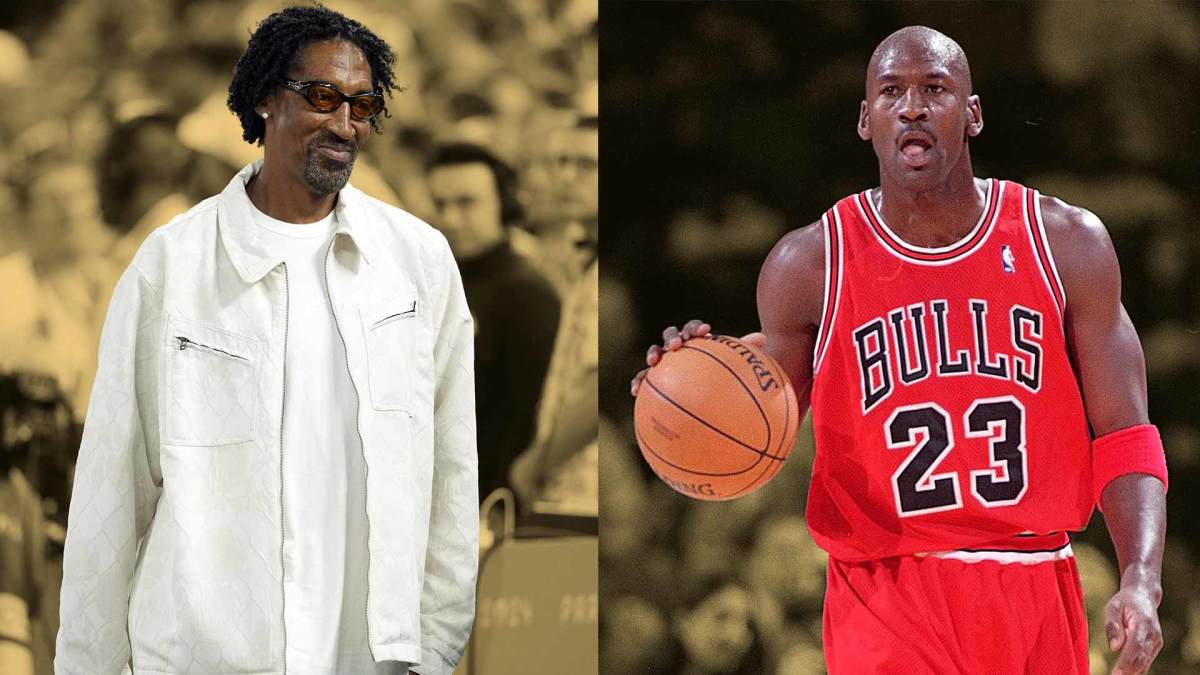
A lot had changed from when Michael Jordan first stepped away from the game in 1993 to when he returned in March of 1995. The world was different. The NBA had begun a quiet shift. And so had the Chicago Bulls.
With MJ playing baseball in Birmingham, the Bulls had gone from an empire to a team trying to find its new identity. They weren’t floundering, but they weren’t the same menacing force that had defined the early ’90s. So when Jordan returned, the gravity in the building shifted again.
Adjusting to Jordan
Of course, MJ was still walking in as the leader of the team. But it was a new kind of feeling for those who came in after he left.
Advertisement
“I think a lot of players found it really difficult,” said Scottie Pippen, who played 478 games with Jordan before his first retirement. “Michael brings a little different type of pressure to the game. And I think a lot of the players that had came there and gotten very comfortable, realized that they had to go back and restart.”
Players like Luc Longley, Steve Kerr, Bill Wennington and Jud Buechler had walked into a post-Jordan locker room and slowly begun carving out space, forming chemistry with Pippen as the team’s unquestioned leader.
Longley had been adjusting to the league’s physicality and was slowly growing into his role as the Bulls’ starting center. Kerr, coming off a productive 1993–94 season, had started to assert himself as a reliable shooter.
Advertisement
But Jordan’s return didn’t come with time to adjust. It came with urgency, with championship weight. And for players who weren’t part of the first three-peat, that meant recalibrating expectations and re-learning the language of greatness.
The Bulls hadn’t felt like themselves since 1993. They made the playoffs in 1994 and 1995, but without Jordan, there was no parade. They bowed out in the second round both years — first to the New York Knicks and then to the Orlando Magic. The NBA’s throne wasn’t theirs anymore, and the league had no intention of waiting for the Bulls to claim it back.
Taking control
Jordan’s return late in the 1994–95 season sparked hope, but not magic. He showed flashes of his old brilliance, even dropped 55 points on the Knicks at Madison Square Garden just five games in.
Advertisement
But rust doesn’t respect reputation. In the playoffs, the Magic exposed what the Bulls lacked — rhythm, depth and cohesion. Chicago lost in six games. And that stung.
By that point, the chemistry that had been carefully built under Pippen’s leadership had to be restructured. Not torn down, but reimagined. Players were relearning how to function around Jordan’s relentless standards.
“We’re not just walking into Scottie’s house anymore,” said Pippen, reflecting on that adjustment period. “It’s Michael’s and Scottie’s house, and we have to sort of change how we do things around here as far as our comfort zone.”
Chicago’s record post-MJ return in 1995 was solid — 13 wins and four losses — but they were never truly whole until the offseason reshuffle. It wasn’t until the summer that Bulls general manager Jerry Krause made the final touches. In came Dennis Rodman. In came a renewed hunger.
Advertisement
What followed was the 72–10 season and a second three-peat, but that only came after the awkward turbulence of that initial reunion.
In hindsight, it’s easy to treat MJ’s return as destiny unfolding. But in real-time, it was messy, uncomfortable and uncertain. For the guys who had held down the fort, adjusting to Jordan’s shadow again was never automatic. It took surrender. It took time.
Because when “Mr. Air” came back, he returned to a team that had grown without him — and now had to reshape itself all over again. They ripped off another three-peat after that.