
LOS ANGELES — Once it became official that Kevin Durant would not suit up for Game 1 of the Houston Rockets’ Western Conference first-round series against the Los Angeles Lakers, it was a foregone conclusion that the Rockets would take a step back on offense. Maybe even two.
But it was much worse than expected.
Without Durant, Houston’s offense fell off a cliff, helping to fuel the red-hot Lakers to a 107-98 victory over the Rockets in what’s already become one of the most odd series in this year’s playoffs. The absence of Lakers stars Luka Dončić and Austin Reaves already deprived this series of some punch.
But once Durant became a late scratch after bumping knees with a teammate during practice on Wednesday, it was almost as if the juice left Crypto.com Arena before Game 1 even started.
At least that’s how it looked on the Rockets sideline, as they were without the fifth-leading scorer in NBA history. Although it’s been weeks since the Rockets fell victim to these kinds of lulls, Houston’s performance in Game 1 was very reminiscent of how it looked during some of its worst stretches of the regular season.
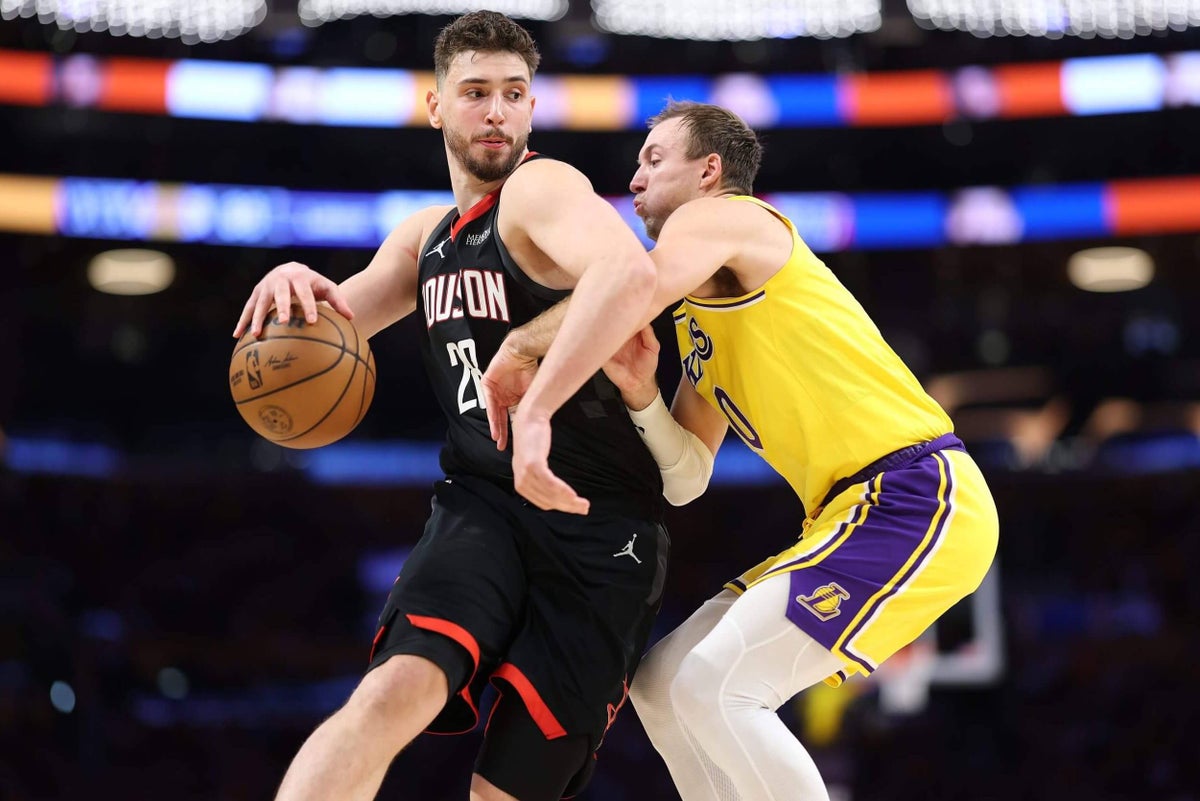
The half-court sets were stagnant. All-Star Alperen Şengün was inefficient and erratic with his decision making. Amen Thompson was driving into crowded lanes. Perhaps worst of all, there was no one to slow down the snowball effect as one turnover or missed jumper bled into another.
Despite knowing they’d be without their two leading scorers to begin the series, the Lakers looked like the team more physically and mentally prepared for playoff intensity. The Rockets were a step slow from the start, allowing their struggles on offense to dictate their attitude and aggression throughout Saturday night.
These problems were supposed to be in the past. But they crept to the forefront again, with Houston’s starting unit shooting a combined 34.7 percent from the field.
“(We got) some decent looks, but we got a little bit too stagnant hunting our own shots,” said Rockets coach Ime Udoka. “When we did touch the paint and had some kickouts, especially early in the first quarter, we got really good looks. … Felt like we had too many contested shots in a crowd at the rim over one or two people.”
One of the biggest surprises was Şengün being a frequent culprit when the offense got stagnant. With Durant out, it could have been a great opportunity for the 23-year-old to show he can dominate against the Lakers’ complicated defensive schemes and lift his team to an improbable playoff win on the road.
Instead, Şengün had one of his worst games in over a month. He finished with 19 points, eight rebounds and six assists, but he made 6 of 19 from the floor, and his overall performance was filled with uncharacteristic mistakes.
Şengün’s patience in the lane and passing vision are two of his biggest strengths, but he was unusually ineffective in both of those areas. He looked frantic trying to attack ahead of double-teams. The paint regularly was so crowded that his go-to passes weren’t available, but he also missed several potential kickouts for 3s.
It would be easy for the Rockets to say that Saturday was just an abnormal shooting night and their shots will start falling eventually. While that may be true to an extent, it undersells how much of the offensive process was broken. Şengün usually controls the game by forcing opponents to react to his post-ups or deep drives in the paint.
But in Game 1, Şengün was the one on his heels and struggled to find the weak spots in L.A.’s defense.
Whether or not Durant returns in Game 2, the Rockets can’t afford for Şengün to be this ineffective. Şengün’s importance isn’t just because of the points he puts on the board. His elite passing from the center spot opens up the game for the other talented forwards around him. While Thompson, Jabari Smith Jr. and Tari Eason are all capable of making plays on their own, the Rockets are most dangerous when those players are taking advantage of the attention Şengün gets around the basket.
When Şengün’s impact is this limited, it doesn’t just bring him down; it affects everyone around him. Especially when Durant isn’t there to pick up the slack.
“I missed a lot of shots, the shots I was making (in the past),” Şengün said. “It happens. It’s the first game — the first away game. It’s going to come back. I’m not upset about it. Of course, I’m upset about the loss, but I’m going to bounce back next game and come stronger. I’m going to have a different mentality.”
While most of the Rockets shot poorly in Saturday’s loss, another player struggled much more than usual: Reed Sheppard.
The second-year guard finished with 17 points and eight assists while shooting 6-for-20 from the field and 5-for-14 on 3-pointers. His added aggression was needed with Durant sidelined, but he settled too often for contested, pull-up jumpers instead of putting pressure on the Lakers by getting downhill.
Three times, he got Lakers center Deandre Ayton switched to him on the perimeter, but he failed to punish Ayton on any of those possessions. One resulted in a failed drive to the basket. One turned into a missed fadeaway jumper. The last was a pull-up 3-pointer that Ayton partially blocked.
Missing shots is one thing. That happens. But Sheppard’s decision making on the ball and his ability to punish the Lakers’ slower perimeter defenders seemed lacking.
Sheppard’s explosive scoring ability has become an essential part of the Rockets’ puzzle. When he looks as disjointed as he did on Saturday, it puts added pressure on some of the role players who aren’t as capable.
Getting your first real playoff minutes on the road against the Lakers is never easy, and Sheppard isn’t the first young player to fall victim to the bright lights. But as this series goes along, his shooting will be key. Even more than that, the Rockets need him to help stabilize the offense during certain stretches and take advantage of mismatches when they’re available.
“I like the shots he was taking, if I’m being real. We need Reed to do that,” Thompson said. “He’s such a threat. When it comes to shooting, he demands so much attention. I like the shots; they didn’t go the way we wanted.”
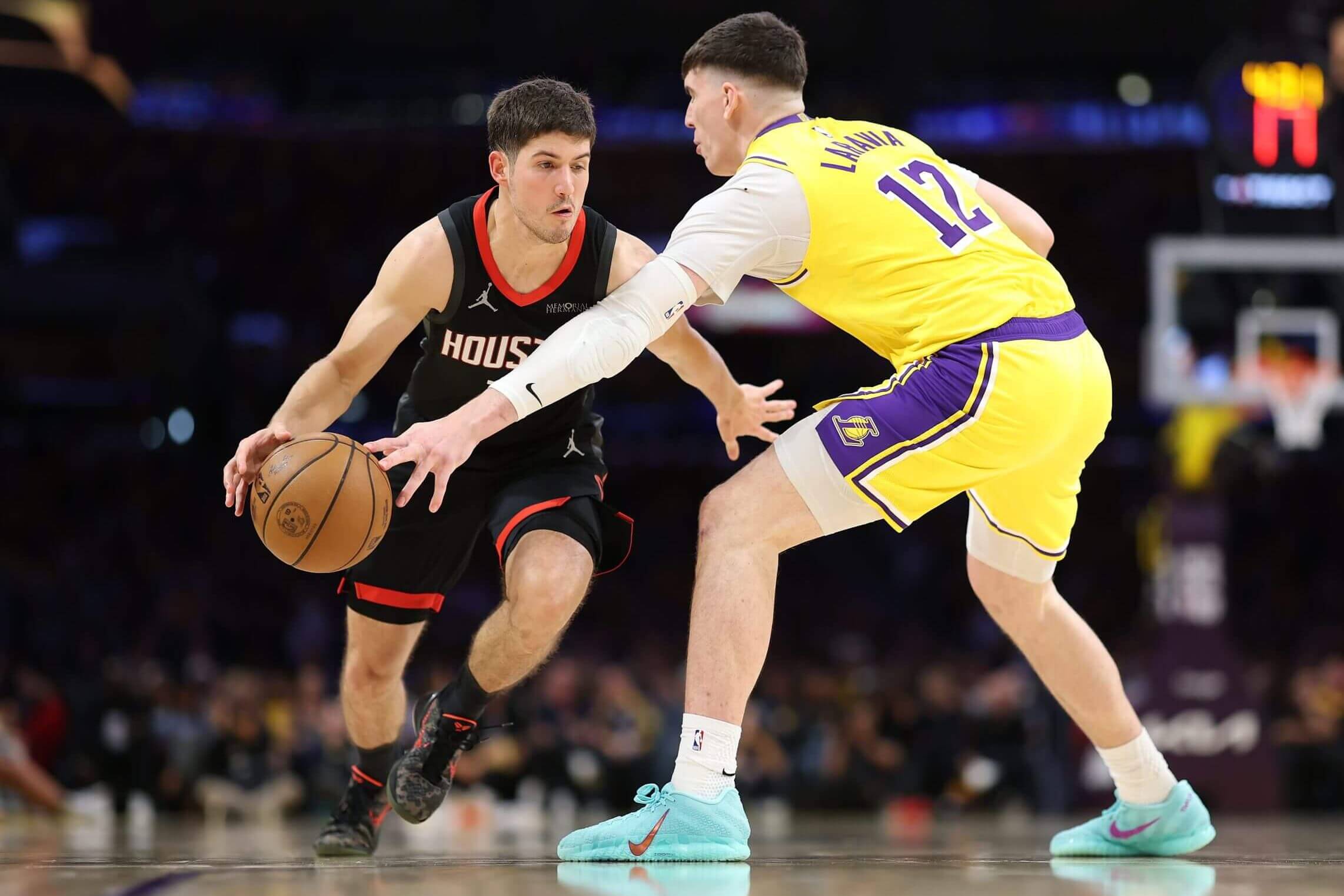
Reed Sheppard had a tough night in his playoff debut Saturday night. (Sean M. Haffey / Getty Images)
Udoka pointed to several numbers that were clearly in his team’s favor, but the poor shooting prevented them from ever making it a game. The Rockets grabbed 21 offensive rebounds and scored 23 second-chance points. They also had 13 steals, forced the Lakers into 20 turnovers and scored 24 points off those mistakes.
In fact, the last time a team had 20-plus offensive rebounds and 10-plus steals in a playoff game without scoring 100-plus points came in 2013. It’s only happened seven times since 2000.
Udoka also pointed out after the game that Houston ended the night with 27 more field-goal attempts than the Lakers, a stunning statistic, especially considering both teams had nearly the same number of free throw attempts (Rockets had 25, Lakers had 26).
This was a game the Rockets usually win. They just couldn’t make up for the poor shooting.
“The looks were decent. We won a lot of areas and just shot it poorly,” Udoka said. “We had 27 more shots than them. We’ve just got to convert those. … It’s hard to win with those numbers.”
Game 2 on Tuesday will be a waiting game. Will Durant be back in the lineup? Will he be moving as well as he has all season? Can he do enough to save the Rockets from these awful offensive woes?
Durant is so talented that his presence alone may be enough to get the Rockets back on track. But the lesson from Game 1 shouldn’t be that things would’ve been different if he’d played. It’s that the Rockets were so bad in half-court situations that it nearly took a Herculean effort from both teams to prevent them from winning anyway.