
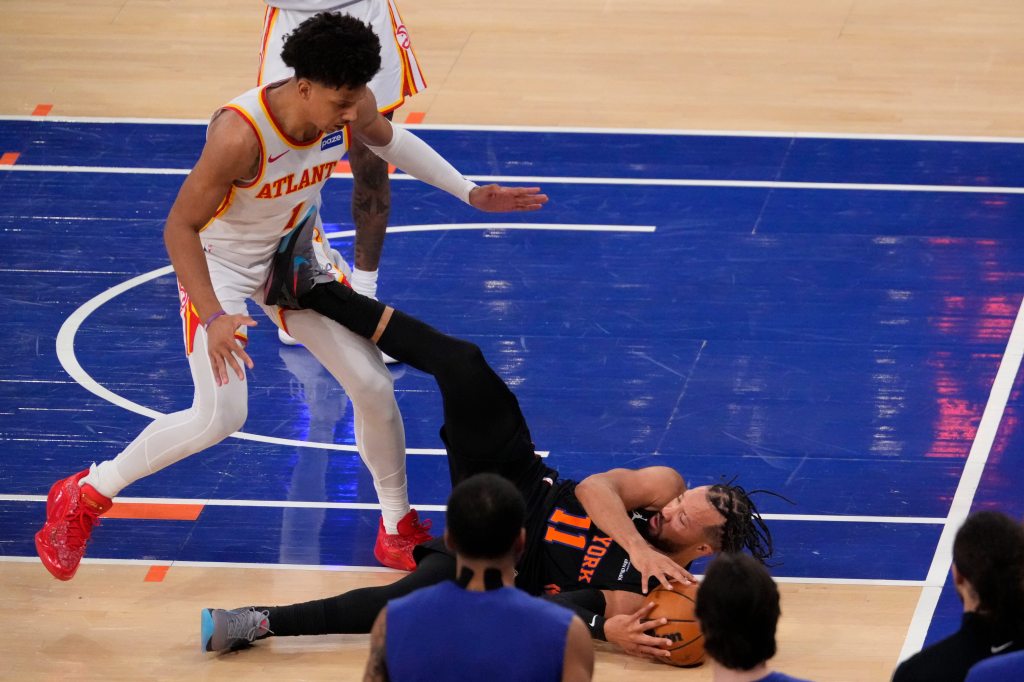
Perhaps if Mike Brown opted not to call a controversial timeout with 2:43 left in the fourth quarter of the Knicks’ Game 2 loss to the Atlanta Hawks, the Knicks may have, indeed, went on to take a 2-0 series lead instead. Because OG Anunoby was open in the corner, and Jalen Brunson made a strong drive to the paint creating a passing lane to a knockdown shooter.
The world will never know. Brown called the timeout, the whistle cutting through a tense Madison Square Garden already bracing for a 14-point lead slipping away. And the way things were going, Brunson was set to call his own number yet again in an effort to prevent an epic playoff collapse.
He finished with 29 points on 10-of-26 shooting. Over the final 7:53, he shot three-of-eight and had the ball stolen on the Knicks’ second-to-last possession. No other Knick took more than three shots in the fourth. Karl-Anthony Towns, who went six-of-seven in the third quarter alone, took just two shots and didn’t score in the fourth.
And the Knicks cited a “stagnant” offense down the stretch — the standstill nature of the scoring flow the chief reason Brown called the timeout many say iced his own All-Star point guard.
“I think [our offensive flow] could have been better,” said Mikal Bridges. “It’s definitely got to be better.”
“I agree. It was a little bit slow,” added Anunoby. “Not a lot of ball movement.”
Maybe that would have changed on this possession had Brown not uncharacteristically halted play as Brunson made his move to the paint. Anunoby was available in the corner for a play his point guard has made time and time again this season.
But not on this night.
“We had a couple of possessions that weren’t fluid, and so I wanted to make sure that we had something that we wanted to get to or to set something up offensively,” Brown explained as his reasoning for the timeout. “Because we had whiffed on the last couple of possessions. It just didn’t look right or didn’t feel right.”
***
Brown wants pace. He’s signaling it from the sideline, waving his players forward to attack an unset Hawks defense.
Brunson, instead, is methodical — deliberate — working against Dyson Daniels’ pressure before even crossing half court.
Atlanta leaned all the way in: traps, blitzes, doubles near mid-court. The goal was to get the ball out of Brunson’s hands and see what happens next.
What happened next decided the game. It’s been a season-long question under Brown: What do the Knicks look like when Brunson isn’t the one creating offense? Game 2 was the clearest version yet — and the ugliest.
The Knicks unraveled possession by possession: Bridges rimmed out two threes on the same trip, Anunoby got stripped on a drive to the rim, Towns left a late-clock three short, and Bridges missed the game-winner at the buzzer.
Even their best non-Brunson possession — a Hart-to-Anunoby lob — ended with two missed free throws. Moments later, C.J. McCollum isolated Brunson and put the Hawks up three, a matchup he said he found advantageous for obvious reasons (“What do you think?” he responded after the game).
“Down the stretch we got some pretty good looks… we just didn’t convert,” Brown said. “They hit their shots. We missed ours.”
There’s another layer Brown won’t fully concede — but Thibodeau understood: The Knicks struggle when Brunson and Towns sit together.
New York led by 11 in the first quarter. Brown sat both stars early in the second. The Hawks took the lead minutes later.
It happened again in the fourth. Up 14, both stars went to the bench. By the time they returned, the lead was nine — and shrinking. The lineup Brown turned to — Miles McBride, Mitchell Robinson, Jordan Clarkson, Landry Shamet and Anunoby — had barely played together all season. It’s been effective in small samples, but Game 2 exposed the risk.
Brown didn’t see it that way.
“No, I don’t think so. We’ve played that lineup quite a bit since the end of the season, and that lineup’s been pretty good,” he said. “We weren’t good tonight and we turned the ball over a few too many times during that period.”
Thibodeau rarely let both stars sit at once. Last postseason, Brunson and Towns shared just 35 total minutes on the bench together — and those minutes were a disaster.
Through two playoff games this year, that number is already climbing. Towns didn’t put the loss on those stretches.
“The time when we were off the court wasn’t where we lost,” he said. “It was the time we were on the court at the end.”
***
Even when Brunson had the ball, things weren’t right. He’s not the same late-game force he was last season.
By the NBA’s definition, clutch time is the final five minutes of a game within five points. Last season, Brunson led the league with 5.6 clutch points on 51.5% shooting.
This year: 3.6 points on 49%. The difference is subtle, but real. Brown has pushed Brunson to trust his teammates more. The tradeoff has been rhythm — knowing when to attack and when to defer.
Brunson hit a tying three with 1:21 left. Another to cut it to one with nine seconds remaining.
But too often, he dribbled deep into the clock before initiating anything — or called his own number immediately advancing the ball into the frontcourt. He was doing it again when Brown called timeout, driving into the lane as Anunoby waited, open, in the corner, flopping his arms under the ostensible realization the ball was not going to find him.
“[The late-game offense was] maybe a little stagnant. Obviously I can control what I can control,” he said after the game. “And so poor decision-making on my part in some possessions… We just got to play better with the lead. That’s twice in the fourth quarter now.”
Then there’s the most glaring issue of all: Towns isn’t touching the ball enough. It’s a layered issue that reared its head under pressure on Monday.
With 3:12 left, the Knicks clung to a one-point lead. Somehow, 6-7 Jonathan Kuminga kept the 7-foot Towns from establishing post-up position, pushing him out of the paint and into the corner.
Towns raised his hands — calling for the ball — then dropped them in frustration.
After scoring 14 in the third, he didn’t score in the fourth.
“The opportunity just didn’t come around to shoot it,” Towns said at his locker after the game. “It just didn’t find me. The opportunity wasn’t available for me in the fourth, and that’s fine.”
It’s not fine: The Hawks are thin at center. This is the matchup the Knicks are supposed to dominate. Instead, Towns has taken 13 and 12 shots in the first two games of the series.
It’s the Knicks’ most glaring flaw — and the easiest explanation if this series turns. They don’t consistently lean into their biggest advantage and haven’t prioritized him as a top scoring option consistently throughout the season. Plus Towns, in certain matchups, is neither forceful asserting himself demanding the ball nor establishing advantageous position against smaller opponents.
“KAT’s a great player, so he’s just got to impose his will on the game,” Brown said after the loss. “I don’t need to tell him every game he’s got to be aggressive. He knows we need him to do that.”
Maybe Towns knows that. Maybe his teammates do, too. But knowing and doing are two different things — and right now, the Knicks are stuck in between. In-between scoring and play-making, scoring and trusting one another. In between a timeout and letting things play out on the floor.
“We got to make sure [KAT is] involved — find him on mismatches, put him into actions, make sure we use his skill and his gravity to our advantage,” said Hart, seated next to Brunson at the post-game podium, in the chair Towns occupied one game prior. “And that’s something that we’ll look at on film and be better with.”