
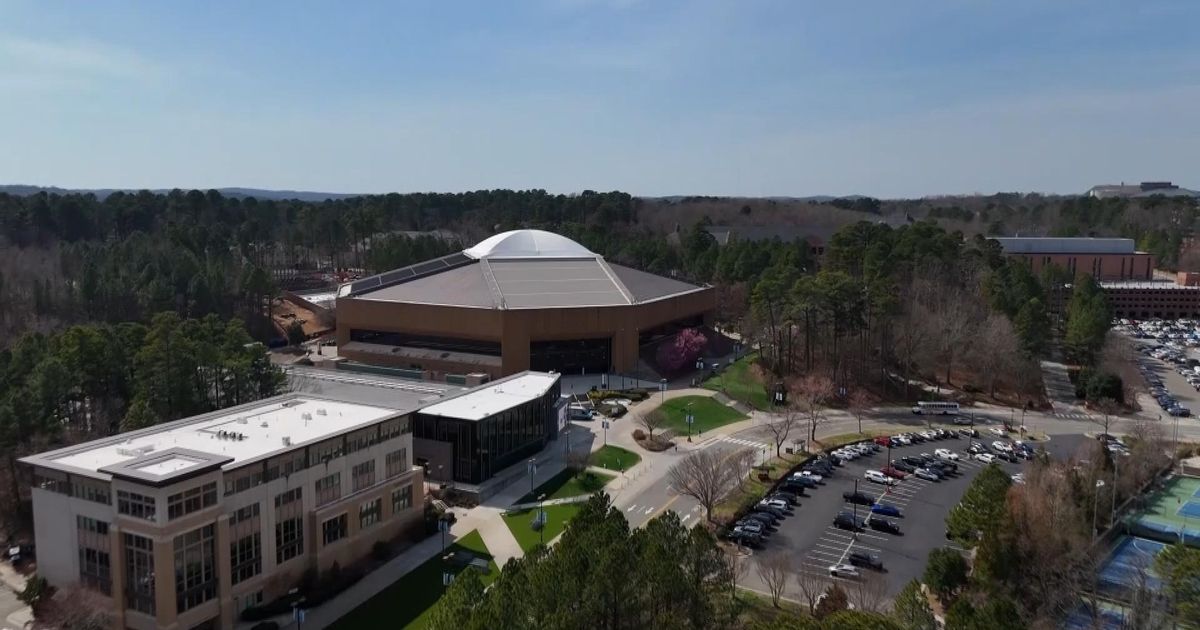
After two years of largely behind-the-scenes work on a new basketball arena at its planned Carolina North development, top officials at the University of North Carolina created a detailed draft launch plan for the new venue late last year, timed just before the 40th anniversary of its current venue — the iconic Dean E. Smith Center.
“From Dean to Dream – A New Home for Carolina Basketball,” they titled the video that was to be part of the presentation. The scope of the project was matched by the potential announcement plans: virtual town halls for alumni, watch events in Raleigh, Charlotte, New York City and Atlanta, an on-campus pop-up exhibit.
Now the dream of a new home for the Tar Heels’ basketball program is on hold.
Months of careful planning, outlined in documents obtained by WRAL through a public records request, were derailed by pushback from members of the basketball family, including former coach Roy Williams. UNC announced in March that it was indefinitely suspending its push for a new basketball arena to allow for its new men’s basketball coach — former NBA coach Michael Malone was hired shortly after — time to establish himself.
In the months leading up to the latest pause, however, key UNC officials in athletics, university communications and The Rams Club traded emails around draft announcements and presentations, financial data for a series of arena options, talking points and meeting schedules as they sought to secure support and anticipate pushback for the planned arena at Carolina North, which could cost up to $800 million, and move the home of the Tar Heels’ men’s basketball program away from main campus.
“This is a once-in-a-generation opportunity for Carolina Basketball,” read the first of many talking points around the arena.
“This is the bold, legacy-defining choice,” wrote Dean Stoyer, UNC’s vice chancellor for communications, in a late December email to athletics director Bubba Cunningham and Rick Steinbacher, a senior associate athletics director who oversees capital projects and has been the lead on the basketball arena for more than two years.
Three months later, with North Carolina about to hire its first men’s basketball coach from outside the Tar Heel family in more than 70 years, it was Stoyer who announced an indefinite pause in arena discussions.
Why Carolina North?
Carolina North is university-owned land about 2 miles north of the university’s main campus off Martin Luther King Jr. Blvd. It is home to an abandoned airport and a forest with trails for hiking and biking. The university plans to develop more than 200 acres into a full-blown campus that UNC Chancellor Lee Roberts has described as the most important expansion since the school’s founding more than 250 years ago.
A basketball arena, to house the men’s and women’s programs, would be an anchor for the new campus, attracting students and fans. Entertainment options could spring up around the arena, generating much-needed revenue for the athletics department, easing traffic burdens and helping lure fans on cold winter nights.
It made perfect sense to Roberts.
“The advantage to Carolina North is you could build a new arena with modern amenities, with premium seating, which would certainly help us on the revenue side,” Roberts told WRAL in January. “Everyone’s trying to figure out how to generate more revenue. We could address this and we could address the considerable traffic and parking issues that we have at the current Smith Center location.”
In their planning, university officials expected pushback, including from some of the very folks who would later come out publicly against moving the arena. Steinbacher sent a comprehensive “draft concept” to top athletics officials and Seth Reeves, now the executive director of The Rams Club, in early November. About two weeks later, Matt Terrell, communications officer of The Rams Club, wrote an email filled with anticipated questions.
“What groups/individuals will be most resistant? Can we mitigate those groups in advance of the announcement?” Terrell wrote. He asked if key players, including Williams, had been notified.
He continued: “What is the future of the Smith Center? Why was renovation not a viable option?”
Officials anticipated pushback from season-ticket holders with permanent seat rights, earned from donations to build the Smith Center. Freeing up those lower-bowl seats are the key to any revenue and student seating plans.
“We must instruct our fundraisers to inform donors with these rights that we do not expect their seating privileges to carry over to the new arena,” Reeves wrote the day after Thanksgiving.
They were not wrong. Some of the strongest resistance to the new arena has come from those long-time season-ticket holders. Rusty Carter, a spokesman for the most vocal group opposed to moving the arena off campus, wants the university to initiate a “buyback program” to compensate long-time ticket holders.
“This is not the Carolina Way,” Carter said of a plan that would take those seats. “It’s not a reasonable position unless you don’t care about anything but money.”
Attract basketball talent, increase revenue
The documents indicate the Tar Heels were looking for a mid-December announcement and even recommended a scenario-planning exercise on Dec. 10 to game out potential media leaks, donor backlash, a faculty petition, legislator questions and student protests. One presentation was called “the song sheet,” meant to “ensure that there is consistency in all of the varied conversations,” Stoyer wrote.
UNC officials, including incoming athletics director Steve Newmark, worked over Thanksgiving weekend to update talking points, answer questions and finalize the documents. Among the talking points: renovation is not fiscally nor operationally feasible, Carolina North solves the problems the existing site cannot and the project will build a sustainable financial model for Carolina athletics.
“This is a once-in-a-generation project that will aid in attracting basketball talent while increasing revenue for Carolina and UNC athletics by more than 700%,” officials wrote in a presentation on the larger Carolina North development.
“The area surrounding the new arena will provide superior parking capacity, tailgating areas, and pedestrian circulation that helps to eliminate the congestion experienced currently on game days. The new arena and the surrounding entertainment district will also have museum-style and interactive spaces dedicated to celebrating the history and legends of Carolina basketball and the legacy of Dean Smith and Roy Williams.”
Smith coached UNC for 37 years and won two national titles. He retired as the all-time leader in coaching victories. His sustained excellence over decades made the Tar Heels one of college basketball’s most prominent programs. Williams, a former Smith assistant, won three national titles in 18 seasons after a distinguished career at Kansas, elevating the program in a new era. Smith’s name is on the arena. Williams’ name is on the court. UNC officials said they would remain in any new arena.
In December, Chancellor Lee Roberts, Newmark and current athletics director Bubba Cunningham were scheduled to meet with The Rams Club, basketball coach Hubert Davis and Courtney Banghart, other head coaches. In early January, the plan was for media interviews and announcements. As those conversations were happening, a resistance was forming.
On December 12, dozens of stakeholders — including former basketball stars Billy Cunningham, Danny Green, George Lynch, Luke Maye, Ty Lawson, James Worthy and Tyler Hansbrough — signed a letter to Roberts, writing that they “do not support the move of the Smith Center and our historic Carolina Men’s Basketball program off campus, specifically to Carolina North.”
Pushback from the outside
Williams and his wife, Wanda, signed the letter. As did two generations of UNC quarterbacks: Drake Maye and Mark Maye. Former athletics director Dick Baddour signed and former UNC System President Erskine Bowles did, too.
“As stakeholders, we feel we have not been included to date in any known process and feel strongly that the Smith Center and men’s basketball team must remain on campus,” wrote the group, Tar Heels Concerned for the Future of the Dean E. Smith Center and Carolina Basketball, in the letter.
“We are interested in a far less expensive and for more fan and student friendly experience of a renovation or rebuild of the Smith Center or South Campus to include needed surrounding enhancements and amenities, long promised and underdelivered. We further wish to honor Dean Smith’s request that our cherished basketball brand and legacy always remain on campus.”
Williams and Hansbrough released videos on social media in support of renovation. The group, renamed the Committee for the Smith Center on South Campus, created social media accounts and a petition that has been signed by nearly 40,000 people. The group took out advertisements in The Daily Tar Heel, the student newspaper, which students held during basketball games. Current players discussed their love of the arena.
The careful planning had just hit a major snag — one the push for a Carolina North basketball arena never truly recovered from.
Throughout January, UNC officials continued with meetings — presenting on Carolina North and the arena to the Chapel Hill Chamber of Commerce. They mapped out ways to leverage home men’s basketball games to do external outreach with former players, donors and other key figures.
In late January, Roberts went public with plans to develop the Carolina North campus, asking the board of trustees for millions to begin the process. No basketball arena was included in that plan, though the arena found its way into press coverage of the announcement. Sensing a need for more engagement, Roberts announced two new committees would be formed — one of basketball folks and another of students.
On Feb. 7, Seth Trimble delivered a last-second, game-winning 3-pointer as the Tar Heels knocked off Duke in one of those memory-making games that make any discussion about leaving the Smith Center so difficult. Fans rushed the court — twice. Then they bolted from the basketball court, up the hill, through campus and onto Franklin Street.
In mid-February, Cunningham said that the administration had “dropped the ball” on basketball arena discussions — erasing years of work they’d put in developing options. Weeks later, the university released full cost and revenue estimates for seven potential options, including renovation and Carolina North. The university spent $1.3 million since 2022 compiling data from some of the nation’s top firms in arena design, construction and planning.
The costs ranged from $153 million for a repair of the Smith Center to nearly $800 million for a new arena at Carolina North. But proposed developments at several facilities could generate tens of millions annually while a repair or renovation of the current Smith Center wouldn’t, according to the presentation.
Another option emerges
The debate has often been framed as renovating the current Smith Center, which could be costly and involve playing elsewhere, or building new at Carolina North.
But another option has emerged, the public records make clear. On the day after Christmas, Steinbacher produced an AI-generated synopsis of the final three options: renovate the Smith Center, building new at Carolina North … and building new at Odum Village.
Odum Village is on campus and used to be home to family housing. A new arena there would cost about $700 million.
“This is the pragmatic, lower-risk modernization path,” the summary said, noting that “it lacks the transformational upside of Carolina North, but it’s a very strong basketball-centric solution.”
Put another way:
“If the question is “What is the least painful way to keep playing basketball?” — renovation wins.
“If the question is “What arena best serves Carolina Basketball?” — Odum Village wins.
“But if the real question is “What decision will look smartest in 2055?” — Carolina North is the clear answer.”
The 11 members of the “arena players’ council,” formed by Roberts in January, liked the Odum Village option, too. The council includes players from the 1960s through the 2010s. They made their top preference clear in conversations with Cunningham: “keep the basketball arena on campus.”
Cunningham has been working on a new arena or a renovation since early in his tenure as athletics director. He will move into a new role in July with the basketball arena issue still unresolved.Now after millions of dollars were spent on studies, countless hours devoted to researching the options and planning for a potential announcement, the Tar Heels are back at the beginning.
In late March, after the Tar Heels had lost their final three games of the season, including blowing a 19-point lead in their NCAA Tournament opener against VCU, and fired Davis, school officials announced that they had suspended indefinitely discussions about the future of the Smith Center “until a new coach has had time to develop their program and focus on the long-term success of Carolina Basketball.”