
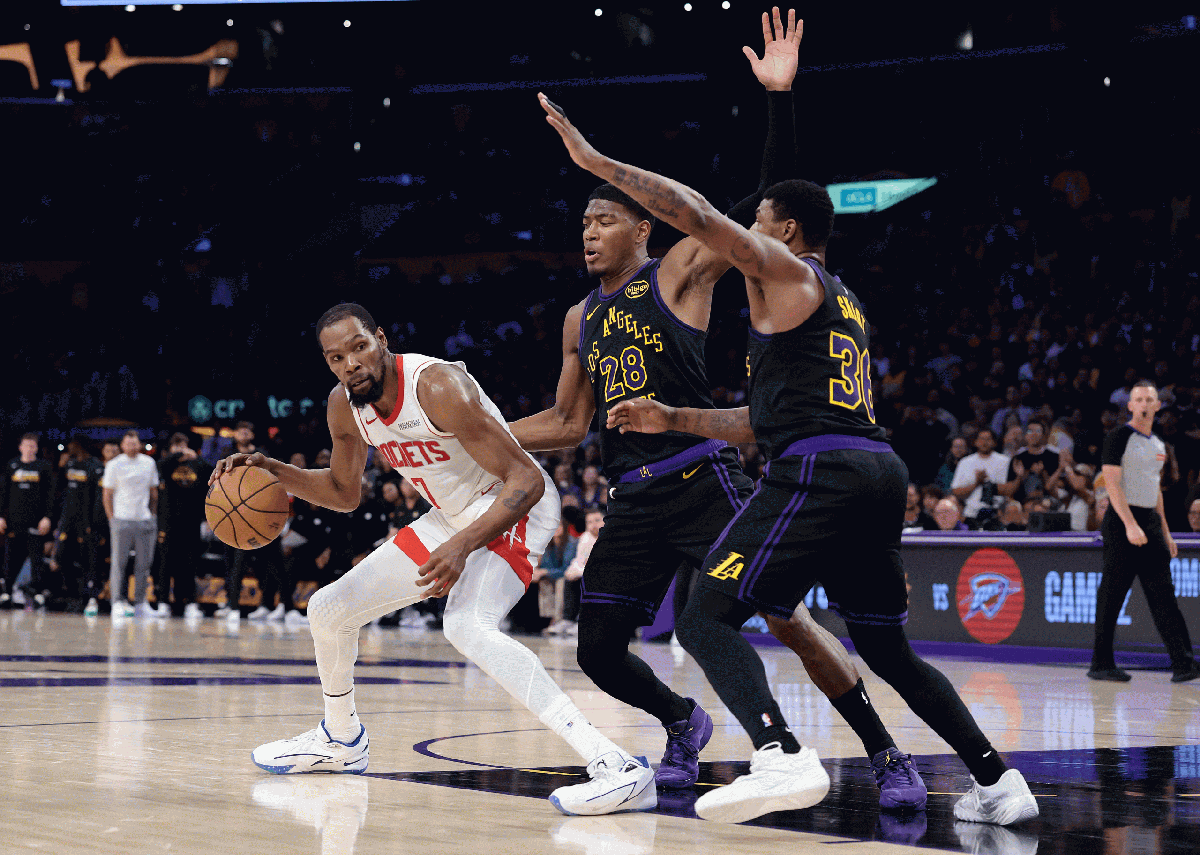
LOS ANGELES — Kevin Durant hates double teams.
That might sound like an obvious statement — and in some ways, it is — but this goes much deeper than that for the 37-year-old living legend. As the undermanned Los Angeles Lakers were well aware heading into Game 2 of their first-round matchup against the Houston Rockets, when Durant joined the playoff festivities after missing the opener with a right knee bruise, he sees the double-teaming as a defensive cheat code of sorts that shouldn’t be used by self-respecting basketball people. Or something like that.
This is something widely known around the NBA — how the quickest way to draw Durant’s ire is to double, and even triple, as a means to stopping his incredible scoring ability while daring his teammates to beat you. But this is the burden that comes with being the fifth-leading bucket-getter of all time, the guy who passed Michael Jordan on that hallowed list this season and who, 18 years in, is somehow still doing it at the kind of elite level that demands desperate defensive measures be taken.
So as the Lakers readied for Durant’s return, knowing that the continued absences of Luka Dončić (hamstring) and Austin Reaves (oblique) meant that their defense would need to rule the day, the word was sent from coach JJ Redick and his staff that it was time to make Durant miserable. And no matter how much it might have pained him to admit it after the Lakers’ 101-94 win at Crypto.com Arena to take a 2-0 series lead, this much was clear: it worked to perfection.
Durant tied his career playoff high with nine turnovers. Just three of his 23 points came in a second half in which the Rockets were outscored by four. And Houston — which had the league’s 14th-best offensive rating during the regular season — shot just 40.1 percent from the field while missing 22 of 29 3s and failed to reach triple digits for the second time in this series.
“Yeah, they’re switching our pick-and-rolls, and then once they switch they’re just doubling off of me,” said Durant, who also had six rebounds, four assists and a minus-2 mark. “So it’s hard to get into our actions. We’re used to teams playing pick-and-roll, or maybe trapping me or playing in the drop. But they’re switching, and then just running a guy at me at the half (court line) or at the 3-point (line), or wherever I’m at, to double.
“We’ve played this team before, and they know this is the way for them to stay in the game, is to play this type of defense. We’ve got to make them pay.”
By Tuesday night’s end, with the Rockets’ offense floundering even worse than it had without Durant in Game 1, the effectiveness of the strategy served as a brutal reminder that Houston’s title-contending plan might have fallen apart seven months ago.
In late September — less than three months after the Rockets traded for Durant from the Phoenix Suns — veteran point guard Fred VanVleet tore his ACL, and questions were immediately raised about how the offensive duties would be doled out. The 32-year-old VanVleet had signed a two-year, $50 million deal just one week after the Durant deal was done. VanVleet and Durant, along with big man Steven Adams before his season-ending ankle surgery in late January, were supposed to be the veteran leaders on a top-tier team.
None of the proposed solutions to VanVleet’s absence has actually panned out. Amen Thompson, the third-year talent who was forced into a playmaking position, has not shown he can consistently pick up that slack. Reed Sheppard, the sharpshooting second-year guard who had seemed to earn some level of trust from coach Ime Udoka, played just 11 minutes (while missing all four of his shots) in the Rockets’ most important game of the season. Alperen Şengün, the fifth-year big man who is a willing and talented passer, has struggled mightily to mesh with Durant and be at his best within this new Rockets construct.
“I definitely need to be aggressive when I get the ball in the middle,” said Şengün, the All-Star center who had 20 points (nine of 20 shooting), 11 rebounds, five assists and just one of the Rockets’ 15 turnovers. “Missing so many shots, so I need to get back to who I am and dominate the paint when I get the ball and help KD a little bit and make my teammates better for sure.”
In hindsight, perhaps too much was made of the late-season stretch in which the Rockets won nine of their last 10 games. It was seen by some as a strong sign that they’d finally found their way, with Houston registering the league’s second-best offensive rating during that span and Durant (6.9 assists per) leading the way on the facilitating front. But six of those wins came against teams that didn’t make the playoffs, including games against known tankers in the Memphis Grizzlies (twice), Utah Jazz and New Orleans Pelicans.
LeBron James and the Lakers, meanwhile, are officially flirting with the notion of doing something truly special. The loss of Dončić and Reaves was supposed to decimate their hopes of advancing, but their backup backcourt of Marcus Smart and Luke Kennard was spectacular in Game 2.
Smart had 25 points, including five 3s, with seven assists. Kennard had 23 points, following his 27-point outing in Game 1. Lakers president of basketball operations Rob Pelinka deserves a hat tip for landing them in the last year. (Smart was signed in free agency last summer, while Kennard came via trade from the Atlanta Hawks in February.) If the Lakers can survive until the second round, then the chance remains that Reaves and Dončić (in that order) could eventually return.
Truth be told, though, James (28 points, eight rebounds, seven assists) is reminding us all that he’s pretty good at running point too. At 41 years young, he managed to navigate his fair share of double teams en route to dominating in a way that no one his age ever has. In that sense, this was the inverse experience of when James and Durant last met on the postseason floor.
The 2018 NBA Finals featured a loaded Golden State Warriors squad that swept James’ Cleveland Cavaliers, back when the idea of doubling Durant regularly was foolish because of all the firepower and facilitating that surrounded him. Times have changed for Durant, though, and not for the better.
“No matter what play is called, no matter what action is called, or what side of the floor, they’re gonna double-team, you know what I’m saying?” Durant said. “No matter if I catch it at the elbow or the block. So if a team doesn’t mind double-teaming at half court, you don’t think they’re not gonna double-team everywhere else on the floor too?
“So … when I see those doubles, because they’re gonna come and guard me, and be aggressive, go to try to shoot over some of them, make the correct pass. But, yeah, I’m not expecting them to not double me in certain areas of the floor. Regardless of where I get it at, I feel like it’s going to be two to three people on me. I’ve just got to be smarter and make the correct play. And then we got to make shots out of it.”
If it only it were that easy. As these first two games have revealed, it most certainly is not.