
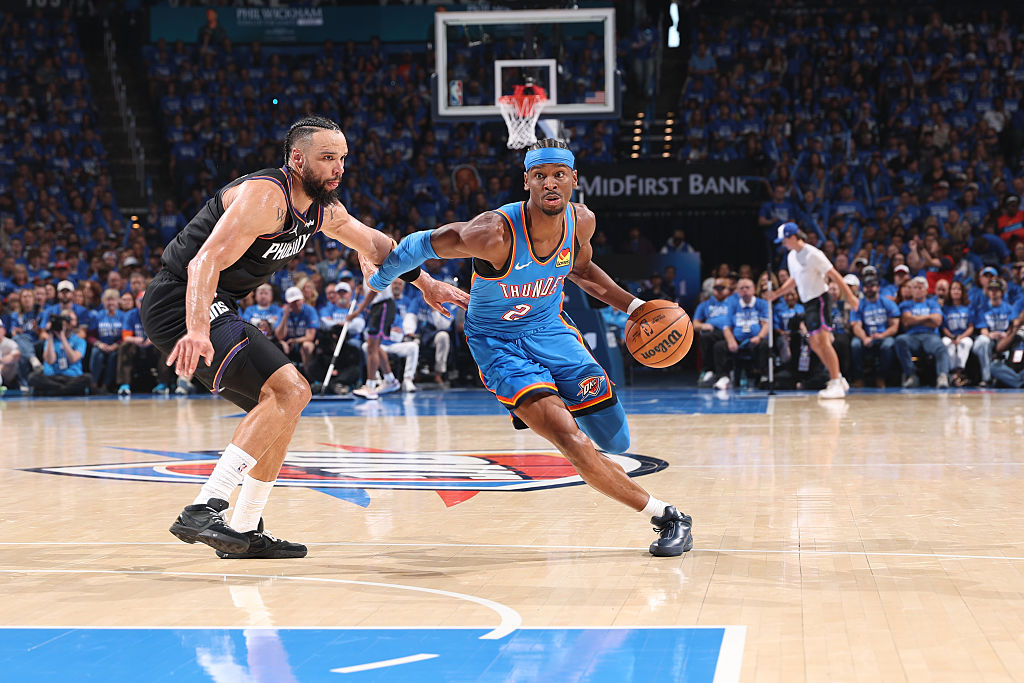
Griffin Wong breaks down his analysis, prediction, and pick for Game 2 of the Phoenix Suns-Oklahoma City Thunder series.
The Phoenix Suns battled for an automatic playoff spot all season as one of the league’s most over-performing teams. In the end, though, they fell short, lost the 7-8 Play-In Tournament game, and now have to deal with playing the defending champion Oklahoma City Thunder.
If it wasn’t already aware, Phoenix was reminded why Oklahoma City won a title last season and romped its way to 64 wins in 2025-26. The Thunder throttled the Suns in Game 1, winning 119-84, despite likely MVP Shai Gilgeous-Alexander’s 27.8% effective field goal percentage being his worst of the season.
To make matters worse for Phoenix, Grayson Allen (hamstring), Jordan Goodwin (calf), and Mark Williams (foot) are all questionable for tonight’s 9:40 p.m. ET Game 2. Oklahoma City will have a completely healthy rotation.
The Thunder are 17.5-point favorites at DraftKings Sportsbook (-2100 on the Moneyline), and the point total is set to 215.5. The Suns are is +1100 on the Moneyline. Below, I’ll break down this pivotal contest and offer a prediction.
Phoenix Suns at Oklahoma City Thunder preview, prediction
Phoenix had an admirable regular season, but it managed to do very little right in Game 1. Devin Booker had a solid game, finishing with an efficient 23 points and adding six rebounds, but the Suns’ other primary scorers, Dillon Brooks and Jalen Green, both struggled. Brooks and Green combined for just 35 points on 12-for-38 (31.6%) shooting. Without Allen’s shooting and Williams’ rebounding, Phoenix struggled to get much going offensively, and youngsters Ryan Dunn and Khaman Maluach looked overmatched. The Suns made just 16 two-point baskets.
Meanwhile, with the exception of Gilgeous-Alexander’s inefficient shooting, Game 1 was Oklahoma City at its finest. Gilgeous-Alexander got to the line 17 times, making 15, and Jalen Williams — who struggled through most of the regular season with wrist and hamstring injuries — contributed 22 points, seven rebounds, and six assists on nine-for-15 shooting. Every player who played at least nine minutes except for Alex Caruso recorded either a steal or a block, a testament to the synergy of the Thunder’s swarming defense. With some better three-point shooting, especially from Gilgeous-Alexander, this game could’ve been even more lopsided.
Suns at Thunder pick, best bet
Oklahoma City’s Plan A defensively is always to wall off the interior, making it an extremely difficult matchup against a Phoenix team that attempted the second-fewest shots within five feet during the regular season. The Suns did a terrible job getting downhill in Game 1, attempting only 15 shots within five feet, and they made just six shots in that range and two from within five and nine feet. Meanwhile, though the Thunder have a well-balanced shot diet overall, they finish well, going 19-for-26 (73.1%) in Game 1 after posting the 11th-best percentage in the regular season. Oklahoma City’s advantage inside should be sustainable; it limited opponents to the lowest percentage on layups during the regular season, while Phoenix allowed the eighth-highest percentage. Both Chet Holmgren and Isaiah Hartenstein rank in the top quintile in rim points saved per 100 possessions, while Williams ranks in the bottom quintile and Oso Ighodaro in the 46th.
The Thunder also won the rebounding battle by nine despite the fact that they finished six ranks lower than the Suns in total rebounding percentage during the regular season. If they can maintain their competitiveness on the glass, they should be in line to continue stacking wins; during the regular season, they went 16-3 when they snagged at least 50 boards and 2-3 when they grabbed 35 or fewer. Expectedly, Oklahoma City also throttled the Suns in transition, recording 32 points off of turnovers and giving up just two, and Phoenix was a relatively turnover-prone team during the regular season. The Suns did draw more fouls, but the Thunder were the more disciplined team during the regular season, so that factor could flip in the defending champions’ favor.
Neither team shot the ball particularly well, but after doing an excellent job closing out on opposing shooters during the regular season, the Suns couldn’t even do that in Game 1. They allowed Oklahoma City to attempt 27 wide-open threes and got fairly fortunate that the Thunder only made nine. Phoenix was also just five-for-16 on wide-open looks itself. Goodwin’s and Allen’s potential returns could help offensively, but both of them rank below the median in points saved per 100 possessions, while every member of Oklahoma City’s rotation ranks above the median. The Thunder also led the league in both the regular season and the playoffs (so far) in contested three-point shots. Even if the Suns are more due to benefit from shooting luck normalization, that difference alone doesn’t remotely account for the 35-point margin of victory.
It’s likely that Phoenix will lose by fewer than 35 points, since Williams’ potential return should help on the glass, but unless it’s able to find some way to penetrate inside, the Thunder’s game plan is simple. The Suns already have a fairly one-dimensional offense as is, so they always should’ve been expected to struggle against a dominant interior defense. An upset scenario is possible if Phoenix gets hot from beyond the arc, but Oklahoma City makes that as difficult a task as any team.
Best bet: Oklahoma City Thunder Race to 50 Points – Both Halves (-140)