
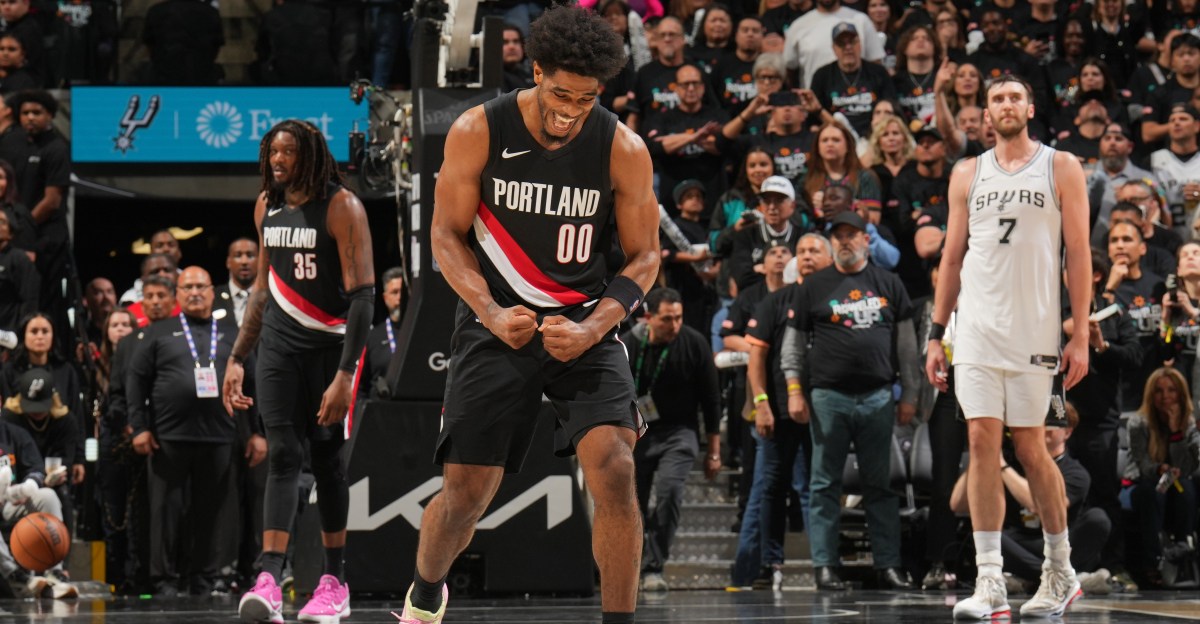
The Portland Trail Blazers accomplished the first part of their mission in the opening round of the 2026 NBA Playoffs last night. They defeated the San Antonio Spurs 106-103, evening the series at 1-1 on San Antonio’s home floor. This not only extends the series, it shows that the Blazers have a chance at winning no matter where they play, bringing hope for a true contest even if they can’t take two straight at Portland’s Moda Center this weekend.
The biggest difference between Game 1, a 111-98 loss, and the victorious Game 2 was obvious. Spurs center Victor Wembanyama—their best player and one of the league’s brightest young stars—left the game in the second quarter of Game 2 with a concussion. Absent their best defender and one of their game-changing scorers, San Antonio left the door open. Portland stepped through for a narrow victory.
But Wembanyama’s absence wasn’t the only factor that changed between the two games. His departure opened up the court for the Blazers to play to their strengths. They took that opportunity. It showed in several ways.
If you want to know how Portland won the second game, consider these stats.
Accuracy and volume beyond the three-point arc have been determining factors for the Blazers all season long. They’ve been long on volume, short on accuracy, but as long as the two balanced out somewhere in the middle, they’ve done ok.
In Game 1 Portland shot 10-38, a paltry 26.3%, from distance. That’s not enough attempts, far too many misses. They weren’t great in Game 2—13-38, 34.2%—but that’s at least passable. It gave them an opportunity to win.
The real change came in three-point shooting defense, an area the Blazers have been fairly strong in this season. In Game 1 the Spurs shot 15-33, 45.5%. Portland took only five more threes than San Antonio that night and they hit five fewer. There was no chance. In Game 2 the Spurs shot 7-24, 29.2%, mirroring Portland’s futility from the first game. Going +18 over the opponent beyond the arc was a huge stroke for the Blazers.
The Blazers attempted only 12 free throws in Game 1 of the series. That’s a good night for Deni Avdija alone, a terrible number for the team. They hit 10 of those foul shots, but San Antonio went 16-19, leaving Portland -6 in the category.
In Game 2 the Blazers drew 23 foul shots, hitting 17. You can quibble with the percentage, but at least the attempts were there. They’re critical to the team’s scoring, also indicative of aggression on offense.
The Spurs went 20-28 that night. Portland still lost the category, but only by three.
The Blazers have been one of the best offensive rebounding teams in the league this year. In Game 1 they managed only 8 offensive boards, losing the category 8-11 to the Spurs. In Game 2 they won the battle 15-12. The marginal victory is less significant than the huge difference between 8 offensive rebounds and 15.
The Spurs tend to be a polished, efficient team. They’re also more talented than Portland and the heavy series favorites. For all these reasons, it behooves the Blazers to “ugly up” games, making them chaotic, messy scrums where anybody can end up ahead.
Two categories showed Portland doing that far better in Game 2 than Game 1.
The first was blocked shots. Portland generated only 2 blocks in the first contest, a massive 11 in the second. Every Portland starter had at least one block in Game 2. Robert Williams III added two more off the bench with a little help from Shaedon Sharpe and Matisse Thybulle. The Blazers didn’t have to channel players into Donovan Clingan to disrupt shots. Everybody was doing it. They got into the shot attempts, and heads, of San Antonio’s scorers.
Overall, the Spurs shot 47.6% in Game 1, 44.2% in Game 2. That wasn’t an accident. That was more active defense on Portland’s part.
The second “messy” indicator was turnovers. In Game 1 the Blazers committed only 11, San Antonio 14. At first that looks good for Portland, but that’s also a clean, measured performance. They’re not going to win that way. Chess matches belong to the Spurs.
In Game 2 the Blazers committed 15 turnovers and San Antonio committed 17. The difference doesn’t seem huge, but the Spurs average 13.5 turnovers per game, 4th in the NBA. 17 is Portland’s average. The Blazers are the worst in the league. Making San Antonio play sloppy like a low-end team instead of one of the best evens out this matchup considerably. If this is chess, we’re tipping over the table and then we’re going to scramble to see who can pick up the most pieces off of the floor.
High turnovers for the Spurs are a good sign for Portland even if the Blazers, themselves, commit more in response.
Obviously Wembanyama’s injury contributed to these factors. Some of them wouldn’t exist if he played. Others wouldn’t matter as much. It’s worth noting that even though Wemby played less than half a game, the Blazers still only won that second game by three.
Still, Portland played much more like Portland in Game 2 than they did in Game 1. If they have any chance of winning the series—give or take a hot streak or two from the arc—that trend is going to have to continue. If the Blazers can generate free throws, force turnovers, play tight and disruptive defense, and grab offensive rebounds, those are good signs for games to come.