
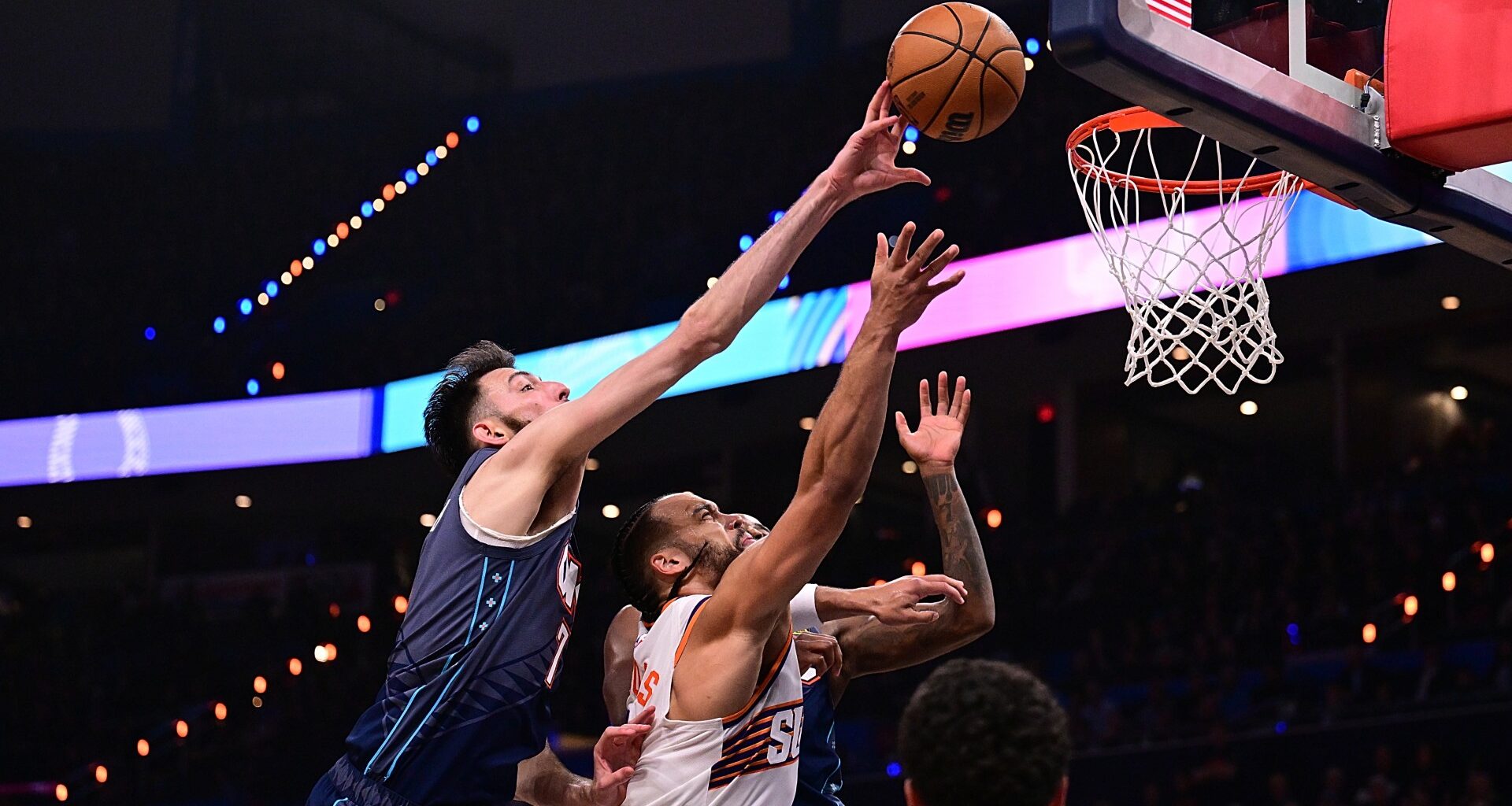
The Oklahoma City Thunder defeat the Phoenix Suns 120-107 to take a 2-0 series lead
Everybody loves close games, but the best teams take care of business when they’re facing overmatched opponents. And the young core of the Oklahoma City Thunder is now 10-0 in first round playoff games, having secured a 120-107 victory in Game 2 of their first-round series with the Phoenix Suns on Wednesday.
Those 10 wins have come by an average of 18.9 points and, unsurprisingly, the Thunder have been the most dominant team in the first five days of playoffs.
Shai Gilgeous-Alexander scored at least 30 points in a playoff game for the 23rd time in his career, finishing with 37 and nine assists. Chet Holmgren added 19 points, eight rebounds and four blocks, and Jalen Williams (19 points on 7-for-11 shooting) looked sharp again … but exited the game early with an apparent left hamstring injury.
Here are some notes, numbers and film as the champs became the third team to take a 2-0 lead in this first round …
1. Thunder lose Williams again
The Thunder are almost certainly going to win this series, so, with apologies to Phoenix, the most important developments are those that affect their ability to repeat. And in that regard, there was a major development in the third quarter of Game 2.
With the Thunder up 15 midway through the third, Gilgeous-Alexander skipped a pass ahead to Williams, who was racing down the floor in transition. Devin Booker was able to contest Williams’ left-handed layup, and as the Suns chased down the rebound, Williams grabbed his left hamstring under the basket.
Williams stayed on the floor for another two possessions, but he checked out after committing a foul with 5:53 left in the third.
Thunder coach Mark Daigneault gave no prognosis on Williams’ hamstring after the game, only saying that the team would “take a look at it over the next couple of days.”
Williams missed 49 games this season, first recovering from offseason wrist surgery and then dealing with a right hamstring injury. Counting the two in this series, he has played in just nine games since returning from a six-week absence. He was off to a great start in the postseason, totaling 41 points on 16-for-26 shooting over the two games.
Now he could be on the shelf again, and at the most important time of the year. The Thunder can obviously win without him (they went 39-10 in those 49 games he missed), but they’re just not as potent if he isn’t their second option and/or there to keep the offense afloat when Gilgeous-Alexander isn’t on the floor.
Gilgeous-Alexander also appeared to injure his left hand early in the first quarter on Wednesday but played through it.
2. Thunder bring the offense, too
The No. 1 strength of the Thunder is a defense that allows 8.3 fewer points per 100 possessions than the league average, the second best differential in the 30 seasons for which we have play-by-play data. Their offense ranked seventh, but it wasn’t nearly as good as it was last season, in part because Williams missed those 49 games and (for the most part) wasn’t quite himself when he was in uniform.
With the Suns having a top 10 defense, maybe this would be an ugly series.
Nope. Through the two games, the Thunder have scored 124.5 points per 100 possessions, 11.6 more than the Suns allowed in the regular season. That’s the biggest such differential for any of the 16 teams, so the Thunder have the No. 1 offense in the playoffs, both in regard to standard efficiency and relative to their opponents’ regular-season numbers.
The offense starts with the defense, and the Thunder forced 14 live-ball turnovers out of the Suns on Wednesday. But Oklahoma City scored just 13 points in transition, according to Synergy tracking, 16 fewer than they had in Game 1 and nine fewer than they averaged in the regular season.
Shai Gilgeous-Alexander records his 29th career postseason game with 25+ points for the Oklahoma City Thunder with 37 in Game 2.
So much of that efficiency was half-court execution, led by Gilgeous-Alexander. After shooting 0-for-8 from outside the paint in Game 1, the reigning MVP was 4-for-9 from mid-range and 2-for-5 from 3-point range in Game 2. It wasn’t his best game, but he was still the best player on the floor.
He worked in isolation. He worked out of the post. He attacked the Phoenix bigs in the pick-and-roll.
When the Suns tried to build a wall, Gilgeous-Alexander busted through it …

The Thunder defense is the best in the league by a wide margin. And if the offense is also the best in the league? Uh oh.
3. Green and Brooks keep the Suns in it
Though they lost by double-digits, this was a much better showing for the Suns than Game 1. And the much bigger difference between the two games was on Phoenix’s end of the floor.
Big picture, 107 points on 99 possessions isn’t great. But it’s much better than the 84 on 93 that the Suns scored three days earlier, and it could have been even better if they didn’t turn the ball over 22 times.
As great as the Thunder defense is, it can still be beat on occasion by great talent. Jalen Green kept the Suns close by scoring 14 of his 21 points in the first half, with the kind of quickness and explosion that any defender would struggle to keep up with.
Isaiah Hartenstein couldn’t contain him on a pick-and-roll …

And he attacked Chet Holmgren, finishing around one of the league’s best rim protectors …

Green cooled off in the second half, and the Thunder went up 26 early in the fourth quarter. But Dillon Brooks kept the OKC starters on the floor by fueling a 20-4 Phoenix run that made things just a tad interesting.
The Thunder have kept Booker (45 total points over the two games) somewhat in check, putting multiple stout defenders on him and making him play in a crowd. But Phoenix’s other two scorers had their moments on Wednesday, keeping this game from getting out of hand.
4. Rim protection first
The tenacious and handsy guards are usually top of mind, but the most important aspect of the Thunder’s historically good defense is the rim protection.
When it comes to defending and preventing shots at the rim, Oklahoma City is in a class by itself. The Thunder led the league (by a wide margin) in opponent field goal percentage in the restricted area (60.7%) while also ranking second in the (lowest) percentage of opponent shots (24%) that have come there.
On Wednesday, Holmgren showed why he was the runner-up for Kia NBA Defensive Player of the Year, blocking four shots and altering others. The highlight was a sequence midway through the third quarter where he prevented Brooks from getting a clean layup on a fast break, and then blocked Booker’s put-back attempt …

He also smothered Brooks’ attempt to take him one-on-one early in the fourth quarter.
Hartenstein had one block but also had a couple of key contests at the rim. And over the two games, the score in the restricted area is Thunder 70, Suns 38, with Phoenix shooting just 19-for-39 (49%) at the basket.
The offense was better on Wednesday than it was in Game 1, but still not good enough to beat the champs. The Suns will need to take another step forward in Game 3 on Saturday (3:30 p.m. ET, NBC/Peacock).
* * *
John Schuhmann has covered the NBA for more than 20 years. You can e-mail him here, find his archive here and follow him on Bluesky.