
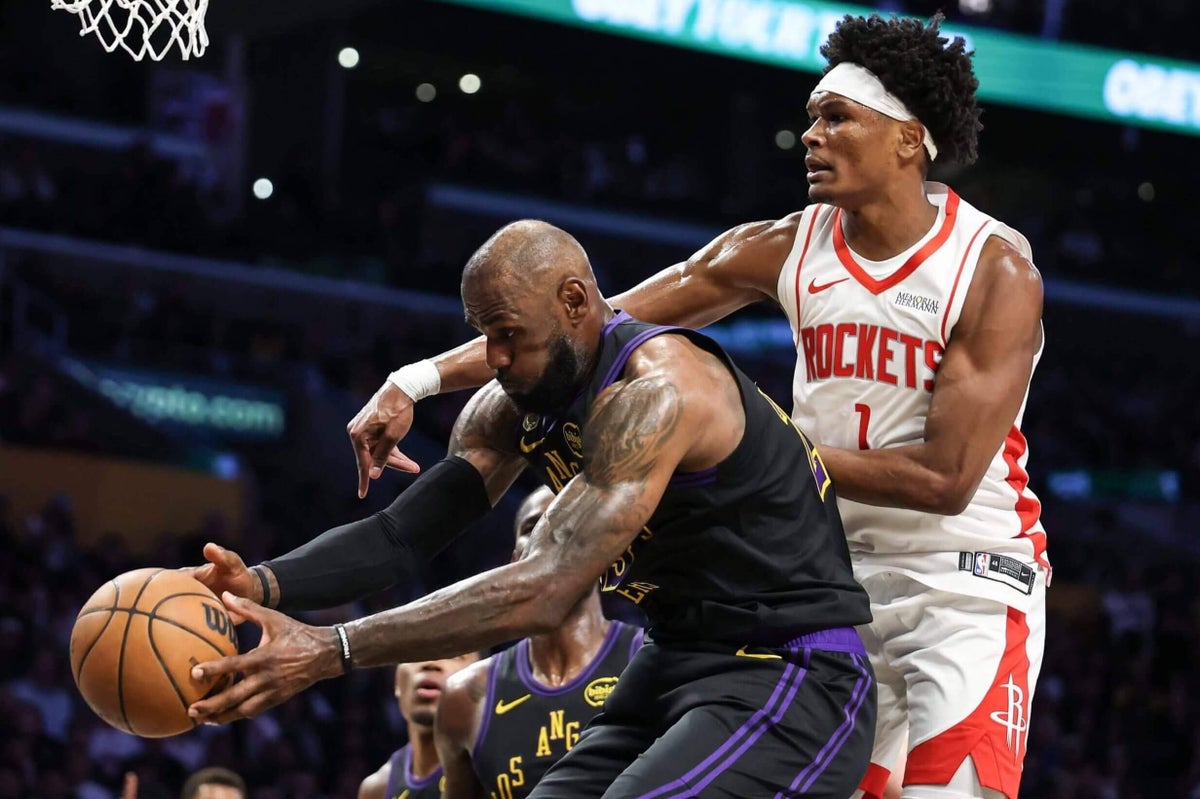
Welcome to the mud.
The old saw is that the game slows down and offense becomes less efficient in the postseason. While that’s generally true historically, the trend has been more emphatic in some years than others. This year it’s been quite emphatic, indeed.
With 14 playoff games in the books through Tuesday, the NBA is experiencing a double whammy — both pace and points per possession are down sharply from the regular season. As a result, scoring is down. Way down.
A regular-season NBA contest averaged 231.2 points per game. In the playoffs thus far, that figure is 214, as 17 points a night have vanished into the ether. (Note: All stats via basketball-reference.com through Tuesday’s games.)
The two hideous games between the Lakers and Rockets will likely come to mind relatively quickly, but the trend has been greater than just one series. Only two of the 14 games played through Tuesday have even landed within 10 points of the regular-season average: Cavs-Raptors Game 1 and Nuggets-Wolves Game 2.
While it’s easy to say it’s still early in the postseason and that this could change, it’s no longer that early. Remember, more than half of all playoff series are first-rounders (eight of 15). The 2025 postseason contained 86 playoff games; we’ll be nearly 20 percent of the way there by Thursday morning.
In case you’re wondering if all this is normal … no, not exactly. For comparison’s sake, the last four postseasons didn’t see nearly as great an offensive drop. In the 2025 playoffs, the league scoring rate dropped 10 points a night, not 17, and that was with the Thunder, an all-time great defense, playing in 23 of the 86 games.
The 2023 postseason also lost 10 points, while the drop-off in 2022 was just eight points. And in 2024, we did lose 17 points a game from the regular season, but that disparity was driven heavily by a single factor: a dramatic slowdown in pace. This time, it’s more broad-based.
In some ways, it’s a bit surprising that this spring’s scoring meltdown hasn’t been worse. If you look at the 16 teams that qualified for the postseason, they were all slowpokes. Among the league’s top eight teams in pace, Atlanta was the only one to make the playoffs, whereas three of the league’s four slowest teams (Boston, Houston and New York) qualified, as well as seven of the bottom 11.
The playoff pace is indeed slower, by seven total possessions per game (3.5 per side). But that difference tracks with most recent postseasons aside from the great slowdown of 2024. Last season, pace decreased by 6.2 possessions in the postseason, even with six of the 10 fastest teams making the playoffs and the fifth and seventh-fastest (Oklahoma City and Indiana) meeting in the Finals (and thus having the most playoff games).
In other words, the pace hasn’t slowed unusually, even though the field is made up of unusually slow teams. If anything, it’s surprising that pace hasn’t slowed by more.
Instead, the problem is that these slowpokes haven’t been nearly as efficient. It’s a jarring decline. Offensive efficiency is down by 4.4 points per 100 possessions, which is massive compared to recent history. The drops in the last four postseasons were 1.4, 1.7, 1.3 and 0.8.
Everyone’s first instinct, of course, is to blame the refs. I think they’ll beat the rap pretty easily this time. What strikes me as so odd about this postseason’s numbers is that they lack a neat officiating explanation. If anything, it might be worse if the zebras hadn’t been so active.
Unlike the 2022, 2023 and 2024 postseasons, in which free-throw rates hardly budged from the regular season, the whistles have blown freely this spring. The league free-throw rate in the 2026 postseason is .280 (i.e., .28 free throw attempts for every field-goal attempt), an increase from the regular-season mark of .260. Overall, there has also been a marked increase in fouls, from 39.8 in the regular season to 43.4 in the playoffs.
If we can’t blame the refs, what’s to blame? Digging deeper, I’m wondering if an unusual development is at work: Have teams turned away from the offensive glass? And if so, is this the start of a tactical turnaround?
The offensive rebound rate in the postseason is only 24.4 percent, compared to 26.0 percent in the regular season, despite three of the four teams that posted monstrous, outlier offensive rates this year also making the playoffs (Houston, Portland and Detroit), and nine of the top 12 teams in this category qualifying.
Offensive rebound rates also went down in the 2025 playoffs, but not this dramatically — and they actually increased in 2023 and 2024.
Moreover, it’s an odd moment in time to pivot away from crashing. The league leaned into offensive rebounding like never before this year, with more teams realizing they could safely defend in transition and still attack the glass with multiple players.
Are we … not doing that anymore? Does it just not work as well in the playoffs?
Of those top rebounding teams above, only the Rockets have been able to maintain their monster offensive rebound rate from the regular season (and man, have they had a lot of opportunities to collect misses). Several other glass-fiend teams have fallen well short of their norms; notably, the Pistons’ 15.0 percent mark in Game 1 against Orlando was less than half their regular-season rate.
Additionally, the dip in offensive rebounding also explains two other factors: why points per possession are down so much, and why pace hasn’t declined as much as we might have expected.
Offensive boards generally push up league-wide offensive efficiency in two ways: first, because second shots are often highly efficient possessions, and second, because teams that enthusiastically offensive rebound do tend to be a bit more vulnerable to quick transitions. The dip in offensive rebound rate doesn’t explain the entire efficiency difference between the 2026 playoffs and the last three, but it soaks up the lion’s share of the gap.
The other factor here is that, statistically, offensive rebounds also make the game look slower than it really is. Offensive boards extend possessions, after all, so the possession total in a team’s pace factor will be much lower in a game with a lot of offensive rebounds. The opposite is also true; fewer offensive boards make a game look faster.
Where I’m going here: I think the pace has actually slowed more than the pace factor stat would tell you.
If that’s true, the conundrum I mentioned up top — that the playoffs, with all slow-paced teams, haven’t slowed down as much as we’d expect — suddenly has a convenient answer. It is actually slower; it’s just been masked a bit by the lack of offensive boards.
Regardless, I do think we’ll see a bit more scoring during the rest of the postseason. A league-wide case of the yips from the line (74.8 percent compared to 77.9 percent last postseason) strikes me more as a fluke than a trend, and even a slight reversion in offensive rebound rates would push the efficiency stats toward something a bit respectable.
Nonetheless, the overarching conclusion is inescapable: Between a slower pace, fewer offensive rebounds and the usual decline in shooting efficiency from the regular season to the postseason, points have been a lot harder to come by in the 2026 playoffs. Underscoring this, we may be witnessing a turning point in the emphasis teams put on offensive rebounding in particular.
We’ll see if those trends hold over roughly 65 playoff games to come, but the reality check is that they’ve been apparent in all eight series thus far. Compared to the regular season, seven of the eight series have a slower-than-league-average pace, seven of eight have less-than-league-average offensive efficiency and all eight have less-than-league-average scoring.
Thus, until we see differently, the forecast calls for mud. Enjoy the slog, everyone.