
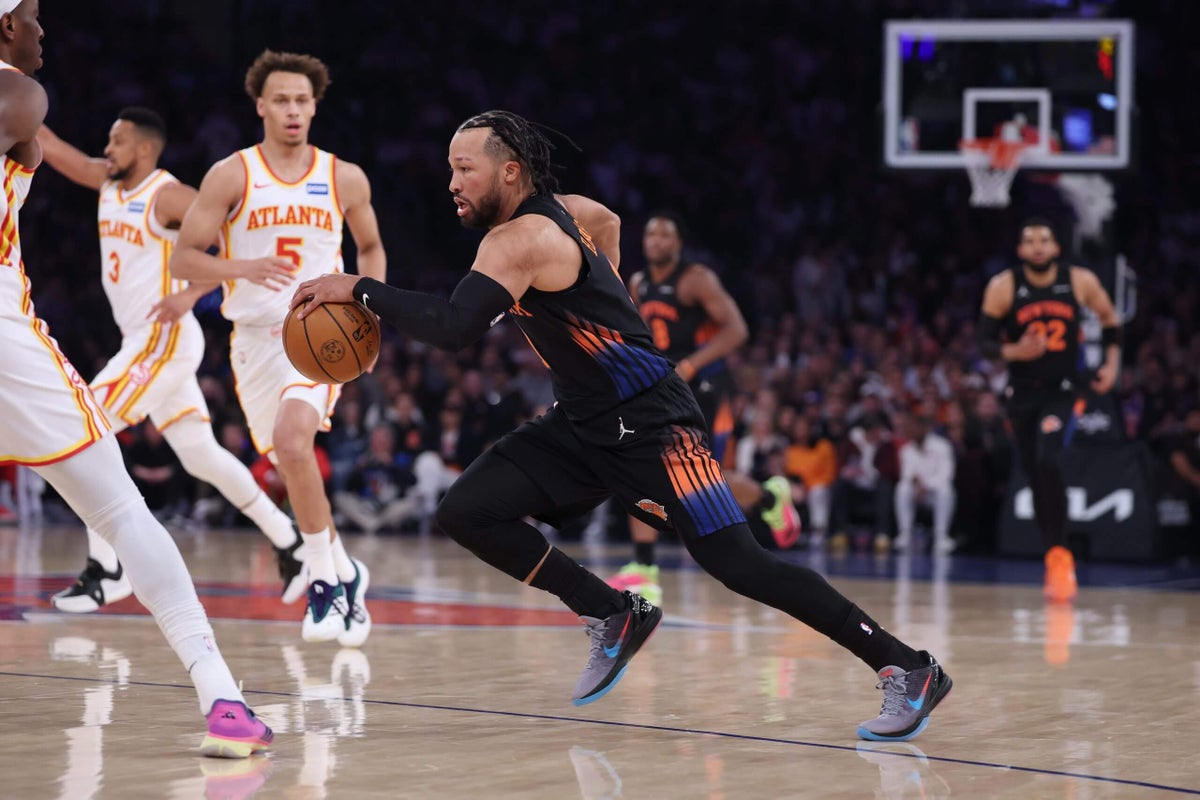
NEW YORK — CJ McCollum answered a question with a question.
The Atlanta Hawks guard had just led a miraculous comeback in Game 2 of a first-round playoff series against the New York Knicks. With two minutes remaining, he lofted in a floater to give the Hawks, who trailed by double digits earlier in the fourth quarter, an improbable lead. He banged in a jumper a minute later. Another bucket followed.
A theme built. McCollum was targeting the Knicks’ best player, Jalen Brunson, an offensive wizard who is clever on the other end but doesn’t possess the size or tools to disrupt defensively. The Hawks pulled within three points with four minutes to go because McCollum rushed down the court, forced Brunson to pick him up, sped into him on the way to the hoop, attracted a help defender from the corner and then whipped a pass for an open 3-pointer.
When the Knicks changed the matchups, throwing the rangier Mikal Bridges on McCollum late, the veteran scorer sought out New York’s All-Star point guard. McCollum’s go-ahead floater came only because Brunson’s primary assignment, Nickeil Alexander-Walker, flashed to the top of the key to set a screen for McCollum. The Knicks switched the action — Bridges taking Alexander-Walker and Brunson returning to McCollum, who attacked the basket to toss a teardrop off the glass and in.
He finished with an impressive 32 points, seeking out Brunson in such apparent ways that, after polishing off the 107-106 victory, he had no choice but to answer a reporter rhetorically.
“It seemed like you were maybe intentionally, maybe not trying to get that matchup against Jalen (Brunson) … Did you like what you had in those pick-and-rolls?” the reporter asked.
“What do you think?” McCollum responded.
The reporter offered one word of analysis.
“Yeah,” he said.
McCollum agreed, repeated “Yeah,” and nodded approvingly.
Two games into this series, which is tied at one win apiece, the Hawks have made a point to claw at the Knicks’ vulnerabilities. They have put Brunson and Karl-Anthony Towns, a fabulous scorer with defensive limitations, into loads of pick-and-rolls. But the Knicks haven’t returned the favor.
It’s one of the various ways that their process needs to change come Game 3.
There are obvious tweaks to make when the Knicks play Thursday in Atlanta, many of which The Athletic’s James L. Edwards III touched on earlier this week. A notable one is the prominent non-Towns, non-Brunson lineups, which got outscored by seven points in 11 minutes during Game 2. That may not sound like much, but extrapolate it over a full game, and it’s the equivalent of losing by 30. And it occurred on a night that the Knicks fell by one.
During the regular season, the Knicks played 610 non-garbage-time possessions with Towns and Brunson both on the bench and got outscored by a whopping 76 points in those minutes, according to Cleaning the Glass. Now, against an Atlanta team that lives to jump passing lanes, they are sitting their two offensive engines simultaneously — and in the second quarter of Game 2, they did so without any natural creators on the court, which glared when the Hawks forced turnover after turnover, eliminating a nine-point deficit in a few minutes.
In turn, the Knicks have leaned into their starting lineup, the one that has had problems for a year and a half. The first unit ran together for 24 minutes in Game 2, which is even more than it averaged under former head coach Tom Thibodeau, who faced criticism for sticking with the fivesome for too long. The starters (Brunson, Towns, Bridges, OG Anunoby and Josh Hart) may be filled with big names and expensive salaries, but there is ample evidence to show that they, for whatever reason, haven’t meshed. That quintet has played 1,301 minutes, the most of any lineup in the NBA, since Jan. 1, 2025. During that time, it has gotten outscored by 14 points.
But the Knicks continue to roll with those five, as if they’re road tripping on a donut tire. On Monday, the starters coughed up an eight-point advantage with less than five minutes to go.
There are also the mishandled timeouts or the fact that the Knicks left Game 2 with a challenge still in their pocket. These troubles all appear fixable, as long as the Knicks and head coach Mike Brown identify them as issues and choose to eliminate them.
But what stands out most on the court, purely from the way the Knicks and Hawks operate between the lines, is the uneven style these two squads are playing.
We often look at playoff basketball through an opposite lens than it requires. The champion of the NBA season isn’t always the most talented team. Instead, it’s the least flawed one. The postseason has a way of weeding out the groups with clear deficiencies. The longer a series goes, the more each team identifies another’s warts and then picks at them.
The Hawks have bested the Knicks in that aspect thus far. Atlanta isn’t a pick-and-roll heavy squad, but it’s leaning into those actions more because of who’s on the other side. Sixty-five percent of the pick-and-rolls it has run over the first two games of the series have brought at least one of Brunson or Towns, the two weakest defenders in New York’s starting lineup, into the action, according to Second Spectrum.
The Knicks have not done the same. Only 35 percent of their pick-and-rolls have involved at least one of the two weakest defenders in the Hawks’ starting lineup, McCollum or All-Star and soon-to-be All-NBA forward Jalen Johnson. McCollum is a superior defender to Brunson. He’s been frisky since arriving in Atlanta midseason. But there is a hierarchy inside every defense, and he is at the bottom of the Hawks’. Now, he is giving it to the Knicks, and the Knicks aren’t giving it back to him.
Brunson has had to guard 58 pick-and-rolls, either as the guy manning the ballhandler or as the one on the back side of the screen, according to Second Spectrum. McCollum has guarded 31.
Towns has defended 49 pick-and-rolls. Johnson has guarded 18.
Johnson has manned Anunoby for most of the series, but the Knicks use the All-Defensive wing as a spacer in the corner, keeping him out of most primary actions. McCollum has toggled between guarding Hart and Bridges. Bridges, especially, is not forcing his hand. He has set only four ball screens all series with McCollum guarding him.
It’s a microcosm of how much the Knicks’ offensive identity has changed since the start of the season, when they pledged to show off a more free-flowing, egalitarian system. Back then, Bridges’ improved facilitating was the talk of the town. Now, it’s two games into the playoffs, and he has run — not set screens for but been the ballhandler in — only four pick-and-rolls against the Hawks. The next pick-and-roll Anunoby runs will be his first of the series.
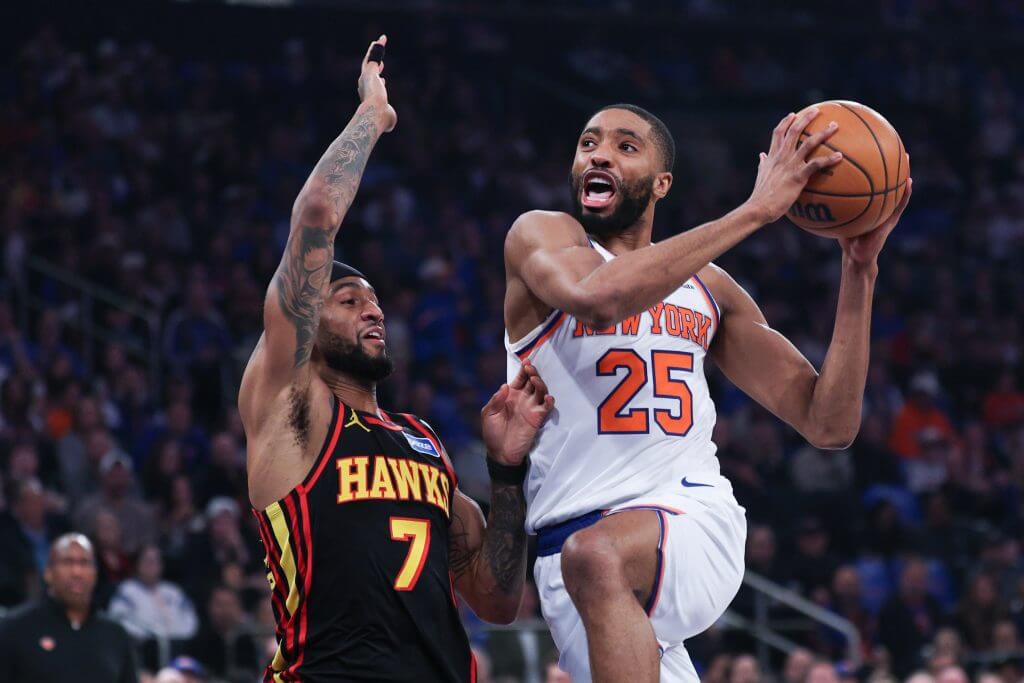
Mikal Bridges has been nearly nonexistent in the Knicks’ pick-and-roll actions. (Vincent Carchietta / Imagn Images)
Even during last season’s run to the Eastern Conference finals, when stagnant offense became a running storyline, Brunson did not carry this much weight. And today, the Hawks are doing their best to exhaust him on defense.
Now, the Hawks’ trouncing the Knicks in this category may be a tinge inflated, if only because of matchups.
If the Knicks want to put their center, Towns, on Dyson Daniels, a guard who doesn’t shoot 3s and commonly finds big men guarding him, then Anunoby has to take Atlanta’s center, Onyeka Okongwu, which forces Brunson onto one of McCollum, Alexander-Walker or Johnson. Johnson is too big, strong and talented for Brunson. Hart, who has been the Knicks’ most consistent player this series, has stuck to him like glue for two games. Bridges is an ideal Alexander-Walker defender, considering the shooter’s off-ball acumen and the defender’s intelligence, length and anticipation away from the basketball. It leaves Brunson on McCollum, which means he will naturally be in the middle of more pick-and-rolls than McCollum or Johnson would be on the other end. It leaves Towns on the back ends of more ball screens, too, because the best way for Daniels to exploit a big man roaming off a non-shooter is to set picks aplenty.
Of course, the Knicks are only exacerbating that issue by playing their starting lineup so many minutes together. If they split up Brunson and Towns, running them for the same number of individual minutes but for less time together, they wouldn’t corner themselves into such difficult matchup choices.
But even if they stick with their rotational decisions, the Knicks could benefit from changes to their process. They are avoiding the Hawks’ weak points. They are getting into their offense even slower than usual. Hart has mentioned that the pace is too slow. They have begun the first actions of their possessions a half a second later on average during these two playoff games than they did during the regular season, according to Second Spectrum, which may not sound like much but is the difference between conducting the fastest offense in the NBA and finishing in the middle of the pack.
These are solvable issues, ones that come from the inside. Brunson is an introspective playoff performer. A couple of years ago, the Philadelphia 76ers swarmed him for two games to begin a first-round series. Kelly Oubre, a long-armed wing, was the main man defending him and did so with an inventive approach, guarding him from behind once Brunson crossed inside the 3-point arc to prevent the crafty point guard’s stepback jumper. Brunson missed too many shots. The Knicks won anyway. But then came Game 3, when he went for 39 points. And then Games 4, 5 and 6, when he exploded for 40-plus each time.
Brunson tends to examine his process. If it isn’t working, he promptly rejiggers it. The Knicks, as a team, must do the same.