
Offseason Approach
Add reinforcements for a push up the standings
Actual Cap Space
-$74.8 million
Practical Cap Space
-$71.5 million
Projected Luxury Tax Space
$60.6 million
Under Contract (13)
Leaky Black (two-way)
Bub Carrington
Justin Champagnie (non-guaranteed)
Bilal Coulibaly
Anthony Davis
Kyshawn George
Jaden Hardy
Tre Johnson
Julian Reese (two-way)
Will Riley
Alex Sarr
Tristan Vukcevic
Cam Whitmore
Potential Free Agents (5)
Sharife Cooper (restricted – two-way)
Anthony Gill (unrestricted)
D’Angelo Russell (unrestricted – player option)
Jamir Watkins (restricted – team option)
Trae Young (unrestricted – player option)
Dead Cap (0)
None
Projected Signing Exceptions
Non-Taxpayer MLE ($15.0 million)
(No Bi-Annual Exception due to using it during the 2025-26 season)
Notable Trade Exceptions
Kelly Olynyk ($13.4 million)
Projected First Round Draft Pick (pre-Lottery)
#1
Notable Extension Candidates
Bilal Coulibaly (rookie scale extension)
Anthony Davis (veteran extension (as of August 6))
Jaden Hardy (veteran extension (as of October 22))
Cam Whitmore (rookie scale extension)
Trae Young (veteran extension)
Analysis
The Washington Wizards are in an absolutely fascinating spot. They enter the lottery in the top overall spot. That comes after spending the entire season tanking to make sure that they wouldn’t convey a top-eight protected first-round pick to the New York Knicks. Mission accomplished.
However, unlike most teams that find themselves in position to have a high lottery pick, the Wizards are no longer deep in the rebuilding woods. Washington is positioned to move up the standings in rapid fashion next season.
The Wizards front office has completed the tear-down phase of the roster. They’ve added considerable young talent over the last few drafts. Then, this season, Washington exercised some “pre-agency” by trading for Trae Young first, then Anthony Davis.
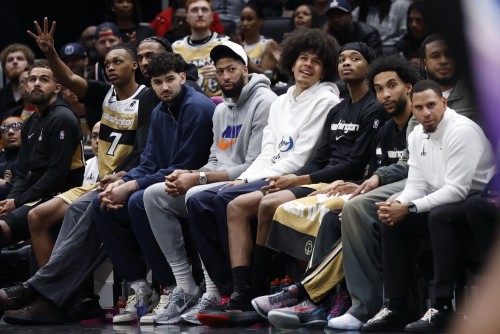
The veteran combo of Davis and Young is expected to lead a young, but improving roster into playoff contention next season. As it stands today, this roster is a little shy of the talent that will take, but they’ve got plenty to work with to build a team that can make at least the Play-In Tournament.
Let’s start on the sidelines. Brian Keefe took over midway through the 2023-24 season, and has shepherded an extremely young team through two-and-a-half seasons full of losses. In a lot of ways, we still don’t really know what Keefe’s calling card is as a coach. No one has said that these recent Wizards teams have been extremely well-prepared, play extremely hard, run great stuff on offense, have great schemes on defense, or…well…really anything positive.
That’s all somewhat of a reflection on Keefe. But it’s important to note that he followed the organization directives to develop the young players, while also staying at the bottom of the standings. Not exactly a great environment to evaluate a coach, but that’s where the Wizards are.
With Davis and Young in the fold, the Wizards are going to try to win games. Has Keefe shown enough to convince the front office, and those two veteran players, that he’s the guy to get the team into playoff contention? It’s hard to say that he has. If the Washington front office has doubts, they’re better off moving on and getting an experienced head coach to run things from the jump. It’s better than making that decision after the season starts, and the team may have lost ground in what should be a much-improved Eastern Conference. Is that rough on Keefe? Absolutely. But the situation has changed in Washington. It’s winning time, and they need a coach who the team feels can take them there.
As for the roster, the bones of a good team are here. Davis will team with Alex Sarr in a very big, athletic, versatile frontcourt. Sarr took real steps forward in his second year, as he improved in just about every phase of the game. Behind those two are unproven options like Tristan Vukcevic and Julian Reese. Both have flashed potential, but may not be ready for bigger roles just yet. After that, Washington played with a bunch of wings masquerading as bigs at times. More depth is needed here, especially given Davis’ injury history.
Speaking of those wings, this is a pretty deep group of mostly younger options. Kyshawn George looks like a long-term starter. Bilal Coulibaly is still full of mostly unrealized potential. That’s kind of scary, considering he’s extension-eligible this summer. (More on that later!) Will Riley and Jamir Watkins (who should have his team option picked up, unless the Wizards can work out a team-friendly deal), had good rookie seasons. And Justin Champagnie is helpful vet to have around the backend of the rotation.
In the backcourt, Young was acquired to lead a young, but exciting group. Tre Johnson’s rookie season went about as expected. He showed a ton of offensive potential, including being completely fearless as a shooter/scorer. Bub Carrington has played every game over his first two seasons. Year 2 for Carrington saw him take a leap as a shooter, while he continued to figure out being a lead playmaker on the fly, with everchanging personnel around him. At the very least, this is a nice backcourt trio, as Carrington can play both spots next to either Young or Johnson. Jaden Hardy gives Washington another interesting player for guard depth. In addition, most of the wings can slide down and play in the backcourt.
All of the above means Washington can focus on taking the best player available in the draft, no matter where they land. A.J. Dybantsa would give them another wing with size and skills. Darryn Peterson would be another combo guard for the backcourt. Cam Boozer would give the team a legit power forward, who can also play the three in big lineups. If the Wizards slide in the lottery, they’ll be plenty of opportunities to add to the backcourt or to pick up an additional frontcourt player.
Another option, but not a recommended one, is to trade the pick for a win-now veteran. That’s extremely risky, as we haven’t seen how the Wizards will look with Davis and Young leading the way. But Washington should expect some calls, given they are looking to win next season and this draft is deep with top-end talent.
In free agency, there are decisions to be made. Washington was once in range of having $100 million in cap space. That was vaporized when the team traded for Davis and Young. Even though the Wizards didn’t pay a massive price for either All-Star, they do need to get them locked up on long-term deals to make the trades worth it.
Young is the more pressing situation. The veteran point guard has a $48.9 million player option for next season that he’s widely expected to decline. Washington could ink Young to an extension before he even gets to free agency (if he declines the option), or they could re-sign him this offseason. It doesn’t seem overly likely that Young is going to test free agency by meeting with other teams, as the cap space teams aren’t great fits for his skillset and/or aren’t ready to spend that kind of money on a veteran.
However, and this is crucial, that doesn’t mean Washington should just hand Young a max deal and move onto the next decision. Right now, the Wizards have some cap and luxury tax flexibility, because they have players on rookie scale deals. But the clock is ticking on some of those players and they’ll be on new contracts before you know it. Giving Young a max, along with Davis (more in a moment!), makes for a very expensive team when players like Sarr, George, Carrington and Coulibaly are on new deals.
The negotiations will probably start with Young looking for a max, because he’s coming off a max deal. Washington doesn’t want to mess around too much, because they did trade for the All-Star point guard to have him long-term. A max contract isn’t the smart play, but re-signing Young to something like five years, $200 million would be a smart play. The Wizards could even frontload that deal, so it becomes less expensive as the other deals kick in. A deal starting at $47.5 million next season would finish at $32.3 million, which should be plenty large enough for Young to extend off of in the future.
As for Davis, he’s extension-eligible this summer. That deal would start with the 2027-28 season, when Davis turns 35 years old. Moreso than with Young, age and injury history are factors here. If Davis and his reps are insistent than an extension gets done, and that was the buzz around the trade deadline, Washington should look to do something similar to what we suggested with Young. Start the deal high and have it decline year-to-year. $221 million over four years, starting at the $62.8 million player option Davis would decline, makes sense. If the All-Star big man insists on a straight max extension, the Wizards should hold firm and see how things look into next season. They can always go back to Davis in-season and re-open extension talks then.
Bilal Coulibaly and Cam Whitmore are both eligible to sign rookie scale extensions. Whitmore isn’t going to get extended, after he missed most of the season with a venous condition. Whitmore also wasn’t fitting in great prior to having to be shutdown for the season. With a lot of other forwards on the roster, Washington won’t lock into long-term money for Whitmore.
Coulibaly is in a far trickier situation. There’s a ton of raw talent there, but his improvement has come very slowly over his first three NBA seasons. Coulibaly is also being pressed by the presence of other young wings on the roster. Unless Washington can get him on a fairly team-friendly extension, they should hold off. At that point, Coulibaly may be best to bet on himself and then to look to get paid the following summer.
Of the Wizards actual free agents this summer, they only have a couple. We covered Trae Young above. Jamir Watkins can either do a long-term, team-friendly deal this summer or Washington can keep him for $2.1 million then make Watkins a restricted free agent in 2027.
D’Angelo Russell is highly likely to opt in for the $5.9 million he’s owed. That’ll make his contract a nice chunk of salary-matching in trade for Washington. Anthony Gill is an unrestricted free agent, and he’s well-liked by the Wizards. If there’s a roster spot, don’t be surprised if Gill is back on a veteran minimum deal. He’s not a free agent, but Washington will bring back Justin Champagnie on his non-guaranteed contract.
If Young is back on something that’s even above $45 million, that should still leave Washington in range of being able to use the full Non-Taxpayer MLE. That’s $15 million in spending power to add another veteran or two to aid in the playoff push. Adding frontcourt and backcourt depth are the priorities. Using the NTMLE would hard-cap the Wizards at the first apron, but that’s not an issue, as they probably aren’t going to exceed the luxury tax next season.
The Washington Wizards front office was refreshingly candid when they took over. They knew this was going to take some time, considering the roster they inherited was bloated with bad contracts and didn’t have much young talent. Three years in, the Wizards are ready to start moving back up. They’ve got the ability to lock in a solid roster this offseason, but Washington has to be careful with how they do so. Otherwise, in a few years, we could end up right back where we were when this current rebuild started.