
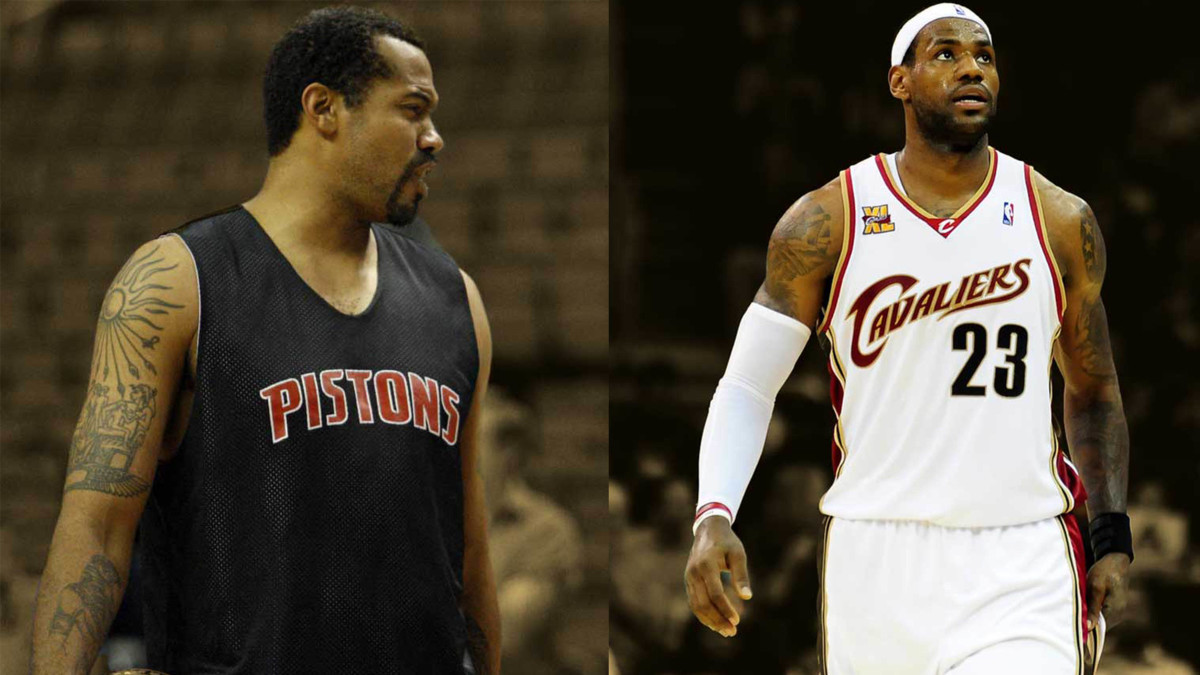
In 1990, Michael Jordan had just suffered his third straight playoff loss to the Detroit Pistons. That year, Detroit beat the Chicago Bulls in the Eastern Conference finals and MJ once again had to walk off the floor having been physically and mentally punished by the league’s reigning bullies.
What happened after that?
Advertisement
Jordan bulked up, toughened up, and burned every Piston’s scar into his competitive DNA. That summer changed everything. He came back meaner, stronger and colder — championships followed.
Nearly two decades later, the same narrative unfolded, only this time, it involved a 22-year-old LeBron James in a fire.
Toughening LeBron
By the time James walked into the playoffs in 2006, he was already billed as basketball’s chosen one. But when he ran into the Pistons in the Eastern Conference semifinals, it was a different story. Detroit’s edge made him sharper.
“I think we did help him with the maturation level of the way that LeBron plays now,” former Pistons star Rasheed Wallace said, reflecting on those playoff wars. “Especially when he’s dealing with big games or in the playoffs. Because coming down, we didn’t make nothing easy for him.”
That Pistons squad wasn’t the “Bad Boys,” but they still embodied Detroit’s energy built on rugged defense, anchored by the likes of Rasheed, Ben Wallace, and Tayshaun Prince. They made everyone, including James, uncomfortable.
Advertisement
They didn’t let him glide to the rim or own the paint like he’d been doing all season. It took seven bruising games and in the end, Detroit reminded the league why it was a perennial title contender. The Cleveland Cavaliers were out in the second round.
The following season, however, things flipped. In 2007, the Cavaliers and Pistons collided again. This time, it was one step further in the Eastern Conference finals — and James had leveled up. After two losses to open the series, he responded with a brutal efficiency that mirrored the evolution Jordan once made against the “Bad Boys.”
Game 5 in Detroit was a performance that still echoes in NBA memory. The four-time champ dropped 48 points, including Cleveland’s final 25 points in regulation and overtime. The Cavs won in six games, and James averaged 25.7 points, 9.2 rebounds, and 8.5 assists in the series.
For Detroit, a team that had been to the conference finals five straight years, it marked the beginning of an end. For James, it was a passage that he could get over such teams.
Advertisement
Finding success
By the 2009 playoffs, Detroit was fading. Cleveland swept its nemesis in the first round, completing a full-circle moment. The Pistons had gone from tormentors to a defeated footnote in Bron’s ascending story in just four years.
Unfortunately for James, Cleveland didn’t earn a championship during his first stint there. That 2007 Finals appearance ended in a sweep by the San Antonio Spurs. The Cavaliers remained contenders for several seasons, but the pieces never aligned. Still, those battles against Detroit carried value.
Advertisement
“It was tough, it was nice, it was fun,” Wallace recalled. “The guy, he is a hell of a player, but it was always some great series. We loved going out there.”
By the time James left Cleveland in 2010, he had made five straight All-NBA First Teams and averaged 27.8 points per game across seven seasons. He had two MVP awards under his belt and a hunger crafted in battles against veterans like Wallace, Billups and Rip Hamilton.
Those Pistons, battle-tested and championship-hardened, groomed him.
Since then, James has won four championships for three different franchises and earned 10 Finals appearances. Those hard-fought battles during his formative years proved helpful after all.