
Get Starting Point
A guide through the most important stories of the morning, delivered Monday through Friday.
In that generation, teams had the right to renew their drafted players’ contracts each season, carrying full control over who could eventually change teams.
“We’ve been involved with the Oscar Robertson suit, which spoke to those issues and we were very successful in court,” he told the Globe. “Well, whether I deserve it or not, over the years we’ve got a lot of criticism, and from a lot of people, in the press, owners. There are a lot of ballplayers who just benefiting from this didn’t criticize me too much. All I can do is look at look at what happened in a case I was involved in. Well, for a franchise in basketball [Lakers] to cost $10 billion dollars? Another [Celtics] cost $6 million? And ballplayers making $65 to $75 million a year? I think it’s remarkable.”
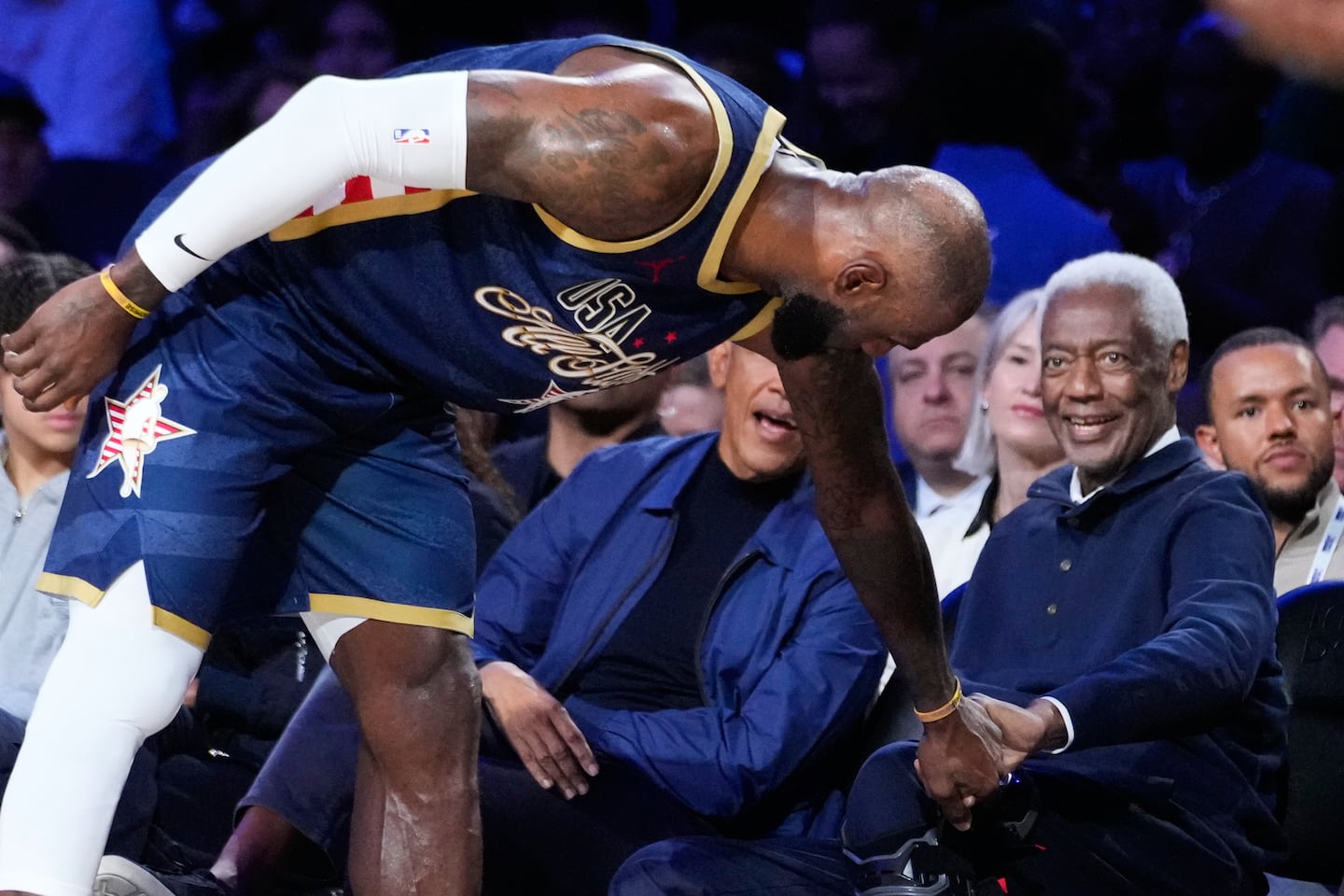
With thepassings of greats such as Bill Russell and Jerry West, Robertson is one of the remaining all-time greats from that 1960s generation. The question is whether today’s players recognize him and his accomplishments. Robertson’s all-time triple-double record of 181 stood until Russell Westbrook eclipsed it in 2021.
Robertson is associated with being an all-around player, able to help his team by dominating multiple categories.
“I think [current players] know who I am … I think so,” he said. “If we think about it, I think we went from a situation where it was borderline never making any money to where now they can protect their families. Live a great life, a real great life, OK. Even the players who are not great players, he makes $15 million a year for 10 years. I think it’s wonderful. I’m glad I was a part of it.”
When asked to list some of his all-time favorite players, Robertson named several from his era, including Celtics great Sam Jones.
“I watched a lot of players and there’s a lot of good players, you know what I’m saying?” he said. “Elgin [Baylor], Wilt [Chamberlain], Sam Jones, Jerry West, Bob Pettit, Rick Barry. [Michael] Jordan, of course, and I loved Kobe [Bryant]. I like guys who perform, put it on the line, go to the line to get it done. When I say go to the line, I don’t mean the free throw line, I mean get it done in big games, when it counted. They had to perform well in order to win. They were there and of course LeBron [James].”
While today’s players have better facilities, equipment, shoes, and modern medical innovations, which has led to more elite athleticism, Robertson gave a nod to his generation of players who thrived with their natural physical skills and work ethic.
“I think players have gotten more athletic because years ago, I didn’t see any 6-foot-5[-inch], 335-pound tackle [in football],” he said. “Yeah. If they weighed 250 pounds, boy, you had a good tackle. Well, I can see where players have gotten more athletic but when I look back at Jim Brown play football, all he did was go off tackle. He didn’t have all these downfield blockers, just blockers on double teams, he just went off tackle. Any player greater than he was? No, he’s here and there. It’s a great conversation. Some players like different players.”
During his career, Robertson averaged 25.7 points in 14 seasons (with no 3-point shot) along with 7.5 rebounds and 9.5 assists for the Cincinnati Royals (who eventually became the Sacramento Kings) and Bucks. The 6-5 guard was a 12-time All-Star, 11-time All-NBA selection, and the 1963-64 MVP when he averaged 31.4 points, 9.9 rebounds, and 11 assists.
 The Oscar Robertson Player of the Year trophy, named for the Cincinnati legend, went to Duke freshman Cameron Boozer last month.Jeff Roberson/Associated Press
“I look back at my career, and when I came into the league, I was asked to do everything and all I could do was say, ‘Yes, thank you,’ ” he said. “I think that when you’re proud and gifted to play a game, do something you like to do, you don’t care about the accolades, or what people say or what they think. You don’t really care about personal goals as well. All you care about is trying to win. I mean, we had a good team [in Cincinnati], and we could never beat the Celtics. A lot of teams couldn’t beat the Celtics. That’s the way it goes in sports.”
Robertson spent his first 10 seasons in Cincinnati (playing his final year there for Celtics great Bob Cousy), before he was traded to the Bucks to join a second-year center named Lew Alcindor (Kareem Abdul-Jabbar) to form one of the league’s greatest duos.
The Bucks won the title in 1971 and reached the Finals in ′74, losing to Dave Cowens and the Celtics. Milwaukee management broke up the team, prompting Robertson’s retirement and Abdul-Jabbar’s eventual departure for Los Angeles.
“When I went [to Milwaukee], I looked at my first practice. I saw that we needed a lot,” Robertson said. “We needed to make a lot of players better. I knew what I had done before, so, as a matter of fact, I told my wife, ‘You know, I’m not going to score as many points as I did in the past.’ It was a great team. I’m just sorry that management had to break us up after the first year. Unheard of in sports, to win a championship and then trade all your players away. Unheard of.”
Being around the game’s current greats reminds Robertson of his younger days in Indianapolis, where he would play every weekend at the local YMCA. An employee would let Robertson and his friends in for free because they couldn’t afford memberships.
“We [were] going to play ball, man,” he said. “And after a while … all the great players will show up. Then it got to be real tough to play, man. And that’s what I’m very, very proud of. I competed in those games because I just loved to play.”
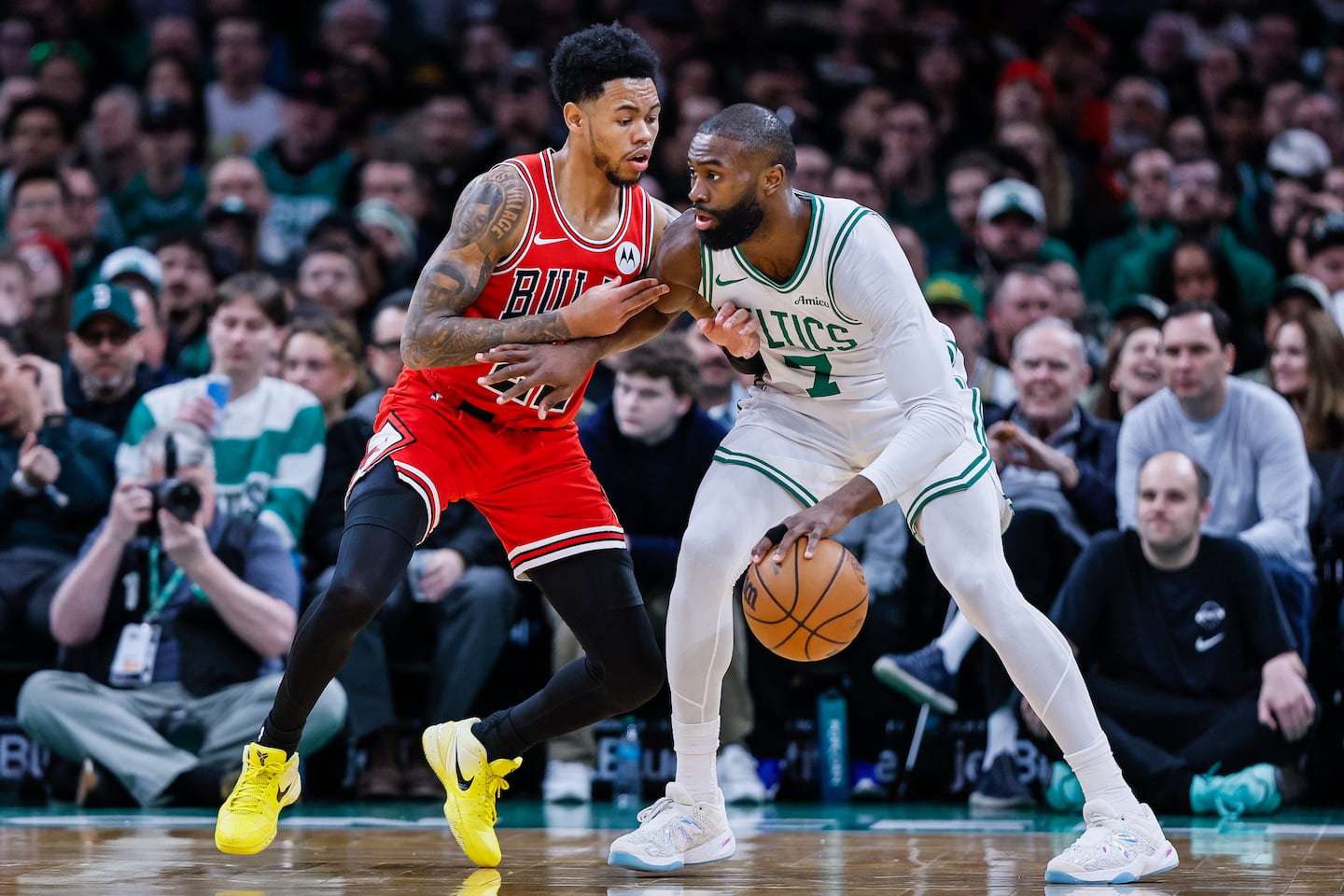 Free agent to be Anferee Simons (left) began the season as Jaylen Brown’s teammate, then guarded the Celtics star following a trade to the Bulls.Erin Clark/Globe Staff
SOON TO COME
Free agent market starts to take shape
We’re roughly two months from NBA free agency and as playoff teams dwindle, there are a number of attractive veterans who will be on the market. Among those whose contracts expire after this season are James, Kristaps Porzingis, CJ McCollum, Anfernee Simons, John Collins, Tobias Harris, Deandre Ayton, Nikola Vucevic, Norman Powell, Marcus Smart, and Mitchell Robinson.
James, who plans to play at least another year, will be the most intriguing free agent story because it appeared a few months ago the Lakers were ready to move on with Luka Doncic as their cornerstone. But James has blended so well into the team element and remained healthy that their marriage could continue for at least one more season.
Porzingis’s market value will be tricky because of his health history, although he finished strongly with the Warriors, who made the unpopular trade of Jonathan Kuminga to the Hawks to get the often-absent Porzingis. If the Warriors desire one final title run, they could bring back Porzingis to join Stephen Curry, a healthy Jimmy Butler, Draymond Green, and perhaps a re-signed Al Horford to compete in the West.
McCollum may have boosted his value with a strong first three games of the Hawks’ Eastern Conference first-round series with the Knicks, as he became the team’s No. 1 option. He could be a solid addition for a championship-contending team looking for a secondary scorer.
Smart has played well for the Lakers although injuries limited him to 62 games. But after some tough seasons in Memphis and Washington, Smart has proved his value to a playoff team and could be a welcome addition to a contending team’s backcourt.
Simons, coming off the final season of his contract at $27 million, flourished in his bench role with the Celtics and had his moments with the Bulls before being shut down with a wrist injury. He is not likely to garner $27 million on the open market but at age 27 and with the ability to score, he’ll be an attractive piece for a backcourt.
ETC.
Benchmark for coaching success evolves
There was a theory a decade ago that a successful coach needed to have NBA playing experience to relate to his players. This generation of players apparently needed someone who has shared the same experiences. That method worked effectively for years.
But there has been a growing number of successful coaches who don’t have NBA experience, including the Celtics’ Joe Mazzulla, Mark Daigneault in Oklahoma City, San Antonio’s Mitch Johnson, JB Bickerstaff in Detroit, and Minnesota’s Chris Finch. In fact, only seven current head coaches played in the league.
So is there a new blueprint? Does playing experience boost a résumé or have no impact.
“It’s hard to put a blueprint on that when we’ve had seven different champions each year,” former NBA player Danny Green said. “’I like Mark Daigneault, I like Mitch Johnson, they’ve done great jobs, even Joe Mazzulla. And I see Utah making a turnaround next year. Will Hardy, we’ll see with the pieces he got, what he can do because he’s been dealt a pretty bad hand the last couple of years trying to rebuild in Utah.”
With Doc Rivers stepping down in Milwaukee and Billy Donovan resigning in Chicago, veteran coaches are beginning to become extinct. As the number of tanking teams increased in past years, so have young coaching hires whose foremost responsibility is to build first and then win. Hardy, for example, is considered a bright young coach but has a .326 winning percentage in his first four seasons as the Jazz continue to rebuild. Veteran coaches generally don’t join teams to watch their career winning percentage plummet.
In Milwaukee, the Bucks replaced Rivers with Taylor Jenkins, who was removed in Memphis in April 2025 after six seasons and three playoff appearances.
“Some of the young coaches I do like, but I feel like you also need some experience too,” Green said. “I don’t know what that is. I’m assuming front offices and owners, I think they’re going in the direction of younger guys, giving assistants an opportunity, because it’s hard to recycle the same people, older coaches.
“The new generation is very different. It’s hard to just put one particular category on it, oh, this is what works for them. I think it’s different for different teams, different organizations, different generations. Some of them like the old guys, some of them don’t. I think the newer generation is more relatable to guys that are younger and closer in age. I won’t say respect them because not everybody has respect, but they think they can relate to them better.”
 Cooper Flagg fought through NBA defenses to average 21 points as a rookie.Matthew J. Lee/Globe Staff
Meanwhile, Green made an interesting comparison when discussing Rookie of the Year Cooper Flagg, who completed a stellar first season with the Mavericks. Flagg played point guard most of the season under Jason Kidd, turning him into a better playmaker as the Mavericks bring back the likes of Kyrie Irving next season for a potential deep playoff run.
“I know people looked at him like Jayson Tatum or Grant Hill when he was coming out,” said Green, who won three NBA titles in 14 seasons. “I’m looking at more like Gordon Hayward. I think he could add more to the bag a little bit. I don’t think he needs much more. I think he just needs a consistent 3-point shot [and] midrange. That will help him because he’s great at finishing around the rim, he’s great at getting out in transition. He’s a good defender, too. And just learning and communicating, he’ll just grow with that.”
Atlanta’s Nickeil Alexander-Walker was named the league’s Most Improved Player, and deservedly so. But there remains confusion about the award and what actually constitutes “Most Improved.” The league does not set any guidelines on what actually it is so the voters are left to interpret. In some opinions, it’s the player who made the biggest step, even if that means star to superstar. For others, it’s the player who has made the biggest strides in terms of role and impact. Fourteen players received votes for the award this year but two of those names — Victor Wembanyama and Jamal Murray — were All-Stars, and Wembanyama is an MVP candidate. The Celtics’ Neemias Queta finished fourth and others such as Phoenix’s Collin Gillespie, Milwaukee’s Ryan Rollins, Houston’s Reed Sheppard, and Dallas’s Naji Marshall received votes while placing in the category of players who thrived under expanded roles. So until the league defines what “Most Improved” actually means, there will be a plethora of players who receive votes depending on the voter’s philosophy. Portland’s Deni Avdija and Detroit’s Jalen Duren finished second and third behind Alexander-Walker, respectively, and both were All-Stars. In his first year in Atlanta, Alexander-Walker more than doubled his scoring average from the previous season … Speaking of voting, Flagg edged out former Duke teammate and Charlotte forward Kon Knueppel for Rookie of the Year, receiving 56 first-place votes to 44 for the NBA’s all-time rookie 3-point leader. Flagg turned in an incredible season for the Mavericks, leading his club in total points, rebounds, assists, and steals. But there have been questions about the motives of the voters. While the season ended April 12, ballots were not released until four days later, after the NBA spent a few extra days pondering the eligibility cases of Doncic, Anthony Edwards, and Cade Cunningham, all of whom fell short of the 65-game minimum for awards eligibility. The league approved Doncic and Cunningham for all ballots but not Edwards. Because of that, voters didn’t receive ballots until after the April 14 play-in game when Knueppel went 2-for-12 shooting and was benched in the fourth quarter of the Hornets’ win over the Heat. One voter openly admitted that performance swayed their vote and the question is how many others perhaps placed Flagg over Knueppel because of that difficult game. Both will make the All-Rookie team and the league hopes to avoid timing issues such as this in the future.
Gary Washburn is a Globe columnist. He can be reached at gary.washburn@globe.com. Follow him @GwashburnGlobe.