
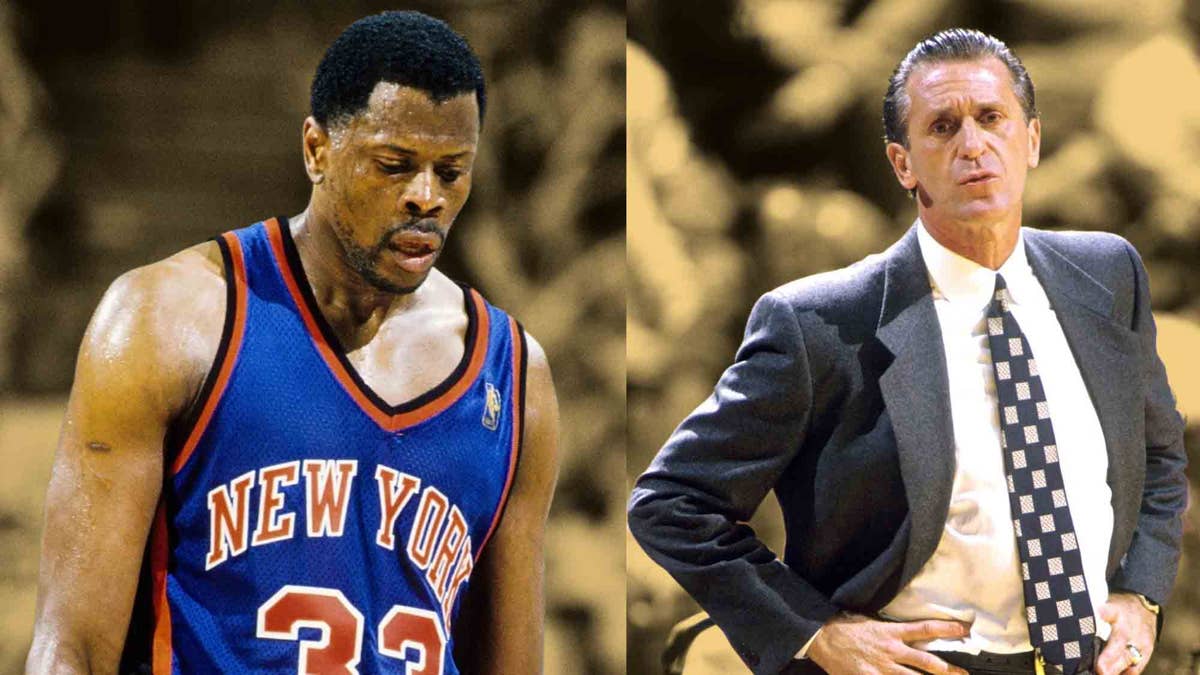
NBA legend Patrick Ewing was the crucial centerpiece of a iconic and extremely physical New York Knicks team in the 1990s. He looks back at it with a lot of pride and fondness for the mark they left on the league and the success they achieved.
Under coach Pat Riley (1991 to 1995) and later Jeff Van Gundy (1996-2001), the Knicks adopted a tough defensive identity that made opponents aware they could expect a dogfight every time they set foot in Madison Square Garden.
Advertisement
Playing alongside the likes of Charles Oakley, Anthony Mason, Xavier McDaniel, John Starks and Derek Harper, Ewing led the Knicks’ rugged, intimidating and no-easy-basket defense, earning comparisons to the championship-winning Detroit Pistons “Bad Boys.”
On his appearance on “The Pivot Podcast,” Ewing spoke about the kind of mindset they had under Riley that made them one of the most physical teams in league history.
“Pat Riley had a rule. Anybody who comes in the paint, you put them on their back. If you pick them up, that [was going to be] a fine. So, you know, yeah, we were definitely physical. We weren’t trying to be Detroit. We weren’t trying to be the Bad Boys, but we had our own version of that,” Ewing, a three-time All-NBA Defensive Team member said.
Advertisement
“You know, we had myself, you had Oak (Oakley), you had Mase (Mason). When X (McDaniel) played with us, you had X. So, we were a physical ball club, and we weren’t going to take any trash from anybody. Detroit, [Chicago] Bulls, whoever,” he continued.
Physicality equals success
The physicality the Knicks adopted under Riley translated into a lot of success, with the team developing into a consistent contender in the Eastern Conference. In Riley’s four years in the Big Apple, he guided the Knicks to an average of 56 wins per season and deep playoff runs each time.
Advertisement
Their run was highlighted by reaching the NBA Finals in 1994. After handling their business against the New Jersey Nets, Bulls and Indiana Pacers in the East, New York ran into Hakeem Olajuwon and the Houston Rockets.
In the Houston series, the Knicks’ physicality was a major factor, giving them a 3-2 series lead. Unfortunately, they narrowly lost the last two games to the Rockets and missed out on the NBA title in seven games.
Riley left in 1995 to join the Miami Heat, but the Knicks’ physical, defense-oriented style stayed under Van Gundy.
Advertisement
Ewing still anchored their attack but saw changes in the roster with the arrival of the likes of Latrell Sprewell, Marcus Camby, Larry Johnson and Kurt Thomas.
New York remained a playoff staple and returned to the NBA Finals in the 1998-99 lockout season. The Knicks, however, missed the services of Ewing in the championship series after suffering an Achilles injury in the Eastern Conference finals, and they bowed to the San Antonio Spurs in five games.
Shaq felt the physicality of the Knicks
Among those who experienced the physicality of the Knicks in the 1990s was NBA Hall of Fame big man Shaquille O’Neal. While playing for the Orlando Magic early in his career, O’Neal saw a lot of Ewing and the Knicks and recalled how tough it was.
Advertisement
“Nobody played me one-on-one. I always got triple or quadruple-teamed, you know,” O’Neal shared on the “Literally!” podcast with Rob Lowe back in November.
“Coming to New York was tough, ’cause those guys tried to beat you up… I don’t know about the Bad Boys Pistons era, because I didn’t play, but they were definitely physical,” he added.
Ewing did not win an NBA title with the Knicks, but the defensive persona his team adopted made it one of the notable teams in league history and helped define the 1990s NBA, which many people still think was the best era in league history.
Advertisement
This story was originally published by Basketball Network on May 3, 2026, where it first appeared in the Old School section. Add Basketball Network as a Preferred Source by clicking here.