

The most important development of the Washington Wizards 2025-26 season — that didn’t involve losing — was the improvement of Alex Sarr. In his age 20 season, the big man did virtually everything better than he did in his rookie year.
He scored more and on significantly better efficiency. He grabbed more rebounds, produced more assists, blocked more shots, and had a slight uptick in steals. His turnovers were flat on a per possession basis despite the increased offensive responsibilities, and he kept his fouls under control while doing more on defense.

Wizards big man Alex Sarr improved in every facet of the game in his second year. | Getty Images
While it didn’t show (much) in the lineup level stats, Sarr emerged this season as one of the NBA’s busiest and more effective at-rim defenders. At least two factors are likely at work in the on/off numbers. First, he’s 20 years old and in his second season. And second, lordy did you see who was defending on the perimeter?!
Advertisement
Don’t discount the first factor. Plus-minus pioneer Dan Rosenbaum was bothered that raw plus-minus and adjusted plus-minus (APM) metrics were incredibly noisy for young players and others with small sample sizes. Meanwhile, box score stats stabilize much more quickly.
Being a pioneer, Rosenbaum used this information to develop a Statistical Plus-Minus metric — using more stable box score stats to predict long-run APM. So, when looking at a young player, if the box score is saying he looks good and the plus-minus stuff disagrees (or really is saying “don’t know yet”), trust the box score. Over time, the on/off data becomes more reliable and typically begins to match what we’d expect from the box score.
This foundational work led to creation of Box Plus-Minus (BPM), Real Plus-Minus (RPM), and an array of Regularized Adjusted Plus-Minus (RAPM) metrics. Cool stuff.
The point of this digression is that Sarr’s on/off numbers are likely to improve as he gains experience and better teammates.
Advertisement
Among the improvements from last season: Sarr’s score in my Consistency Index metric. As a rookie, his score was 134 — suggesting his performance could swing from epic fail to epic hero (and anything in between) from game to game without rhyme or reason. This season, he scored an 83 (in the Consistency Index, lower is better and zero would be perfectly consistent).
For context, the most consistent player I can recall (I’ve not run it on a large set of game logs) was Tim Duncan, who scored in the 40s in multiple seasons. More than a little on brand for “The Big Fundamental.”
There’s still plenty of room for growth in all aspects of Sarr’s game, which is fine because he just turned 21. In a typical career path, the biggest improvements come at ages 21, 22, and 23 — all of which are still in Sarr’s future.
Below is Sarr’s Performance EKG for this past season — dubbed “EKGs” because the squiggly lines on the chart sometimes look like an EKG result. The graph shows Sarr’s score in my Player Production Average (PPA) metric in four ways:
Advertisement
Full season PPA after each game — red line
Rolling 5-game average PPA — silver line
Rolling 10-game average PPA — blue line
Rolling 20-game average PPA — pink line
PPA is an all-around production metric that accounts for pace, role, and defense. In PPA, 100 is average, higher is better, and replacement level is 45.
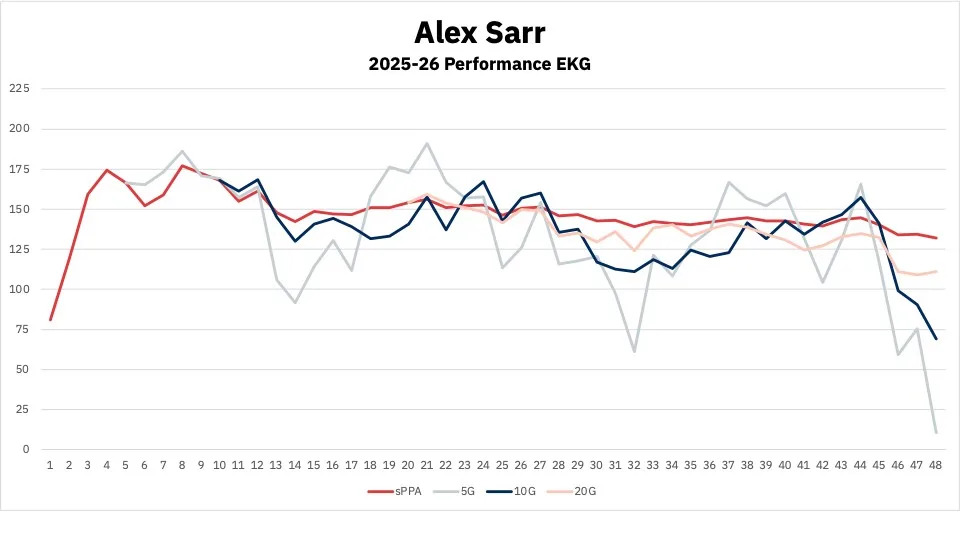
What I see is a strong start followed by a fairly steady decline, which I’d attribute to injuries and the challenge of staying motivated to give a true 100% effort when you know you’re going to lose anyway.
The crater at the end doesn’t concern me. They brought him back from injury, he performed poorly, and they shut him down for the rest of the season. Among the positives:
Sarr didn’t have a 20-game stretch that rated below average.
Sarr didn’t have a 10-game stretch that rated below average until the end of his season.
He had only a few 5-game stretches that rated below average.
Sarr rated average or better in 67% of his games played this season — up from 43% the previous season.
Sarr’s PPA scored was 150 or higher 48% of the time this season.
Sarr’s single game PPA score cracked 200 (MVP conversation if done over a full season) 23% of the time — double the number from 2024-25.
None of this is a guarantee that he’ll be great, of course. But the signs are pointing in the right direction. The Wizards may have emerged from The Tank with a building block.