
The pain of losing in the NBA Finals in Game 7 was compounded when Tyrese Haliburton ruptured his Achilles tendon early on in the game. Thankfully, the Pacers front office made one of the more timely trades in recent history by trading the 23rd overall pick in the upcoming draft for their 2026 first-round pick back. This put them in an enviable position compared to the rest of the league of being a contender in play for a lottery pick.
Most expected the Pacers to remain mediocre in a historically depleted East and at least stay in the Play-In Tournament mix. Injuries, the loss of Myles Turner in free agency, and a generally bad product, even when their best players were available, left them with one of the worst records in the league and the worst record in franchise history. They were set up to contend again over the next few seasons, and potentially over the next 5-10 seasons if the lottery odds had fallen in their favor.
The Pacers did not reap the full reward of their bad record. The loss of Turner was compounded when they traded multiple first-round picks for Ivica Zubac, one of which became the fifth overall pick in the 2026 draft. Zubac may not be worth a top-five pick in a vacuum, but the Pacers needed a starting center and were not going to get one with that selection. They now have their core and most of their bench in place for next season. The offseason is mainly about making marginal moves to fortify the rotation within a budget.
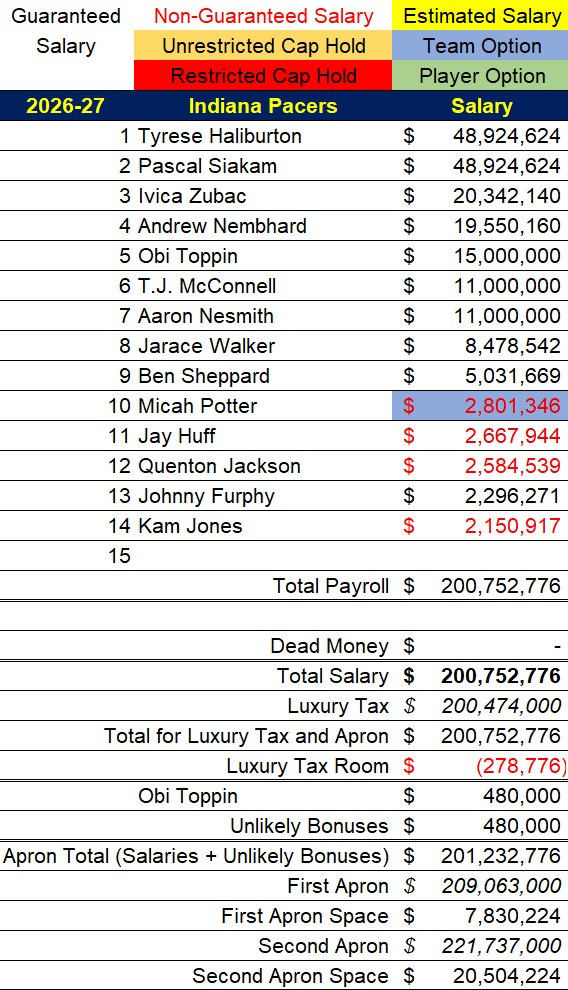
The Pacers are entering the 2026 offseason with a nearly full roster, including 14 players with a combined salary of $200.8 million. That leaves their payroll just $279,000 above the $200.5 million luxury tax line and $7.8 million below the $209.1 million first apron. Had they kept their first-round pick, which would have carried a minimum salary of $10.7 million if it landed fourth overall, they would have been above both the tax and the first apron.
One decision the Pacers need to make is how willing they are to spend above the luxury tax line. They were reportedly prepared to go above it after their Finals run, and doing so would have been required to keep Turner while retaining all their top reserves. That would have been a major deviation for a team historically averse to paying the tax. The last time they paid a tax penalty was in 2006, when they owed just $4.6 million. They could have gotten under the tax no later than the trade deadline, but losing Turner kept them under it entirely.
Not retaining a top-four first-round pick may have also clarified the Pacers’ spending question. Maybe they would have been willing to pay some luxury tax had they kept it. The new luxury tax system lowered the rates in the first two levels. For 2026-27, it’s $1 for every dollar spent up to $6.05 million above the tax, then $1.25 for every dollar from $6.05 million to $12.1 million above the tax. As an example, the first overall pick’s $14.8 million salary would have cost roughly $14 million in tax. A $25 million total cost is a lot for a rookie, but a $14 million tax penalty is also low by today’s standards.
Maybe the Pacers would have gotten under the tax later. That would have required trading one or more of their top reserves, such as Obi Toppin ($15 million) or T.J. McConnell ($11 million), along with others. They should be safe now that there is no urgency to reduce payroll. Between Toppin, McConnell, Jay Huff, and their starters, the Pacers will have a full rotation in place ahead of the 2026-27 season with a path to remain under the tax line.