

Karl-Anthony Towns has the ball near half court. There’s 3:39 left in the first quarter of the Knicks’ closeout Game 4 victory over the Philadelphia 76ers, and Towns is thriving in his new role as point-center in Mike Brown’s remixed Knicks offense.
The All-Star big man takes Paul George off the dribble from the Sixers logo. Miles McBride nails George with a hard screen, forcing the 6-2 Tyrese Maxey to switch onto the center. Towns powers through Maxey. Joel Embiid rotates over as the last line of the Philadelphia defense to take away the easy dunk.
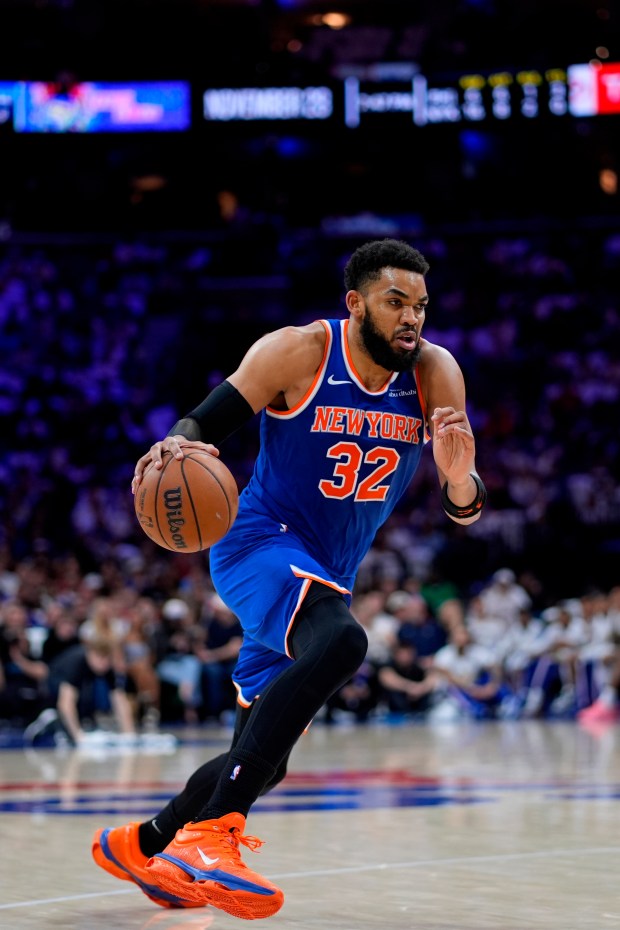 New York Knicks’ Karl-Anthony Towns plays during Game 3 in a second-round NBA basketball playoff series Friday, May 8, 2026, in Philadelphia. (AP Photo/Matt Slocum)
Checkmate.
This is exactly how Brown envisioned the dominos falling when he — reluctantly — turned to his pair of 7-footers to pull away from the Sixers in what became a 30-point road victory to close the second round. Towns dumps the ball off to Mitchell Robinson for his easiest two points of the night.
The next trip down the floor, Robinson sets a hard screen at the top of the key for Jalen Brunson, who dribbles into a pull-up three to put the Knicks up 17.
Timeout, Nick Nurse.
Courtesy of the market differentiator separating the Knicks from the other contenders competing for the Larry O’Brien Trophy at the end of the playoff road.
Through two postseason rounds, Towns and Robinson have shared the floor for only 20 total minutes. The Knicks have outscored the Sixers and Atlanta Hawks by an average of 27.9 points per 100 possessions in those minutes. It’s the best net rating of any 7-foot duo remaining in the playoffs — and a secret weapon Brown finally embraced midway through the Hawks series that could swing any seven-game set en route to the franchise’s first title since 1973.
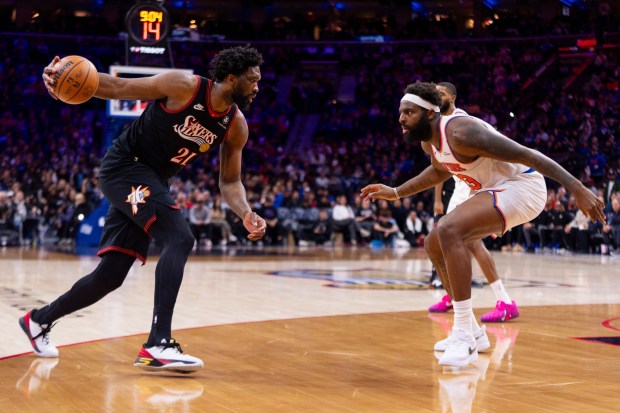 Philadelphia 76ers’ Joel Embiid, left, in action against New York Knicks’ Mitchell Robinson, right, during an NBA basketball game, Saturday, Jan. 24, 2026, in Philadelphia. (AP Photo/Chris Szagola)
“I came to a little bit of a revelation with those guys,” Brown said after practice Friday at the team’s Tarrytown training facility. “We feel it’s a little easier to play with them — not just defensively, but offensively, too.”
COMPLEMENTING EACH OTHER
This is what the Leon Rose-led Knicks front office envisioned when it traded Julius Randle, Donte DiVincenzo and a first-round pick to the Minnesota Timberwolves — because in Robinson, the Knicks already had their own version of Rudy Gobert.
Sure, Gobert is far more decorated than Robinson ever will be. He’s a four-time Defensive Player of the Year, a three-time All-Star, a seven-time NBA All-Defensive First Team selection and a former league leader in blocks and rebounds.
Robinson has his monster trucks. He also has a clean bill of health, plus a vertical leap and lateral quickness Gobert can’t quite match.
That’s what makes this Towns-led 7-foot duo different from the last one. Robinson may not anchor a defense at the level of a four-time award winner, but he dominates the glass and protects the paint nonetheless.
Jose Alvarado remembers facing the Towns-Gobert front court during his years with the New Orleans Pelicans.
“I think this [duo] is better,” Alvarado told the Daily News. “Mitch is mobile. He could guard pretty much one through five. KAT is just — he got better now. That was early in his career. So now he’s better, and it works out nice.”
Towns wasn’t operating like this in Minnesota. Not as a point-center orchestrating offense from the top of the floor.
Now the Knicks head into the conference finals knowing the frontcourt challenge is only getting tougher. If the Cleveland Cavaliers defeat the Detroit Pistons in Game 7 on Sunday, the Knicks will have to contain the duo of Jarrett Allen and Evan Mobley. If Detroit advances, Jalen Duren and Isaiah Stewart will present problems in the paint after the Pistons beat the Knicks by 37, 31 and 15 during the regular season. And if New York reaches the NBA Finals, the challenge could become either the Oklahoma City Thunder frontcourt of Isaiah Hartenstein and Chet Holmgren, or Victor Wembanyama in an NBA Cup Final rematch.
The Knicks may have had their own secret weapon all along. At least it seemed that way once Brown finally dusted off the game-changing artillery after things got rocky in the playoffs.
“[That lineup] is important. [Towns and Robinson] complement each other really well,” Alvarado told The News. “Obviously KAT is not a traditional big — [well] now he is, in this league. He can shoot 3s, post-up and pass, and Mitch covers up defensively for him.
“So it’s complementing each other at a high level, and I’m glad it’s clicking at the right time.”
‘THE FRUITS OF OUR LABOR’
Tom Thibodeau came to the revelation first: The Knicks are better with both Robinson and Towns on the floor.
It’s the lever Thibodeau pulled when the Knicks fell behind 0-2 to the Indiana Pacers in last year’s Eastern Conference Finals. He benched Josh Hart and inserted Robinson into the starting lineup to give the Knicks more size and a stronger defensive presence. Under Thibodeau, Robinson and Towns played 165 total playoff minutes together and were a net positive in those stretches.
Under Brown, dual-center minutes were scarce — at least until the Knicks fell behind 2-1 in the first round against Atlanta.
Brown didn’t want to change the starting lineup. He did, however, change the offense — and with it, his perspective on the Towns-Robinson pairing he once believed created more problems than solutions. Yes, the Knicks could dominate the paint on both ends of the floor, but Brown worried the pairing cramped spacing offensively and left New York vulnerable to mismatches defensively.
“The playoffs — they make you think and adjust, and they make you do it in real-time because if you don’t, your season can end,” Brown said. “You have some time in-between to mess around with things.”
That perspective has since changed.
Towns and Robinson shared the floor for just six total minutes over the first three games of the Hawks series, and the Knicks were outscored by 44.7 points per 100 possessions in those minutes. Since falling behind 2-1 in the first round, however, the Knicks have outscored Atlanta and Philadelphia by a combined average of 55 points per 100 possessions in Towns-Robinson minutes.
“[Their] rebounding for sure, and then KAT being able to roll and he can space, and Mitch just being an impactful lob threat just spaces the floor,” added Mikal Bridges. “And if you leave KAT open, I don’t think he misses if he’s wide-open. [The duo] just builds a lot for us.”
Towns said he and Robinson will continue leaning on the chemistry they built under Thibodeau while evolving under Brown. The Knicks have benefited from extra practice time following their sweep of Philadelphia, but the pairing already received validation when it nearly rescued last season’s conference finals run.
The difference? Thibodeau turned to the lineup in emergency. Brown is using his 7-footers as a turbo propelling the Knicks to its first legitimate title run in more than 50 years.
“I think it’s been great to have more time with [Robinson] and to be able to understand ways to help him succeed on the court,” Towns said. “That comes with just chemistry, time on the court, playing with each other. Throughout the year we’ve had those moments, and in the last year where we were able to build that chemistry — and it’s paid dividends when we were on the court together this playoffs.
“So it’s great where you could see that improvement actually happening and see the fruits of our labor.”