

Duke University men’s basketball led by as many as 19 points in the first half of Sunday evening’s game against the University of Connecticut — an “Elite Eight” matchup in the third-to-last round of the NCAA Tournament.
But UConn fought back. In the dying seconds, guard Braylon Mullins launched a three-point shot from distance to put the Huskies up 73-72 with 0.3 seconds remaining.
It was a historic comeback and a crushing loss for Duke, which had entered the tournament as one of the consensus favorites. It was hardly an upset, though. UConn was ranked No. 2 in its division, and has previously won the tournament six times, most recently in 2024 — that’s one more than Duke.
In a tournament historically renowned for “Cinderella stories,” where lower-ranked teams make a run against traditionally successful programs, those upsets are becoming less and less frequent. The reason could be the college sports landscape’s Name, Image, and Likeness (NIL) rules and the transfer portal.
“I think the phrase that we’re hearing a lot more is ‘chalk,’ that we should expect the higher-seeded teams to win, and they are winning, by and large,” said Rick Burton, a professor of sports management at Syracuse University. “That may be the new reality of the college basketball tournament, which is that those that can’t afford the talent are going to have a much harder time.”
The NCAA lifted bans on college athletes earning money from their fame in 2021. A few years earlier, in 2018, the NCAA had introduced the transfer portal, a mechanism through which athletes could choose to switch schools — to find a more favorable playing situation, seek a better path to the professional leagues, or, increasingly, to find a bigger NIL payout.
Last year, the House v. NCAA settlement was approved. The NCAA would have to pay billions in back damages over the next decade to athletes who competed in college from 2016 onwards, after previous rules prohibited those athletes from earning money. But athletic departments could also start paying players directly.
The settlement detailed a cap to the payments schools could make — up to about $20.5 million per school in the 2025-26 season, with increases each year in the 10-year-long deal.
The result, Burton said, is it has become more difficult for a school with a smaller athletic budget to attract the best players.
“If they’re playing really well at a mid-major… they’ve already got it in their heads to be thinking about transferring to a school that is going to pay them more commensurate with their talent,” Burton said. “Those schools know that bigger fish are going to pay more money for those players.”
The U.S. Department of Education’s Equity in Athletics database publishes financial data for colleges in the 2023-24 reporting period. For the 64 schools that competed in the 2026 NCAA tournament proper, the average men’s basketball expenses were $10,375,091. But for the schools that eventually made the “Sweet 16,” the average expenses were $15,475,202.
(There was no notable gap between public and private schools, Burton said — private schools often have larger donor bases, but public schools have larger alumni bases.)
The difference was even more stark with team revenues, with Sweet 16 programs averaging more than twice as much as the eliminated teams — $21,965,637 versus $9,767,759 respectively.
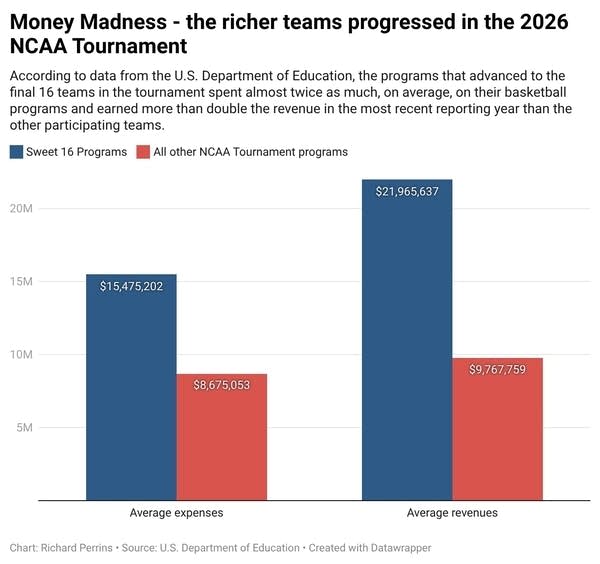
The richer programs progressed further in this year’s tournament, predictably.
Richard Perrins with DataWrapper / Marketplace
In short, programs that spent and earned more money on their basketball teams made it farther in the tournament. That may seem obvious, said Tom Rhoads, a professor of sports economics at Towson University.
“A place like Michigan, a place like Penn State, a place like Alabama, they have no problem finding that money,” Rhoads said. “A place like Towson, it’s going to be tough to find that kind of money.”
Some schools, of course, have been consistently successful in the NCAA tournament or otherwise, with or without NIL and the transfer portal. And those “Cinderella stories” are popular with neutral fans, Rhoads said.
“There’s an element of maybe equity or fairness or parity, however you want to define it, that I think most people kind of gravitate towards,” he said.
Just two years ago, No. 9 Florida Atlantic University made the Final Four. The year before that, No. 15 St. Peter’s University made the Elite Eight.
Those have become far less likely.
Last year’s Final Four were all No. 1 seeds with extensive pedigrees in the competition — Florida, Duke, Houston, and Auburn.
This year, it’s Michigan, Arizona, Illinois, and UConn. And while the latter two are No. 3 and No. 2 seeds, respectively, they are both historically successful basketball schools with large budgets. Illinois was second only to Duke in the 2023-24 revenue charts, with UConn also reporting nearly $19 million in revenue. The women’s NCAA Tournaments have been just as chalky.
Rhoads and Burton said there might be shakeups in the NCAA landscape in the future, in the form of a salary cap in specific conferences or a collective bargaining agreement for athletes. Formalizing the financial structure would help ensure parity and continuity from season to season, they said.
But for now, they said, college basketball is in the midst of a transformation — with the uncertain nature of its finances making the March Madness Cinderella story one of its casualties.
“We’re in a period of great transition. But transition usually ends at some point, where we get to a status quo,” Burton said. “I don’t know that it can be permanently transitioning to something, and so I imagine that we have to reach equilibrium sooner than later, because I don’t know if the confusion is sustainable.”
Related Topics