
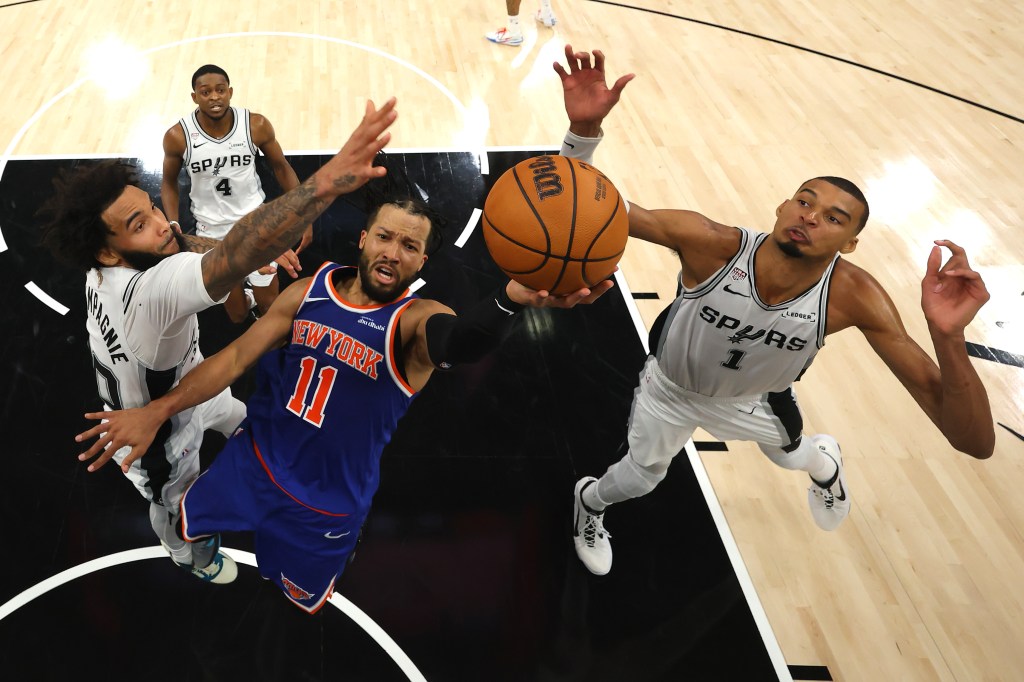
The season started with a Finals-or-bust mandate.
It hadn’t been vocalized yet, but the expectation was crystal clear the moment the Knicks fired Tom Thibodeau after an Eastern Conference Finals berth, conducted an exhaustive five-week head-coaching search, and replaced him with the more collaborative Mike Brown.
The Knicks ultimately accomplished their mission with a historic playoff run, culminating in the franchise’s first championship since 1973, but the road to get there wasn’t always so straightforward.
Let’s relive how the Knicks ended their 53-year championship drought, starting from the beginning.
EARLY ROAD WOES
The Knicks’ first brush with adversity occurred on their first road trip, as they went 0-3, illuminating the learning curve they were undergoing under Brown.
In all three losses, the Knicks failed to put together a complete performance, struggling for prolonged stretches within each game.
The Knicks started the season 7-0 at home but 1-5 on the road.
NBA CUP
Once the Knicks corrected their road woes, they looked the part of a steady, albeit inconsistent, contender.
But the Knicks offered the first reason to believe something special was brewing during the NBA’s in-season tournament, where they defeated the San Antonio Spurs in a hard-fought NBA Cup final on Dec. 16.
Jalen Brunson and OG Anunoby keyed a fourth-quarter comeback, resulting in a 124-113 victory over Victor Wembanyama and the Spurs, in what proved to be incredible foreshadowing.
The Knicks opted against raising a banner for their NBA Cup championship, choosing to keep the Madison Square Garden rafters sacred as they pursued a larger goal.
DOLAN INTERVIEW
The aforementioned Finals-or-bust decree went from understood to unmistakable on Jan. 5, when Knicks owner James Dolan conducted a rare interview on WFAN.
“Getting to the Finals, we absolutely have to do,” Dolan said. “Winning the Finals, we should do.”
At that point, the Knicks were 23-12. But they would lose that night, 121-90, to the East-leading Detroit Pistons.
And things got worse before they got better.
SLUMP AND RESURGENCE
That loss in Detroit was the Knicks’ fourth in a row.
It came toward the beginning of a season-worst slide in which the Knicks went 2-9, raising concerns about a post-NBA Cup letdown and about their trajectory moving forward.
The slump bottomed out with a 114-97 loss at home to the rebuilding Dallas Mavericks on Jan. 19.
After that humbling defeat, Brunson called a players-only meeting to clear the air.
In a testament to their mettle, the Knicks responded with a season-long eight-game winning streak, including a double-overtime thriller over the Denver Nuggets on Feb. 4.
TRADE DEADLINE
Hanging over the Knicks for much of the season’s first half were the seemingly never-ending Giannis Antetokounmpo trade rumors.
Dolan had thrown some cold water on those rumors during his Jan. 5 interview, but as speculation increased that the Milwaukee Bucks were shopping their superstar, the Knicks were repeatedly linked as a potential destination.
Trading for Antetokounmpo would have been a long-term play for the Knicks, costing them depth and chemistry in the middle of a season with championship aspirations.
Ultimately, Antetokounmpo was not traded, and the Knicks stayed the course with the roster they had methodically assembled.
The Knicks did make one notable pre-deadline addition, however, by acquiring Brooklyn-born Jose Alvarado to fill their backup point guard void.
SECOND-HALF ROLLER COASTER
The final two-plus months of the season were filled with ups and downs for the Knicks, who were blown out two more times by the Pistons, completing a sobering three-game season series sweep.
The Knicks won seven games in a row between March 11-24, but every opponent in that stretch was below .500. They then lost three games in a row to teams with winning records.
All told, the Knicks went a full month — from March 6 and April 6 — between wins over teams with winning records.
The Knicks would finish strong, winning their final five games, not including an inconsequential April 12 finale in which their starters sat.
Three of those games, beginning with the April 6 win in Atlanta, were against teams above .500.
ADJUSTMENT IN ATLANTA
The Knicks finished with a 53-29 record, good for the No. 3 seed in the East, setting up a first-round playoff matchup with the sixth-seeded Atlanta Hawks.
Despite their seeding being unsettled at the time, the Hawks sat their starters in the season finale, too, indicating they were OK with — or even wanted — the matchup with the Knicks.
Atlanta had transformed during the season, trading away Trae Young and Kristaps Porzingis while embracing a youth movement.
The Hawks won 19 of their final 24 regular-season games, and some believed they posed a real threat to the Knicks.
Atlanta backed that up by taking a 2-1 series lead with one-point wins in Games 2 and 3, with trash-talking veteran CJ McCollum drilling the game-winner in both.
That proved to be the turning point of the Knicks’ postseason. With their backs against the wall, the Knicks made a key adjustment by featuring center Karl-Anthony Towns as more of a facilitator.
That unlocked the Knicks’ offense, with Towns delivering triple-doubles in Games 4 and 6 as the Knicks won three in a row.
That last of those wins — a 140-89 demolition in Atlanta on April 30 — marked the largest margin of victory in Knicks playoff history.
76ERS SWEEP
The Knicks caught a break when the seventh-seeded Philadelphia 76ers upset the second-seeded Boston Celtics in seven games.
Not only did the Sixers unseat a higher seed, but they expended tremendous energy to do so.
The Knicks swept the 76ers relatively easily in the second round, with star Philly center Joel Embiid — a notorious Knicks villain — struggling in Game 1, then missing Game 2 due to ankle and hip injuries.
Perhaps the biggest takeaway of the series was the Knicks fans’ robust takeovers of Philadelphia’s Xfinity Mobile Arena in Games 3 and 4, the latter of which being a 144-114 drubbing on May 10 (Mother’s Day).
Anunoby tweaked his hamstring at the end of Game 2, then missed Games 3 and 4.
But because the Knicks got nine days between series, Anunoby was able to rest up and return for the start of the Eastern Conference Finals.
Meanwhile, their next opponent, the Cleveland Cavaliers, needed seven games to knock off the top-seeded Pistons.
EASTERN CONFERENCE FINALS
The long lay-off did work against the Knicks a bit, as they came out rusty in Game 1 of the conference finals.
The Cavs led 93-71 with 8:19 left in the fourth quarter that night at the Garden, but that was merely the stage-setter for one of the prevailing moments in the Knicks’ championship run.
Behind 15 fourth-quarter points by Brunson — who repeatedly hunted Cleveland’s James Harden — the Knicks furiously erased that 22-point deficit and won, 114-105, in overtime.
Cleveland never really rebounded from there.
The Cavs prioritized stopping Brunson in Game 2, so he dished out 14 assists against their double teams. Josh Hart, whom they left open, shot 5-of-11 on 3-pointers in a 109-93 victory.
The Knicks faced little resistance in Games 3 and 4, winning the latter 130-93 in Cleveland to clinch a sweep and book their first trip to the NBA Finals since 1999.
That set up a meeting with the young, 62-win Spurs, who were favored in the Finals despite needing seven games to eliminate the Oklahoma City Thunder in an emotional, draining Western Conference Finals.
NBA FINALS GAME 1: CAPTAIN CLUTCH
Game 1 of the NBA Finals didn’t look like it would become a signature Brunson performance.
A first-quarter collision into his right knee briefly sent Brunson to the locker room, while a second-quarter turn of his left ankle left the Knicks star in more pain.
He started 5-of-18 from the field and finished 12-of-31.
But Brunson stepped up when the Knicks needed him most, scoring 13 points in the fourth quarter of the Knicks’ 105-95 win in San Antonio.
With the Knicks down by a point late in the fourth, a leaping Brunson extended a possession by directing a long offensive rebound to Mikal Bridges. Bridges then found Brunson in the corner for the go-ahead 3-pointer with 1:50 to go.
Then, with 37.8 seconds left, Brunson made a tough, off-balance jumper with Devin Vassell all over him that served as the dagger.
“He did what MVP candidates are supposed to do,” Brown said. “He carried us home.”
Towns’ defense against the 7-4 Wembanyama also stood out, as the 22-year-old phenom finished 6-of-21 from the field.
GAME 2: WEMBY WILTS
Game 2 was similarly dramatic, as the Knicks led by 14 points with under six minutes remaining, only for the Spurs to come roaring back.
A three-point play by Wembanyama gave the Spurs a two-point lead with 57.3 seconds left. Less than 20 seconds later, Brunson tied the game, 104-104, with a fadeaway jumper off of one foot over the towering Wembanyama.
That remained the score in the game’s waning seconds when Wembanyama corralled a defensive rebound. But Wembanyama passed the ball when Stephon Castle wasn’t looking, and the ball bounded off of Castle’s back and into Brunson’s hands.
Wembanyama inadvertently fouled Brunson amid the chaos, setting up the Knicks’ go-ahead free throw. On the other end, Wembanyama’s miss at the buzzer clinched a 105-104 Knicks win.
“I’m still very blurry, and that’s the whole problem,” Wembanyama said afterward. “I need to have more poise, more control over the game.”
GAME 3: REALITY CHECK
At the Garden for the first Finals home game since 1999, the Knicks had little answer for Wembanyama, who bounced back with 32 points, eight rebounds, six assists and three blocks in his series-best performance.
Criticized for his passiveness and shot selection through two games, Wembanyama was much more aggressive in attacking the rim in Game 3. Eight of his 11 baskets were lay-ups or dunks. Six of them were set up by a lob.
Just as notably, Wembanyama got away with a first-quarter shove of Brunson that drove the Knicks star to the ground — a non-call that would hang over the rest of the series.
Brown complained of the free-throw disparity after the Knicks’ 115-111 loss, during which San Antonio out-shot them from the line, 24-8, in the second half.
GAME 4: HAND OF OG
For most of Game 4, the Knicks appeared to be at serious risk of relinquishing home-court advantage and falling into a 2-2 series tie
Towns picked up two fouls in the first 62 seconds of the game, sending him to the bench and throwing off the Knicks’ rotations.
Players seemed preoccupied with sending a message to Wembanyama, as Mitchell Robinson and Alvarado both delivered hard, unnecessary fouls against the center within the game’s first 14 minutes.
The Knicks trailed, 81-52, with 9:27 left in the third quarter when the tide began to turn.
Wembanyama caught Towns’ chin with an elbow, resulting in a flagrant foul — and leaving him one flagrant away from an automatic one-game suspension.
That kicked off an immediate 13-0 run by the Knicks, who would outscore the Spurs, 55-25, over the final 21:33. Wembanyama missed two free throws with 1:47 left while the Spurs clung to a one-point lead.
The drama reached its pinnacle when, with the Knicks trailing by a point on their final possession, Brunson missed a long 3-pointer over Wembanyama. Anunoby then came flying in for a go-ahead putback with 1.2 second left.
That gave the Knicks a 107-106 lead — which held up as the final score after Towns tipped the inbound pass on the Spurs’ last possession.
“That has to be the most iconic shot in the history of New York basketball,” Brown said of Anunoby’s game-winner.
The 29-point comeback was the biggest in NBA Finals history.
GAME 5: CHAMPIONS AGAIN
Back in San Antonio, Game 5 followed the same formula yet again.
The Spurs jumped out to another early lead, going up by as many as 16 points in the second quarter.
They led, 72-65, through three quarters.
But Brunson took over from there, scoring 15 points in the fourth to fuel the Knick’s title-clinching 94-90 win.
Brunson scored 29 of his game-high 45 points in the second half en route to unanimous Finals MVP honors.
He joined Michael Jordan, Giannis Antetokounmpo and Bob Pettit as the only players to score at least 45 in a Finals closeout game.
“We played like we wanted to go home champions,” Brunson said.
And for the first time in 53 years, they did.