
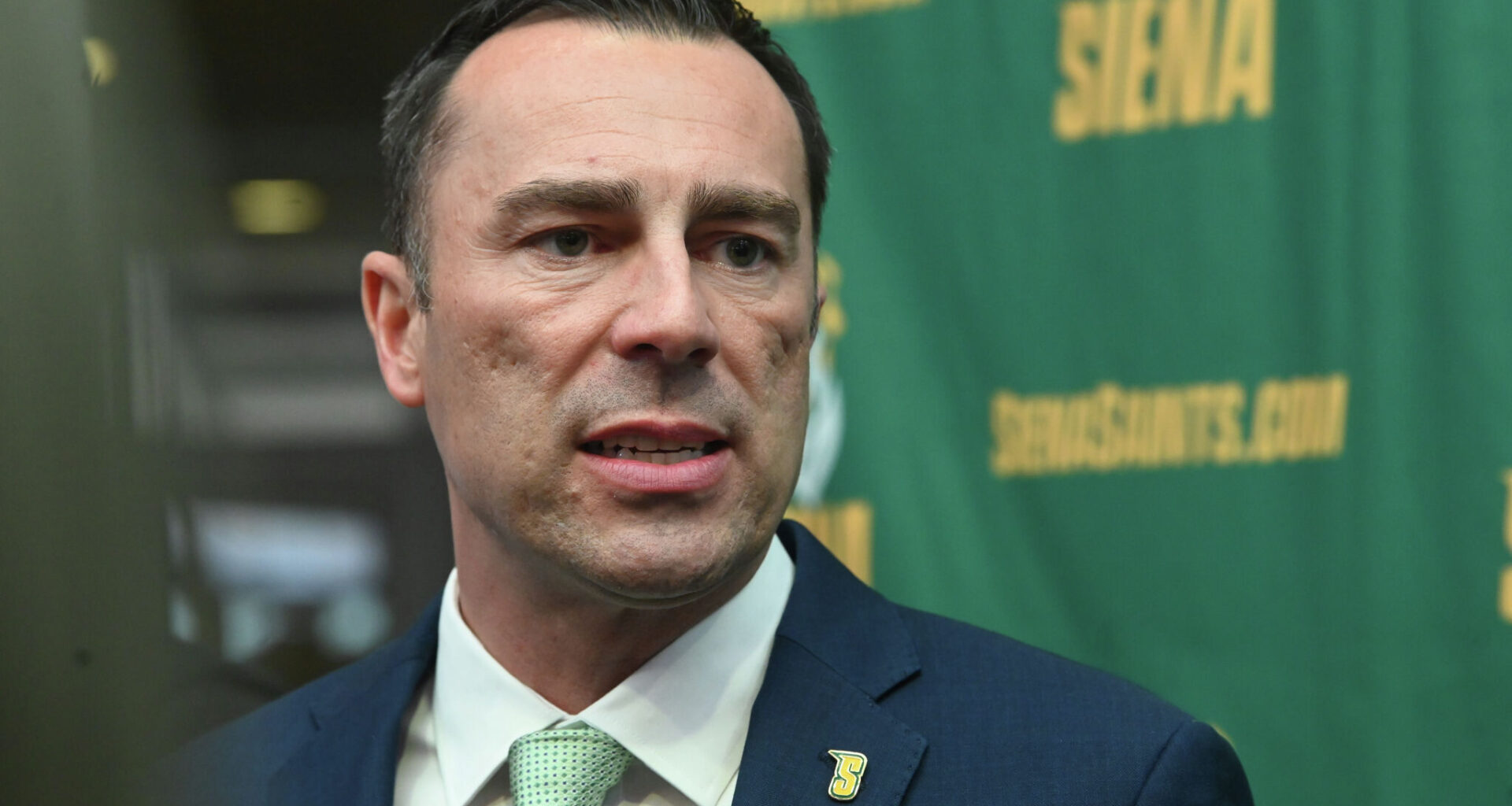
Siena men’s basketball coach Nevada Smith joined the team this spring.
Lori Van Buren/Times Union
CBA sophomore Jack Donohue takes a jumper in front of Shaker senior Patrick Hartman on Tuesday, Feb. 4, 2025, at Shaker High School in Colonie, NY.
Jim Franco/Times Union
The NCAA approved legislation on Tuesday that gives Division I athletes up to five years of eligibility, an increase from the traditional four years of competition.

The Division I Cabinet adopted an age-based eligibility model at its meeting that concluded on Wednesday. Athletes will receive up to five years of eligibility if they enroll in college no later than the academic year after their 19th birthday.
Article continues below this ad
The NCAA said the new rule “streamlines a significant portion of the Division I rule book.” Athletes will no longer be allowed hardship waivers and medical redshirt years. Previously, athletes had five years to complete four seasons of competition, a window that expanded in recent years because of COVID-19 exemptions.
The new rule does allow exceptions for pregnancy, active-duty military service and official religious missions.
“While previous NCAA rules have served college sports well for a long time, we heard also loud and clear from NCAA members and student-athletes that eligibility rules should be easier to understand,” NCAA president Charlie Baker said in a news release.
Make the Times Union a Preferred Source on Google to see more of our journalism when you search.
Add Preferred Source
Current college athletes who have eligibility remaining or athletes who are entering college this year can follow either the previous rules or new rule, whichever is most beneficial to them, according to the NCAA.
Article continues below this ad
Athletes who enroll for the first time in 2027 or later must follow the new age-based model. One of those athletes is basketball player Jack Donohue, a Loudonville native entering his senior season at The Newman School in Boston. He’s being recruited by Siena, Holy Cross, Cornell and Pennsylvania, among others.
“That’s great,” Donohue, who previously played at CBA, said Wednesday of the new rule. “You get to stay playing college hoops for longer.”
Donohue said he also likes the age-based model because it will keep players who are “too old” out of college and discourages high school players from reclassifying multiple times before college.
Siena men’s basketball coach Nevada Smith said earlier this month he was in favor of the so-called “5-in-5” rule, though he’d like to see it coupled with new legislation limiting the number of times a player can transfer. Smith said he believes that combination will help keep down the rising cost of revenue sharing and name, image and likeness money for athletes.
Article continues below this ad
“If you really want to try to get a grasp of this without having to get it collectively bargained and all that, put the ‘5-in-5’ in place and put the one-time transfer rule in place, and that will bring some of these astronomical prices down,” Smith said.
Smith is in favor of letting players transfer just once during their careers, with an exception made for players in programs that experience a coaching change.
“Because the toughest part now is, we don’t know what’s going on day-to-day,” Smith said. “We’re building a roster, and then they’re making up rules after the fact. Like, what are we supposed to do?”
Article continues below this ad
The new age-based eligibility model is already seeing legal challenges from athletes who completed four-year careers in 2025-26. The “5-in-5” rule doesn’t allow any additional eligibility for those players.
On Wednesday, 15 men’s and women’s college basketball players filed a case in Ohio seeking an injunction to play a fifth season in 2026-27.