

Why on earth did the Celtics trade Jaylen Brown for Paul George? We’ll find out Monday afternoon.
President of basketball operations Brad Stevens and majority owner Bill Chisholm are scheduled to hold a news conference to discuss the much-maligned trade, which, once finalized, will send Boston’s longest-tenured player to rival Philadelphia for an aging George, two first-round draft picks and two second-rounders.
As we await the team’s explanation, let’s take a closer look at what the Celtics are getting in George and their two incoming free agents, Mitchell Robinson and Mike Conley:
Paul George
Pros: George probably will end up in the Hall of Fame one day as a nine-time All-Star who’s made six All-NBA teams. He’s far past his prime, but even at 36, he’s still a quality player when healthy.
The Celtics witnessed that in this year’s playoffs, when George averaged 17.4 points on 12.6 shots per game as Philly’s third option during the teams’ first-round matchup. The veteran wing shot 22-for-40 from 3-point range (55.0%) over the seven games and outplayed Brown for long stretches. His net rating in the series was plus-2.6; Brown’s was minus-4.9.
Speaking of advanced metrics, George’s team’s net rating has been better with him on the court than off it in 15 of his 16 NBA seasons. That’s an imperfect stat, but a notable one given the discourse around Brown’s poor “analytics” (his net rating on/off was in the negatives in each of the last four seasons).
George also is a better outside shooter than Brown, shooting 38.4% from three for his career and 39.2% this season.
Defensively, George could add a bit of playmaking to a Celtics team that hasn’t forced many turnovers under head coach Joe Mazzulla. His steal rate regularly ranks in the 90th percentile or higher for his position, per Cleaning the Glass.
“PG had a great series,” Brown said Thursday in a Twitch stream. “PG looked like vintage PG. He definitely was hooping. I think that was part of the reason why the deal for me went down, because PG’s got a lot left in the tank. So don’t sleep on my dog. I f— with PG.”
Cons: He’s old, he’s expensive and he’s rarely healthy. George appeared in just 78 games over his two seasons with Philadelphia, missing 61 with injuries and another 25 for a drug policy suspension.
The durability issues predate his Sixers tenure. Over his half-decade as a Los Angeles Clipper, George missed an average of 25.4 games per season, topping 60 appearances just once. He hasn’t been a regularly available player since the late 2010s, when he earned his lone first-team All-NBA selection and the last of his four All-Defensive nods (both with Oklahoma City in 2018-19).
Salary-wise, unless George waives his 15% trade kicker, he’ll earn the same $57.7 million as Brown this season, and he has a $56.6 million player option for 2027-28. It’s widely regarded as one of the worst contracts in the NBA.
Verdict: Even at his advanced age, George is not a bad player. But he is an unreliable one. Though he should be able to serve as a capable sidekick for Jayson Tatum when healthy, the Celtics can’t bank on him being consistently available.
Baylor Scheierman, Hugo Gonzalez, Jordan Walsh — stay ready.
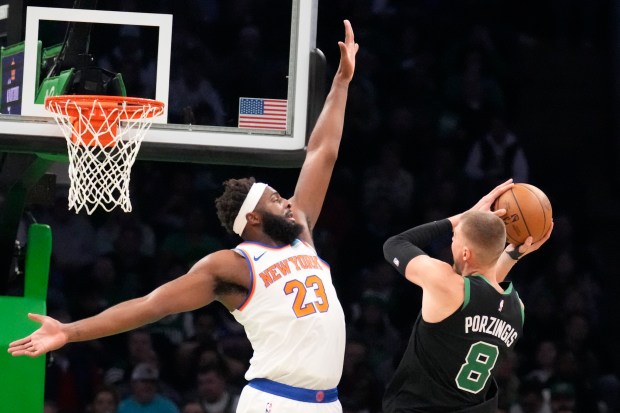 New York Knicks center Mitchell Robinson, left, tries to block a shot by Boston Celtics center Kristaps Porzingis during an NBA game on Monday, Nov. 13, 2023 in Boston. (AP Photo/Charles Krupa)
Mitchell Robinson
Pros: The Celtics needed to add a proven center this offseason, and Robinson was the best one available in unrestricted free agency.
He is an absolute monster on the glass, especially at the offensive end, where he pulled down an eye-popping 20.1% of available rebounds for the champion New York Knicks. With the possible exception of Houston’s Steven Adams, there’s no better offensive rebounder in the NBA than Robinson, who led the league in OREB% and total rebounding percentage this past season. And he’s now joining a Celtics team that already grabbed offensive boards at the fifth-highest rate in the NBA in 2025-26.
The 7-footer also is a versatile and highly impactful defender (87th percentile among bigs in steal rate; 95th percentile in block rate) and an effective screener. His offensive game is extremely limited (more on that below), but he moves well for his size and can contribute as a roll man and lob threat.
Cons: Robinson flat-out can’t — and, for the most part, won’t — shoot. Of the 1,278 field goals he’s made in his eight-year career, 867 of them were dunks. More than 90% of his career shot attempts were within three feet of the basket.
Celtics fans are well aware of Robinson’s struggles at the foul line. He’s a career 50.8% free-throw shooter — a weakness Mazzulla has looked to exploit in the past by intentionally fouling him.
And, like George, staying healthy has been an issue for Robinson. His 60 games for New York this season were his most since 2021-22. He appeared in just 48 total games over the previous two campaigns.
Verdict: Of Boston’s three offseason additions to date, Robinson was the least surprising. The 28-year-old fills a clear need; the Celtics’ big man rotation now looks a lot sturdier with him aboard.
It will be interesting, however, to see how Mazzulla operates with two non-shooters (Robinson and Neemias Queta, who had his team option picked up and then signed a four-year contract extension) at the top of his center depth chart.
 Minnesota Timberwolves guard Mike Conley reacts after forcing a shot clock violation during the second half of an NBA game against the Boston Celtics on Monday, Nov. 6, 2023 in Minneapolis. (AP Photo/Abbie Parr)
Mike Conley
Pros: Conley has played in the NBA forever — his pro debut was against the Seattle SuperSonics way back in 2007 — and has long been regarded as a smart, reliable and well-respected point guard.
His best on-court attribute at this stage of his career is his ability to limit turnovers, which likely endeared him to a Celtics team that values ball security. No team turned it over fewer times per game this season than Boston. Conley also was an excellent 3-point shooter in 2023-24 (44.2% on 5.3 attempts per game) and ’24-25 (41.0% on 4.4).
As a two-time winner of the Twyman-Stokes Teammate of the Year award, Conley should be a positive influence in the Celtics’ locker room, which just lost one of its primary leaders in Brown. He’s started 1,143 NBA games (fourth-most among active players) but shifted into a bench role in his final season with Minnesota. That’s likely how Boston will utilize him behind top guards Derrick White and Payton Pritchard.
Conley’s one-year contract is for the veteran minimum.
Cons: He’s a 38-year-old (39 in October), 6-foot-1 guard coming off by far the worst season of his two-decade-long NBA career.
Conley’s shooting fell off a cliff in his final year with the Timberwolves, during which he made just 33.5% of his field goals and 33.7% of his threes. He averaged 4.5 points per game and 8.9 points per 36 minutes, both career lows by wide margins.
Once upon a time, Conley was one of the best in the league at getting to the basket, but he hasn’t been that kind of player since the Obama administration. Last season, he ranked in the ninth percentile among guards in percentage of shot attempts at the rim; he hasn’t been above the 13th percentile since 2018-19. He’s a great free-throw shooter but rarely draws fouls.
Verdict: The Celtics needed to add depth behind White and Pritchard, and Conley is both uber-experienced and dirt cheap. His leadership should help, too. But he won’t address Boston’s stated desire to add more speed on the perimeter and more interior scoring.
It’s unclear whether there was any mutual interest in an Anfernee Simons reunion, but the ex-Celtic signed for just $6.1 million annually with Philly and would have offered much higher upside than Conley.