
Imagine, for a moment, that you have somehow become lucky enough to own a house in an incredibly valuable, isolated neighborhood of 31 other homes. Imagine, now, that your longtime neighbors see shifting life circumstances and decide to move out of their home. And imagine, finally, that a new family gets giddy over that “For Sale” sign and decides to repeatedly outbid competitors to pay top dollar for that house.
Naturally, the value of your neighboring home would rise. This, according to sports-business expert Patrick Rishe, is analogous to the current economic case of the Denver Broncos and Seattle Seahawks — separated by slightly over 1,000 miles across the American West but approximate neighbors in sheer franchise value.
“When a franchise sells, it really kind of resets the market almost instantly for all the other markets,” said Rishe, a former Forbes contributor and the director of the sports business program at Washington University in St. Louis.
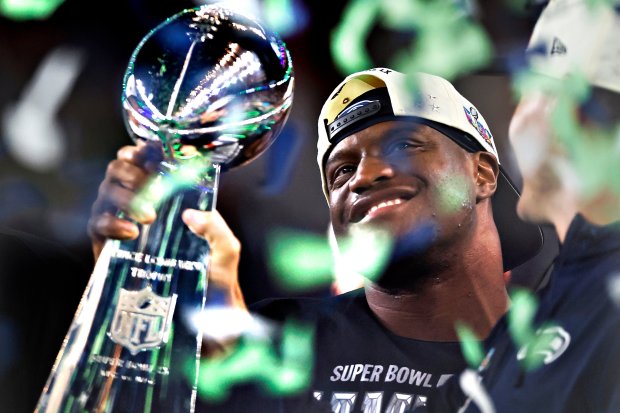 Seattle Seahawks running back Kenneth Walker III holds the Lombardi trophy after the Seahawks defeated the New England Patriots in the Super Bowl 60 in Santa Clara, Calif., Sunday, Feb. 8, 2026. (Scott Strazzante/San Francisco Chronicle via AP)
How Seahawks’ sale boosts Broncos
Last weekend, as first reported by ESPN, the Seahawks were bought by a group led by venture capitalist Vinod Khosla for a league-record-setting $9.6 billion, a number longtime sports-valuation expert Drew Dormeiler told The Post was likely inflated due to “competitive bidding.” Just four years ago, the Walton-Penner ownership group bought the Broncos at less than half that price, for a then-record $4.65 billion. Valuation of an NFL franchise isn’t merely as simple as projecting off established price points — but several economic experts The Post spoke with agreed the Walton-Penner’s investment in the Broncos has seen massive appreciation since their 2022 purchase.
And Denver’s franchise valuation could rise comfortably into the top third of the NFL, too, if ownership’s plans for a new mixed-use stadium district at Burnham Yard come to fruition in the coming decade.
“The math on that is, what something is worth is what someone’s willing to pay,” Rishe said. “And the Broncos aren’t going to go on the market anytime soon, obviously. But I would say that it’s safe to say that the team’s new franchise value at this particular moment, is going to be pretty close to 9.6 billion, because they were viewed in the marketplace as being comparable in terms of market size and brand strength relative to the Seahawks.”
In 2025, Forbes ranked the Broncos No. 13 and Seahawks No. 14 in NFL team valuations, at a respective estimated $6.8 and $6.7 billion. Neighbors. And it takes just a basic understanding of real-estate principles, as Rishe pointed, to understand what that means for Denver’s franchise.
“For the Seahawks to sell for 9.6 billion,” Rishe said, “this immediately skyrockets the Broncos’ franchise value compared to the estimate Forbes produced last year.”
Year
NFL franchise
Majority owner
Reported purchase price (billions)
2026
Seattle Seahawks
The Khoslas
$9.61
2023
Washington Commanders
Josh Harris
$6.05
2022
Denver Broncos
Walton-Penner Group
$4.65
2018
Carolina Panthers
David Tepper
$2.28
2014
Buffalo Bills
The Pegulas
$1.40
2012
Cleveland Browns
Jimmy Haslam
$1.05
2011
Jacksonville Jaguars
Shad Khan
$0.76
In the last 15 years — since Stan Kroenke became the controlling owner of the Rams in 2010 and Shad Khan took over the Jaguars in 2011 for similar, sub-$1 billion prices — NFL franchises have compounded exponentially in sale value. According to decorated economist Andrew Zimbalist, there are three general points contributing to this inflation: the country’s ever-widening wealth disparity, the popularity of the NFL, and the league’s monopoly on the sport of American football.
That last point is key. Rishe noted that franchise revenues from broadcast and corporate partnerships and ticket sales can increase “only so much,” but valuations continue to increase because the NFL itself hasn’t expanded in size since adding the Houston Texans in 2002.
“Demand grows,” said Zimbalist, a professor of economics at Smith College, “but the scarcity of franchises remains there all the time.”
The power of the stadium
There remains, however, drastic gaps between the 32 teams on the totem pole of NFL valuations. And the Seattle sale doesn’t single-handedly lift the Broncos past other franchises; a rising tide lifts all boats, after all. But even as franchise upside is capped by sheer market size — Denver is somewhere around the 20th-largest city in the country by population — several factors in the coming years could contribute to the Walton-Penner group climbing the ranks.
The Broncos, of course, are regaining brand value from last year’s run to the AFC Championship Game, which creates more opportunities for corporate partnerships. Most importantly, too, franchise valuations are based in large part on the value of a team’s current stadium situation — and the Broncos are now aiming for a modern, owner-controlled gem of mixed-use development at Burnham Yard.
 Burnham Yard in Denver on Thursday, June 18, 2026. (Photo by Hyoung Chang/The Denver Post)
“Expectations have just changed over the past 10 to 15 years, with these newer stadiums that have been built,” Broncos owner Greg Penner told The Denver Post in September, with the team’s preferred-site announcement. We’ll be able to provide all those things as well, from different types of seating — GA, premier, clubs, great (food and beverage). It will have all the bells and whistles.”
That is, naturally, framed as a benefit for fans. It is also, quietly, a direct benefit to Broncos ownership, a group that branches from the richest family in America. All but one team in the top 10 of Forbes’ NFL-valuation list, as Rishe pointed out, boasts some robust combination of market size and historical brand appeal: the top-ranked Cowboys, the fourth-ranked Patriots, the New York Giants and Jets.
All, except for ninth-ranked Las Vegas. So why the Raiders? Because of Vegas’s shining Allegiant Stadium, which hosted a Super Bowl in just its fourth NFL season after opening in 2020.
“Shows you,” Rishe said, “the power of the stadium.”
 Owner Greg Penner of the Denver Broncos speaks at the Hanbury Manor in Ware, England on Friday, Oct. 10, 2025. (Photo by AAron Ontiveroz/The Denver Post)
The Broncos’ Burnham Yard development, in coming years, could single-handedly propel the franchise into a top-10 or top-12 valuation despite Denver’s mid-tier market size, Rishe said. And it’s in the Walton-Penner group’s own interest, as experts told The Post, to further make good on their investment by delivering a stadium district they’ve already spent more than $186 million on just in surrounding real-estate transactions.
“It seems to me like there would be a wider — more real estate assets involved in what’s planned for Denver than what exists in Seattle, that are contiguous to the stadium,” said Dorweiler, who has had a direct hand in franchise valuation for acquisitions across American sports for four decades. “So, yeah, I think that’s real.
“Plus, take into account this is still 2031 … I think most people would expect there to be a significant increase in valuation, even if nothing was done at all between now and then,” Dorweiler continued. “So you’re definitely getting up into the double digits of billions I think for, certainly Denver, and probably many other of the leading franchises.”
Want more Broncos news? Sign up for the Broncos Insider to get all our NFL analysis.