
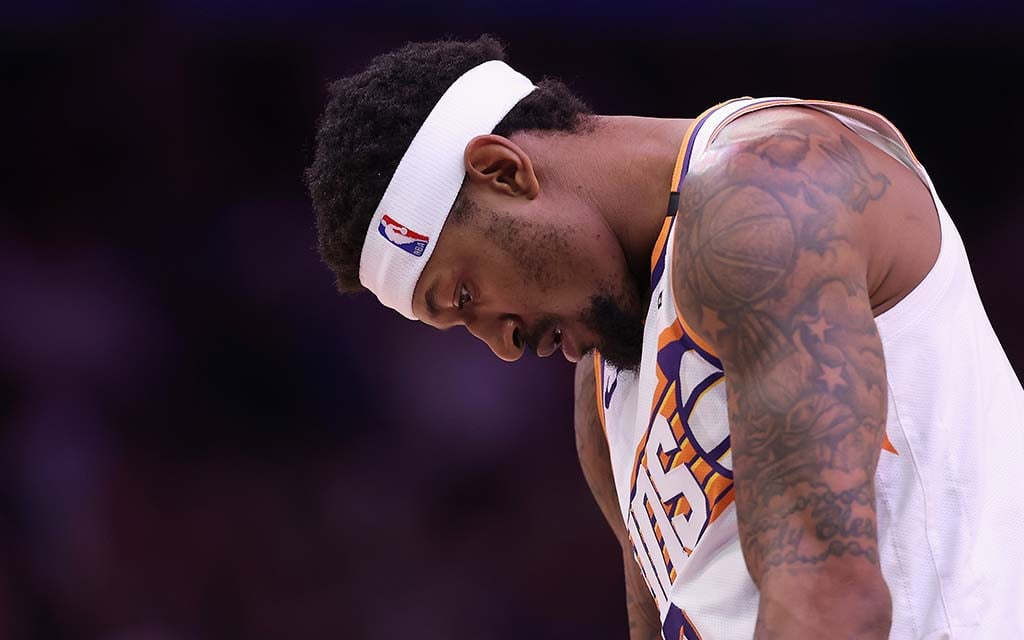
Bradley Beal has been a divisive figure on the Phoenix Suns after the team acquired him in 2022. The team had the most expensive roster in the NBA but did not make the playoffs. (Photo by Christian Petersen/Getty Images)
PHOENIX – College basketball may own March but for hoops fans around the world, June is the best time of the year: the start of the NBA Finals. While the disappointment 29 of 30 teams experience can differ significantly at each season’s end, it often leaves fans believing their team should be aggressive in the offseason.
Thursday’s Game 1 between Oklahoma City and Indiana is a reminder of what other teams strive to be.
Some believe they are a move away from championship contenders or have enough to make a playoff push. In these instances, teams will acquire a player or two that will command a hefty percentage of their salary cap – a significant and risky investment.
Consider the Phoenix Suns. They have the most expensive roster in the NBA but did not make the playoffs this season. After a second-round defeat to the Denver Nuggets in the 2022 season, they decided to trade for Washington Wizards All-Star guard Bradley Beal. This took place just four months after trading significant assets to acquire Kevin Durant.
“You can look and say, ‘Well, why aren’t they winning?’” Fox Sports Radio host Rob Parker said. “They don’t have anybody other than those three players (Beal, Durant and Devin Booker), and that’s where I think the issue comes in.”
The Suns trio were responsible for 70% of the Suns’ $210.5 million salary cap number this season. As a result, the organization has had to rely on quite a few players on smaller contracts over the past two seasons.
The Suns have also fired three coaches since Durant’s arrival. Mike Budenholzer was the latest name added to that list as he was fired after the regular season. He spent just one season in Phoenix after finishing with a 36-46 record and missing the playoffs. In a statement following the move, the team said “change was needed.”
Since Suns owner Mat Ishbia’s arrival to the team in February 2023, personnel decisions have yet to pay off. In May, Brian Gregory was named the team’s new general manager with former GM James Jones transitioning to a senior advisor role.
In Gregory’s introductory press conference, he said he’s been empowered by Ishbia to help build the team. Gregory’s first order of business was addressing the team’s need for a new coach. That was taken care of on Wednesday after reports suggested Cleveland Cavaliers assistant Jordan Ott is expected to occupy the role.
After the Suns’ season ended, Ishbia elaborated on these high expectations.
“I promise you we will win championships,” Ishbia said. “With an ‘s’ at the end.”
Making moves
While Phoenix keeps hammering away, examples are plentiful in which big trades and free agent acquisitions have paid off for teams – putting them in better standing and improving their odds at championship contention.
“The teams that have the best chance at winning have some of the best players,” PHNX Sports Suns reporter Gerald Bourguet said. “If you have a player that is in that elite tier, you want to put as much talent around them as possible, which is going to be more expensive.”
A major factor in all of this is the NBA’s collective bargaining agreement, which went into effect in the 2023 offseason. One of the additions to the league is the “second apron” rule – a financial threshold that limits the roster flexibility of high-spending teams.
Many teams have observed the second-apron number, which is just under $189 million this season, as they build their teams for the immediate and long-term future.
“You’re spending to win, you’re not spending just to spend,” Arizona Republic Suns reporter Duane Rankin said. “The second apron forces you to make certain moves.”
For the Suns, that has meant signing players on minimum contracts, like Tyus Jones and Mason Plumlee, and having them play meaningful minutes. And with both on expiring contracts, Phoenix will have to restart this cycle if its big three stays intact this offseason.
Ishbia said there’s going to be a lot of change this offseason. Some big moves have been made already but it is yet to be determined the specifics of player movement. For ESPN’s Brian Windhorst, Durant is the most likely candidate to be on a new team next season.
Phoenix Suns forward Kevin Durant is the most likely candidate to be on a new team next season, many NBA analysts believe. (File photo by Brendon Pricco/Cronkite News)
The data shows that the correlation between team spending and winning percentage has been a positive one around the league in the past six seasons. But that does not mean spending guarantees winning.
The correlation between team spending and winning percentage this season is weaker than in years past. Reasons for changes in the data include injuries and trades. Digging into the context behind the correlations provide explanations as to why a high spender may be struggling to win games.
Two of this season’s top 10 spenders – the Miami Heat and Dallas Mavericks – have dealt with both injuries and trades of key players, leading to a lack of success. The Heat traded away Jimmy Butler, who played in just 25 of the team’s 50 games before being dealt. While it made the playoffs, Miami failed to win a game in its first round series loss to the Cavaliers.
The Mavericks traded leading scorer Luka Doncic, who had played in just 22 of the team’s 50 games, for Anthony Davis, who suffered an injury in his debut with the team that kept him sidelined for 18 games. Soon after, Kyrie Irving tore his ACL, causing him to miss the last 19 games of the season. The Mavericks were 7-12 in those games and failed to make the playoffs.
As for the Suns, the trio of Durant, Booker and Beal played just 37 games together this season. The season before, they shared the court for just 41 games.
“You have to spend money wisely and get the value in return,” Rankin said. “That’s been the Suns’ problem, they spent money on Beal and he hasn’t played enough to make it worth the dollars they spent.”
The team with the most wins in the regular season was the Oklahoma City Thunder with 68, and they were 20th in spending. While there was a positive correlation between team spending and winning percentage, in the Thunder’s case, spending does not have much to do with their success. They are an example of building a team through the draft – which is more of a cost-saving method.
Outside of Shai Gilgeous-Alexander, who was the league’s MVP this season, some of the Thunder’s best players are still on rookie contracts. That applies to Jalen Williams and Chet Holmgren, both of whom play significant roles on an Oklahoma City team that is nearing a championship.
Like this year, the Thunder were also the No. 1 seed in the Western Conference last season. While they ended up losing in the second round of the playoffs last year, they ranked 25th in spending.
Winning vs. spending
This has been applicable to other NBA teams over time as well. One of the best stories in the league this season was seen with the Detroit Pistons – a team that has brought the “Bad Boys” brand of basketball back to the Motor City. They had the 14th highest winning percentage in the league this season and sit second-to-last at 29th in team spending.
But having a top team while near the bottom of the league in spending is not sustainable.
“If you want to have a successful franchise, you have to be willing to spend some money,” Parker said.
While their success is admirable, eventually teams like the Thunder and the Pistons will have to spend more money on their best players to maintain high levels of success. Cade Cunningham, the Pistons’ lone All-Star this season, will have his five-year, $224 million contract come into effect starting next season.
Williams and Holmgren are likely to sign max extensions with the Thunder this offseason but those will not affect the team’s payroll until the 2026-27 season. Regardless, the ability for a team to maximize its draft assets like the Thunder and Pistons have will allow it to experience success without needing to spend a load of money on external talent like some teams do.
“There are a lot of guys that come into the league, and in their first few seasons, are contributing at a significant rate on minimal, rookie-scale contracts,” Bourguet said. “That’s where the Suns went wrong in my opinion; they’re older than most teams on a nightly basis.”
The Boston Celtics were last season’s NBA champions. They were fourth in spending and had the league’s highest regular season win percentage.
While last season’s correlation between success and a high payroll is strong, Parker said spending a lot of money does not necessarily equate to winning.
“You can look at the New York Knicks who have not won a championship since 1973,” Parker said. “(Spending money) does not guarantee you anything, you have to do it wisely to win.”
The Knicks are a team that, historically, has not been shy to be among the league’s highest spenders. While they were 14th last season, this year they are fourth after acquiring Mikal Bridges and Karl-Anthony Towns last offseason in separate trades. They were the No. 2 seed in the Eastern Conference last season, and although their record was better this year, they were the No. 3 seed in the playoffs.
Unlike last season, the Knicks were able to reach the Eastern Conference Finals this year. This was the team’s first conference finals appearance since 2000. Despite that, the Knicks fired coach Tom Thibodeau after losing the series.
As far as last season’s playoffs, the three highest spenders – the Golden State Warriors, Los Angeles Clippers and the Suns – all failed to make it past the first round. The Dallas Mavericks, the Western Conference’s representative in the NBA Finals, were 11th in spending.
Even with the strong correlation, a good winning percentage in the regular season does not mean that team is more likely to succeed in the playoffs. Five of the top 10 spenders failed to make it past the first round this season. This is a theme that has shown up in past seasons as well.
But the highest spenders in the league fared well in the 2023-24 season as eight of the top 10 spenders made the playoffs. The Suns were one of those teams; they were third in spending. So while it is not a golden ticket to the playoffs, spending more money strategically can put you in a better position than most teams.
The Denver Nuggets likely factored the second apron into their past two offseasons since winning an NBA championship in 2023. They lost Bruce Brown in the 2023 offseason who was a pivotal member of that championship-winning team. And last offseason, they lost Kentavious Caldwell-Pope, who was another key contributor and one of their best defenders.
Unfortunately for the Nuggets, these moves have not been beneficial, as Michael Malone, their head coach since 2015, and general manager Calvin Booth, were both fired just before the end of the regular season. This is what comes with being an underperforming, high-spending team. The Nuggets have been a top 10 spender in the league since 2021-22.
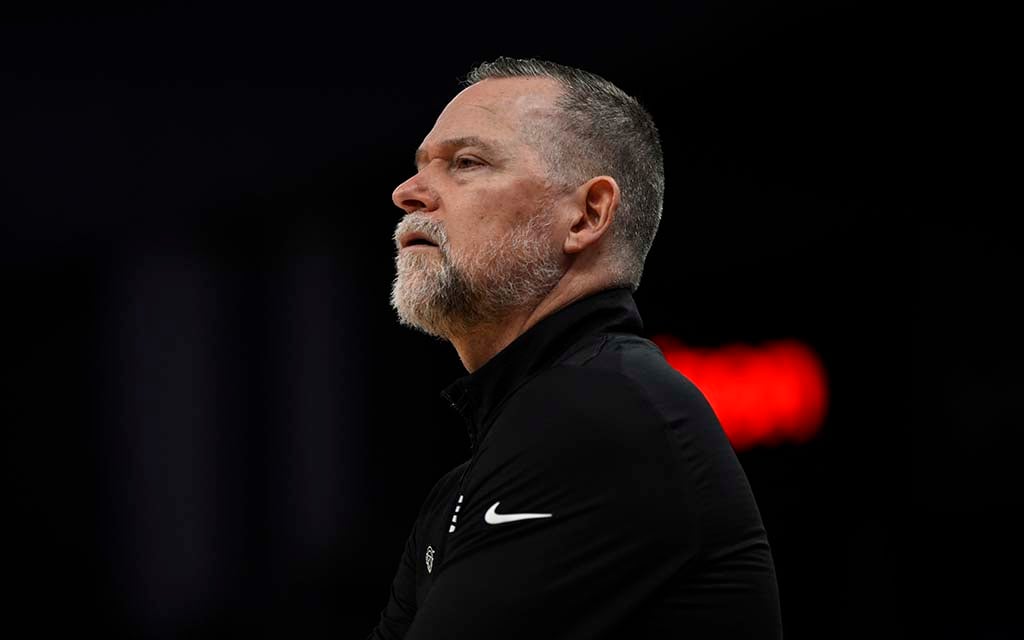
Denver Nuggets coach Mike Malone was fired just before the end of the regular season after his team underperformed. (Photo by Eakin Howard/Getty Images)
“I was surprised to see the Nuggets take that approach,” Bourguet said. “It does feel like they weren’t all in on the best player in the NBA right now (Nikola Jokic).”
While they were able to reach the second round of the playoffs this season, the Nuggets were eliminated by the Thunder. After the loss, Jokic said the roster is not good enough to win a championship. Josh Kroenke, the Nuggets’ team president, agreed with Jokic’s assessment of Denver’s current situation.
Market size matters
Market size may also play a role as small-market teams typically look to spend less extravagantly. That leads to shortened championship windows, but once that championship is won, owners have a willingness to move in a different direction rather than continuing to go for another one.
“It’s different if you’re trying to get one (a championship) and you don’t have one,” Parker said. “But once you win, you can kind of scale back and I think that’s where Denver was after they won their title.”
The Knicks and Los Angeles Lakers are located in two of the largest markets in U.S. sports. And like the Knicks, the Lakers have no issue with spending what is required to add high-level talent to their roster.
Since 2018, they have brought in LeBron James, Davis and Doncic. This is unheard of for most franchises.
One benefit to playing in a bigger market is the off-court opportunities players get through endorsements. A team like the Memphis Grizzlies, for example, can’t offer that same package to players – they are banking on attracting free agents based on their team’s culture and personnel.
But market size does not have a significant effect on winning either. Four of the bottom five teams in market size have made the playoffs at least once in the past two seasons.
“If you run a team well, you can be a title contender,” Spotrac writer Keith Smith said. “The Thunder are a perfect example of that.”
The remaining four seasons of analysis showed some common themes and a few outliers. All of which affect the strength of the correlation from year-to-year.
Being a top-10 spender typically gives teams a great chance at postseason basketball. But there are some notable outliers. The 2021-22 Warriors were first in spending that season but missed the playoffs. This was largely because of Klay Thompson’s injury – he missed the entire season recovering from an Achilles tear.
Two seasons prior, the Cavaliers were fourth in spending but had the worst record in the Eastern Conference at 19-46. First-year coach John Beilein resigned after a 14-40 start to the season.
There are also teams who have built expensive rosters but failed to meet expectations – similar to the Suns. In the 2019 offseason, the Clippers signed Kawhi Leonard and traded for Paul George. While they did make the playoffs in four of their five seasons together, injuries affected this duo’s potential significantly.
Leonard had just one season, 2019-20, where he was healthy for the playoffs but the team lost in the second round after losing a 3-1 lead to the Nuggets. When the Clippers made the Western Conference Finals in 2020-21, Leonard was unavailable after suffering a knee injury in the second round. Leonard and George’s playoff record was 13-13 in their five seasons in Los Angeles.
George also endured his fair share of injury struggles. A big talking point in the NBA over the past few years has been load management – a strategy where teams rest key players to avoid risking injury in hopes of having them at their best for the playoffs. Leonard and George were regularly involved in the discourse.
Leonard and George’s most durable season was in 2023-24 – their final season in Los Angeles. Leonard went on to play just two playoff games after suffering a knee injury in their first round series loss to the Mavericks.
“If you spend a lot of money on a guy, you want him to be at his best when he does play,” Smith said. “If that means throwing away a random game on Tuesday night in January, you throw that game away because you’re trying to win a championship.”
The Thunder traded George away for a 20-year-old Gilgeous-Alexander. It might be a trade the Clippers now regret after seeing his development from afar but these are the risks teams have to take for a championship.
And that is the goal in sports – to win a championship. Teams are not looking to spend money aimlessly, but they are looking to acquire the best players in hopes of getting closer to their goals. But, when these players are not available throughout the course of a season, it puts your team at a disadvantage in the playoffs where they are not prepared for the increased intensity.
So, the most successful formula to winning has not been simply spending more money, but doing so with a purpose while also having some luck on your side. It can give you a better shot at competing, but if you want to build a championship roster, front offices have to be strategic in their approach – especially in this second-apron era.