

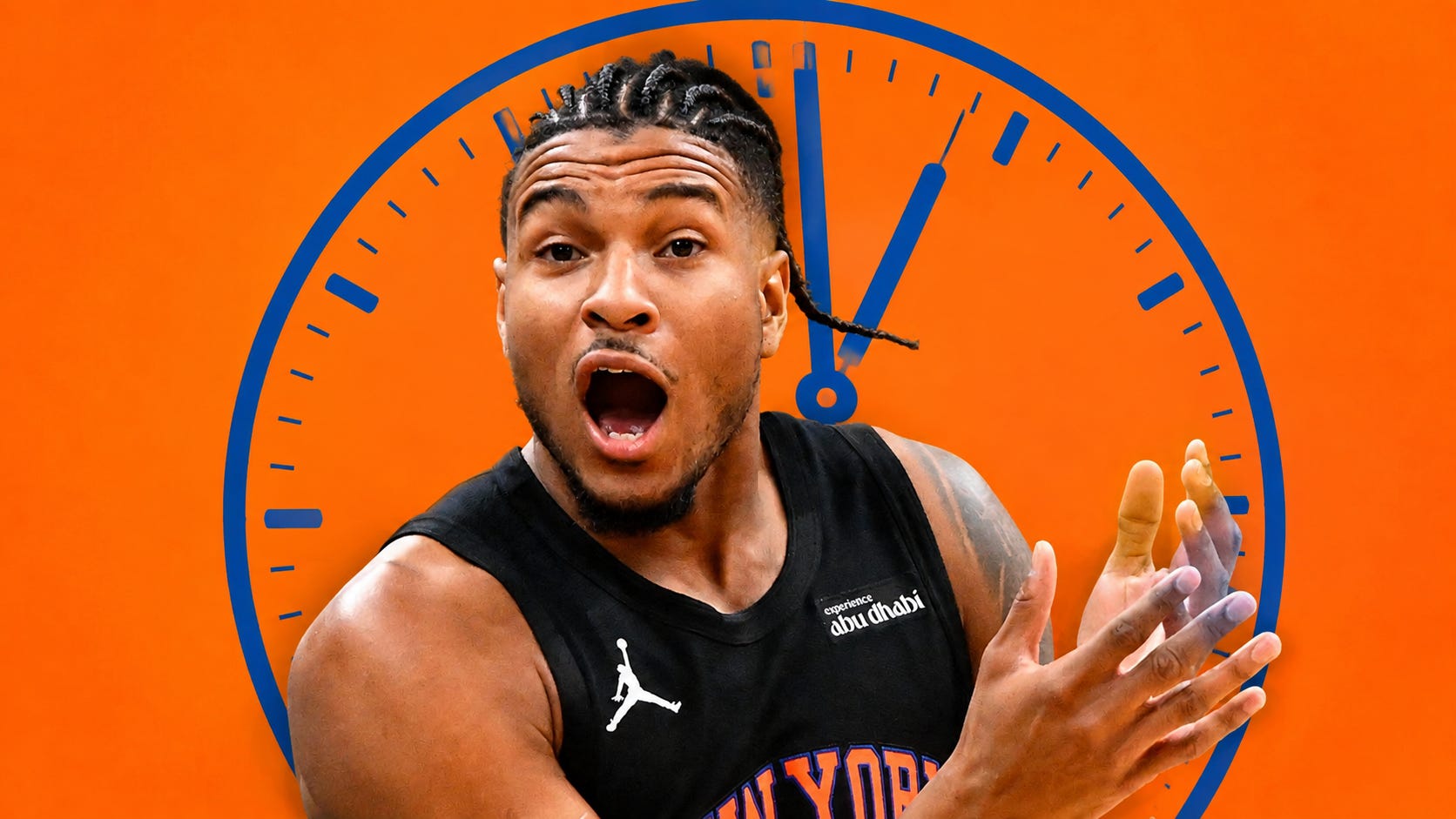
Lee Escobedo of The Knick of Time Show finds three reasons the New York Knicks will trade guard Miles ‘Deuce’ McBride before the February 2027 deadline. The Knicks let an Aug. 11, 2026, extension deadline pass to keep McBride tradable. New York needs a backup center after Mitchell Robinson signed with Boston, and McBride’s $4 million salary is the only contract large enough to match one. The second apron prevents the Knicks from paying McBride’s next deal.
The countdown to Deuce McBride getting traded has officially begun. Stefan Bondy of the New York Post reported Tuesday that the Knicks and Deuce McBride wouldn’t be signing an extension today, and that August 11 served as a soft deadline for a deal. No drama attached. Nobody leaked that talks had collapsed. But it came and went, and Bondy explained that signing McBride after Tuesday means New York can’t trade him before February. Very interesting.
That rule exists so teams can’t extend a player and immediately flip the bigger salary in a trade for a more established player. Any veteran extension freezes the player for six months if it includes a first-year raise of at least 20%, annual raises above 5%, or a term of four years or longer. McBride trips all three, and there’s no clever workaround. Not even with Brock Aller at the helm. Deuce is making just under $4 million in 2026-27, the last year of a deal he signed back when he was fighting for minutes, and the raise he’s earned triples that at minimum.
So Tuesday was about locking him in now, or keeping him tradable through Feb. 5. Bondy pointed out that Karl-Anthony Towns and Josh Hart don’t have this problem, since their extensions can be built to stay under the thresholds. McBride can’t, and the Knicks knew that from the jump.
Bondy made a point of saying the two sides are still talking. But front offices tell you what they’re thinking through the things they refuse to give up, especially Leno Rose. But now, New York has given up on a discount for a 25-year-old who shot 41.3% from three on a title team.
Damn that second apron, man.
James Dolan settled the second apron debate on WFAN before free agency, saying the Knicks “cannot go into the second apron.” He offered to write a big check, but not for the second apron. Roughly $222 million dictates everything the team does, and the penalties reach well past the tax bill. Over the apron, you can’t aggregate salaries in a trade, can’t take back more than you send, can’t use the midlevel, can’t include cash, can’t finish a sign-and-trade. Nassssssssty work. If they finish a season above the second apron, the league freezes your first-round pick for seven drafts.
New York has paid for it twice this summer. Mitchell Robinson left for Boston on a three-year, $47.4 million deal because matching it would have crossed the line. Ariel Hukporti went to Philadelphia for one year and $3.4 million for the same reason. And two summers before that, Isaiah Hartenstein turned an almost identical backup role into $133.5 million in Oklahoma City while the Knicks could only watch.
McBride seems ot be on the same path. He signed his first extension for cheap, then outplayed the deal so badly that a raise became a given. New York has about $213 million committed to 11 players, and the only reason Towns’ $57.1 million and OG Anunoby’s $42.5 million fit at all is that Jalen Brunson signed for $37.7 million and reportedly left $100 million on the table doing it. There’s nothing left in the bank. Barring trading Mikal Bridges or Hart (Not happening), the Knicks can’t pay McBride what somebody else will. Which means somebody else absolutely will.
There’s a possibility the Knicks lose him for nothing. But Rose has never once done that. He turned RJ Barrett and Immanuel Quickley into Anunoby, Julius Randle and Donte DiVincenzo into Towns, Obi Toppin into second-rounders, and a stack of future firsts into Bridges. Selling early is how a team with no homegrown starters ended up with a parade.
The Knicks either find $20 million a year they don’t have, or they get something back for him in a trade while he’s still cheap. Perhaps that missing third center?
Speaking of which.
Andre Drummond will be a nice addition on offense and as a passing hub. But Robinson protected the rim and switched onto guards for stretches. Drummond rebounds. He also fouls.
We only got two true centers on a 13-man roster defending a chip. SNY’s Ian Begley reported earlier in the summer that New York had talked to multiple teams about a backup big behind Towns, and the rumor mill has stayed busy since, running through Kevon Looney, Moussa Diabate, and, three separate times, New Orleans’ Yves Missi. It’s likely a trade is happening before camp. At the latest, the deadline. The only question is whether that third center comes in a trade or on a non-guaranteed deal.
Rose ain’t breaking up the Jalen Brunson, Mikal Bridges, OG Anunoby, Josh Hart, and Karl-Anthony Towns. Don’t be stupid. Jordan Clarkson, Jose Alvarado, and Landry Shamet were all just resigned for cheap. That leaves Tyler Kolek, Pacome Dadiet, and McBride, and Dadiet spent the summer league dumping whatever value he had.
Kolek makes about $2.3 million, which limits who you can match. McBride’s contract is the biggest of the three. Four million could get you a rotation center. While $2.5 million gets you a third-stringer who cannot play in the playoffs beyond spot minutes. Which leaves Deuce. You can almost bank on McBride being used to eventually get their defensive center.
McBride was terrific last season. Career highs across the board: 12.0 points, 2.6 assists, 2.4 rebounds, 42.3% from the field, 41.3% from deep. His plus-9.5 net rating led every Knick who played 30 games or more. He picks up point guards 94 feet, gets over screens, and can switch onto bigger wings. Before their elimination game, Cleveland’s Head Coach, Kenny Atkinson, called the Knicks defense “elite.” He was describing Deuce.
His two best skills are movement shooting and point-of-attack defense. Lucky for us, there are partial answers on this roster to cover both. Alvarado plays the pest role well enough that Brown closed the biggest comeback in Finals history with him out there instead of Deuce. Shamet set an NBA record for 3-point percentage in a conference finals series. Tyler Nickel led summer league in scoring and moves off the ball exactly the way this offense wants. None of them is McBride, but aggregated, they cover most of what he does.
Kolek is a key contrast. He finished eighth in the league in assists per 36 minutes at 8.4, and nobody on this roster besides Brunson creates that way. You can approximate a 3-and-D guard by committee. You can’t fake a passer. Leon Rose gotta sort his assets by scarcity instead of quality, and the better player sometimes goes first, which is exactly the calculation that sent Barrett and Quickley to Toronto.
In the Finals, McBride scored 11 points across five games on 4-of-22 shooting and went scoreless over the final three. Front offices around the league watched that too, and if his price dropped, New York could hold him and wait on a hot November to boost it back up.
I don’t buy it, mostly because five games ain’t enough of a scouting report. Over 19 playoff games, McBride shot 37.5% from three and finished plus-141 in cumulative plus-minus while the Knicks posted the best defensive rating of the 2026 postseason at 104.9. He shot 42.3% from deep against Atlanta, 47.8% against Philadelphia, and closed out the Sixers with 25 points in Game 4, one of the great bench nights this franchise has ever produced. He did it while recovering from core surgery that cost him two months and, by his own admission, never really stopped hurting. Anybody watching film knows the difference between a fade and a decline. Be for real.
Second, people love him. The “DEUUUUUUCE” chant followed the Knicks into four opposing arenas. Deuce earned it the slow way, riding up to Bridgeport for G League games while nobody at the Garden knew his name. Trading him is going to feel awful.
It also isn’t going to stop anything. Sentiment didn’t save Robinson, who meant more to the defense than McBride ever meant to the offense, and it didn’t save Hartenstein.
Nothing became official on Aug. 11. Bondy said as much, and an extension can still land in six weeks.
They can’t afford McBride’s next contract, no matter how this season goes. They need a center, and they only have $4 million to work with. They’ve stockpiled enough shooting and perimeter defense to survive losing him.
Deuce McBride is one of the most beloved players in that building and the answer to the center question. That’s what’s going to make February spooky hours for Deuce and everybody who chants for him.
Did the Knicks and Deuce McBride agree to an extension on Aug. 11? No. Stefan Bondy of the New York Post reported that no agreement would come on Tuesday, though he stressed the two sides have not ended talks.
Why did Aug. 11 matter? It worked as a soft deadline. An extension signed after that date would carry a six-month trade restriction stretching past the February deadline, so passing on it kept McBride tradable this season.
Does that mean McBride will definitely be traded? No, and the Knicks have not said they want to trade him. It does mean New York deliberately kept the option open at a cost, which is the strongest signal available right now.
What extension terms trigger a trade restriction? A veteran extension freezes a player for six months if it includes a first-year raise of at least 20%, annual raises above 5%, or a term of at least four years. McBride’s next deal almost certainly includes all three.
Why can Towns and Hart extend without the same problem? Their extensions can be structured to stay under those thresholds. McBride can’t, because he is coming off a contract that pays him under $4 million.
Why do the Knicks need a center? Mitchell Robinson signed with Boston for three years and $47.4 million, and Ariel Hukporti left for Philadelphia, leaving Karl-Anthony Towns and Andre Drummond as the only true centers on a 13-man roster.
Why is McBride the piece that gets traded instead of Tyler Kolek? Salary. McBride makes just under $4 million, the largest movable contract New York has, and matching money is what unlocks a rotation center. Kolek’s roughly $2.3 million reaches nothing useful, and his secondary playmaking has no backup on the roster behind Brunson.
Can the Knicks just re-sign McBride next summer? Almost certainly not. James Dolan has ruled out crossing the roughly $222 million second apron, and New York already has around $213 million committed to 11 players. Isaiah Hartenstein and Robinson both left under the same math.
How good was McBride last season? He averaged career highs of 12.0 points, 2.6 assists, and 2.4 rebounds while shooting 42.3% from the field and 41.3% from 3. His plus-9.5 net rating led all Knicks who played at least 30 games.
Did his Finals slump hurt his trade value? Some, but the full body of work matters more. He shot 37.5% from 3 across 19 playoff games with a plus-141 cumulative plus-minus, including a 25-point closeout of Philadelphia, all while recovering from core surgery.
Lee Escobedo of The Knick of Time Show analyzes the Knicks’ Aug. 11, 2026, decision not to extend guard Miles “Deuce” McBride, first reported by New York Post reporter Stefan Bondy.
An extension signed after Aug. 11 would block a McBride trade until after the February deadline.
McBride averaged 12.0 points on 41.3% 3-point shooting in 2025-26, with the best net rating on the Knicks roster.
Mitchell Robinson’s departure to Boston left Karl-Anthony Towns and Andre Drummond as New York’s only centers.
Escobedo finds salary matching, not McBride’s Finals slump, drives the trade case.