
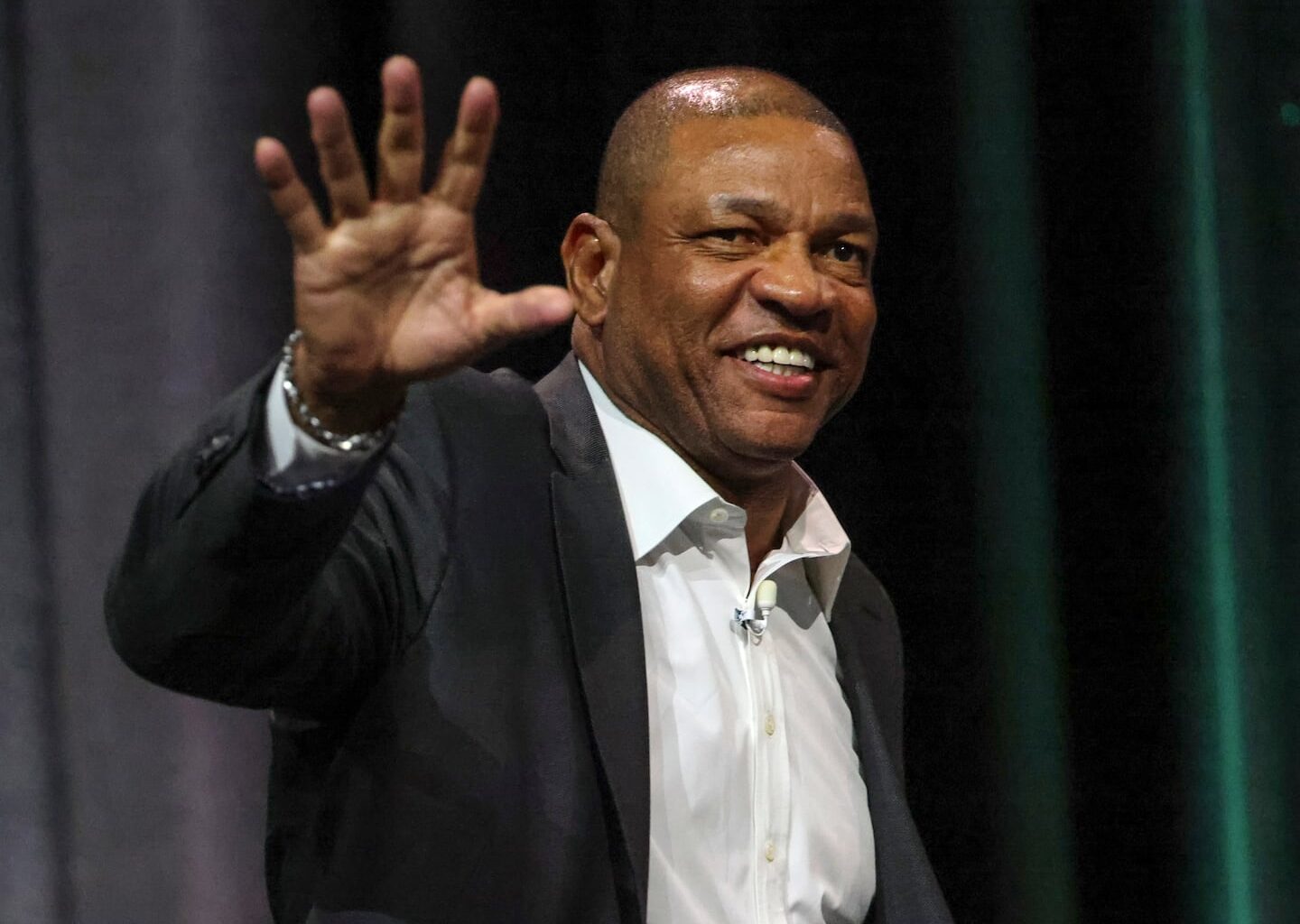
Rivers has been an NBA head coach for more than 40 percent of his life. He uplifted the Magic, taking the job at age 38. Along with president of basketball operations Danny Ainge, he resurrected the Celtics with Kevin Garnett, Ray Allen, and Paul Pierce, winning a championship in 2008, and losing in Game 7 of the Finals two years later.
Get Starting Point
A guide through the most important stories of the morning, delivered Monday through Friday.
Helped by the tutelage of Pat Riley and Gregg Popovich, Rivers became a standout coach whose career was filled with franchise rises, some playoff disappointments, the championship, and he also helped revolutionize modern-day players’ coaches.
Rivers gets teary-eyed about his humble beginnings. A kid from Chicago just trying to earn a college scholarship. His father making sacrifices at work to be his football, basketball, and baseball coach. His mother driving him to every game, and his parents attending all of his home games at Marquette.
“I’m sure when I talk about it on stage, it’s going to be hard for me to get through because I’m an emotional person,” Rivers told the Globe. “You think about your mom and your dad. And they were tough. My dad had this thing about no victims in the Rivers family. He just always said that. He would not let you sit [and stew], it was get over it, keep moving, accept it. Then my mom had this saying, ‘You’re right where you’re supposed to be,’ and that sounds great when you’re in a good place.
“But when you’re in a bad place, what she was basically saying was, ‘OK, well, you’re here because you earned it, and it’s not great but get out of it.’ I think being around that, that probably is why I’m here. It is why I’m here.”
Of course, Rivers will be most celebrated for that Celtics championship, galvanizing a group of talented players with a blend of veterans, and then youngsters such as Kendrick Perkins and Rajon Rondo, to reach the ultimate success. That’s when Rivers became most lauded, for his ability to relate to his players.
That required difficult conversations, especially with Perkins and Rondo, each of whom wanted more expanded roles than Rivers projected.
“Doc’s impact on my life was bigger than basketball,” Perkins told the Globe. “He was just what I needed as a young fella in the league, and what he was able to teach me, the sacrifice, the routine, being a star in my role.”
Garnett was the spiritual leader and demanded excellence from his teammates. But it was Rondo who had to be the floor leader at 21, running the offense to get the Big Three their desired touches. His relationship with Rivers was rocky at first because Rondo was headstrong and confident.
“He had to keep the coach happy, he had to keep the three stars happy, and he had to keep all the role players happy,” Rivers said. “That was easier for me, honestly, because I played with Moses [Malone] and Kevin Willis and Dominique [Wilkins, in Atlanta]. I understood that everybody wanted the ball, everybody wants to shoot.
“I told him point blank, ‘No is maybe your most positive word.’ There’s times that you are going to be unpopular in the locker room with your teammates, and you can’t worry about it. It’s just part of the territory, and I actually said you’ve got to be a [jerk]. Now we laugh at it because Rondo and I have this amazing relationship.”
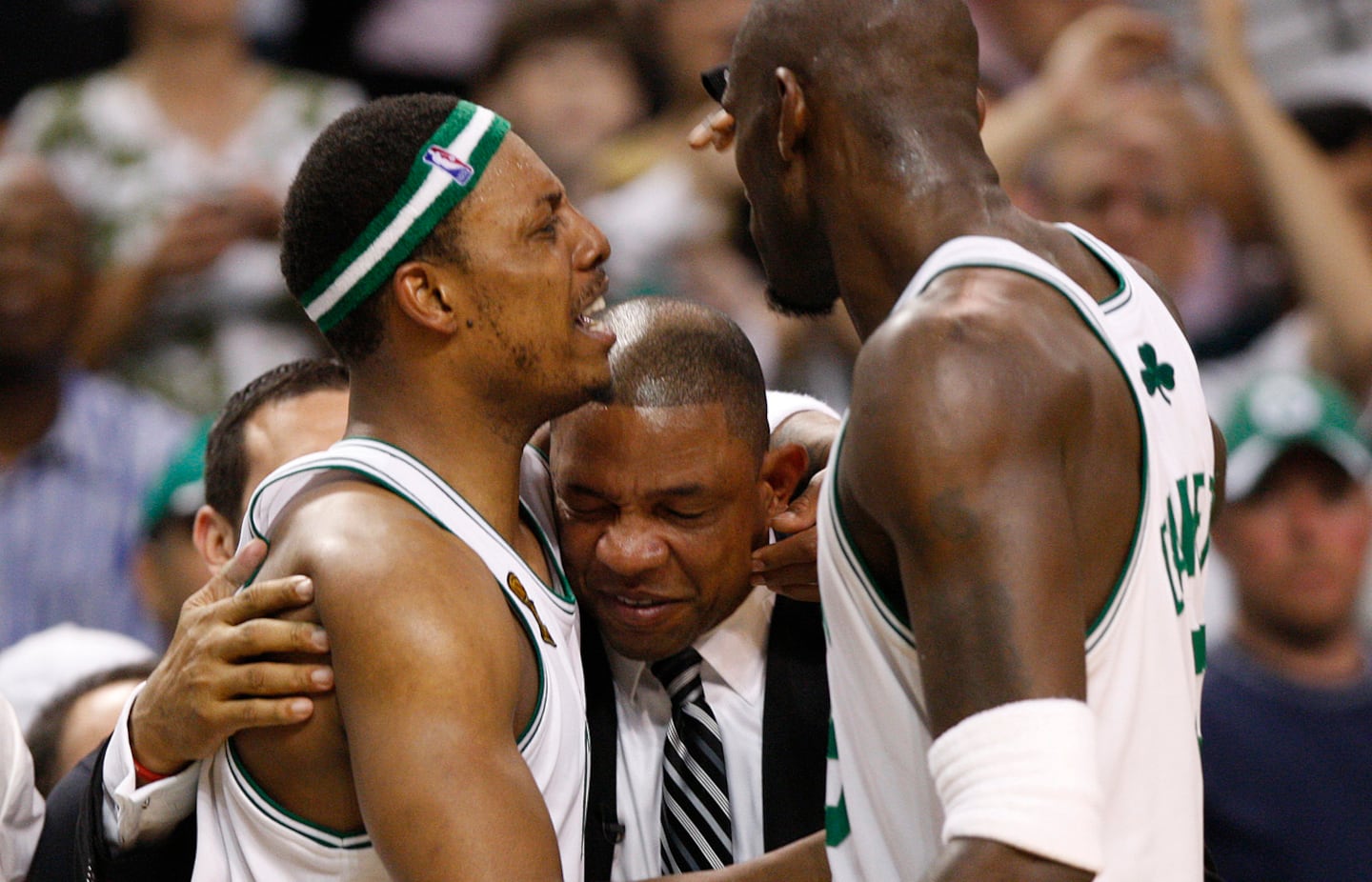 Doc Rivers coached the Celtics, led by Paul Pierce and Kevin Garnett, to the 2007-08 NBA championship.The Boston Globe/Boston Globe
The making of the 2007-08 Celtics required Rivers to speak with each of the Big Three about the desire to sacrifice. This was one of the first times in the modern-day NBA that three All-Stars had been put together with expectations to win immediately. Rivers had to make it work.
“I really felt like we had to establish what we were doing, what we were playing for, how we were going to play,” he said. “We had the conversation about shots. I think each guy the year previous averaged near 20 shots, and I said, well, clearly that’s not possible.”
Garnett was the first to agree, telling Rivers he didn’t need many shots. But Rivers also implored Pierce and Allen to play defense. They all checked their egos, along with Rondo, Perkins, and complementary players Tony Allen, Sam Cassell, P.J. Brown, James Posey, and Eddie House.
Said Rivers, “The thing that I love the most about that 2008 team, and I still challenge people today, to find a team that played that hard for 82 regular-season games and through the playoffs as we did.”
Of course, winning one more championship with the Big Three would have catapulted that group into Celtics immortality, on par with the Cowens-White-Havlicek clubs that won titles in 1974 and ’76. But Garnett suffered a serious knee injury in 2009, derailing what was a sparkling season, and then what was left of the title team fought valiantly to get back to the Finals in 2010, losing to the Lakers in seven.
“Kevin was never the same, and Perk gets injured in Game 6, tears his ACL, but yet we still had a shot,” Rivers said. “It’s spilled milk now, but I hated the way that game was called [by the officials]. If you remember, that game was so physical in the first half, and then in the second half, everything was called.”
The Lakers attempted 21 free throws (nine each by Kobe Bryant and Pau Gasol) in the final quarter, to the Celtics’ six, and won, 83-79. A second title in three years would have changed the perception of the second iteration of the Celtics’ Big Three, but Rivers and the players will have to be satisfied with the one championship, which made Rivers a Celtic for life.
“I’m a Celtic,” he said. “I’ll never not be. I coached there the longest, for nine years. I won the title, and if someone asks me what I am, I’m a Boston Celtic. I don’t think it’s close. I’m connected with the city. The team connected with the city.
“Listen, I’m biased, but maybe New York … but I don’t know … if you can pick the 30 franchises, and then you pick where you want to win at, it’s hard to beat Boston.”
Garnett, Pierce, and Allen will introduce Rivers at Saturday’s induction, and he’ll enter with the reputation of resurrecting franchises and bonding with his players, many of whom remain close.
“He’s a winner, despite what anybody’s got to say about him,” Perkins said. “What didn’t happen in the playoffs and all this [expletive], nobody cares. What people need to realize is Doc ain’t for everybody. But he was for me. He still is for me.”
Gary Washburn is a Globe columnist. He can be reached at gary.washburn@globe.com. Follow him @GwashburnGlobe.