

Basic instinct is to play the blame game when discussing the Nuggets’ salary cap crunch.
How did they get into this payroll dilemma, and which decision over the last few years is most responsible for it? Which contract or trade has limited their roster-building flexibility most in hindsight?
There was the Michael Porter Jr. extension inked by former general manager Tim Connelly, which will end up paying Porter $179.3 million over five seasons. Two front office regimes later, it cost the Nuggets an unprotected first-round pick to free themselves from the last two years of that contract.
Then there was the Zeke Nnaji extension in 2023, a four-year, $32 million deal that proved to be one of the defining transactions of Calvin Booth’s tenure. Halfway through the term of that contract now and six years into his career, Nnaji still hasn’t solidified himself as a reliable rotation player, rendering him almost impossible to trade. The roster’s sixth-highest salary was seated on the bench for almost the entirety of Denver’s first-round playoff defeat in April.
There was the two-year Reggie Jackson contract that used up Denver’s taxpayer mid-level exception, curiously included a player option and eventually forced Booth to cough up three future second-round picks to salary-dump the veteran point guard. And there was the decision to trade away another three second-round picks to move up six spots in the 2024 draft for a non-lottery prospect who hasn’t panned out yet. And the long-term commitments made to Aaron Gordon and Jamal Murray, who will make a combined 50% of the salary cap next season.
Now it’s Christian Braun’s five-year, $125 million deal — the first extension handed out by lead executives Jon Wallace and Ben Tenzer — that has emerged as the latest lightning rod among Nuggets fans, mostly because of who didn’t get extended as a result. Peyton Watson and Denver are stuck in a negotiating stalemate this summer, while the trade value of Braun’s new contract has been heavily scrutinized following a down year for the shooting guard.
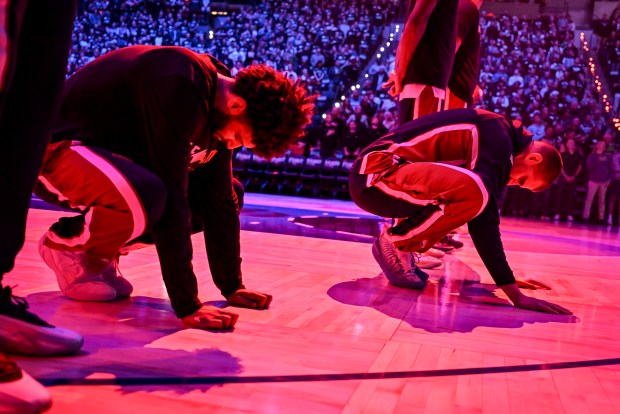 Jamal Murray (27) and Nikola Jokic (15) of the Denver Nuggets stretch before Game 6 of their NBA Playoffs series against the Minnesota Timberwolves at the Target Center in Minneapolis, Minnesota on Thursday, April 30, 2026. (Photo by AAron Ontiveroz/The Denver Post)
Keeping the band together
The truth, of course, is that Denver’s sticky second-apron situation is the sum of all those moves, not a direct consequence of one of them. It’s also the price that every championship team seems to pay for success under the rule of the 2023 collective bargaining agreement. Just this summer, Knicks owner James Dolan declared “you’d have to be suicidal” to spend over the second apron as his team was trying to bask in the afterglow of a dominant title run. Sure enough, New York let Mitchell Robinson walk in free agency — then watched as the 2025 champions (OKC) salary-dumped three players for the same reason Dolan outlined.
“This was a financial decision,” Thunder general manager Sam Presti told the Oklahoman in a surprisingly blunt on-the-record confession after trading Lu Dort, Isaiah Joe and Aaron Wiggins.
As soon as confetti rained on the Nuggets in 2023, every key player who had contributed to the historic scene at Ball Arena suddenly became more expensive. For those who were part of the front office’s long-term vision, their importance to the franchise would show on their next contract. Denver’s margin for error in roster construction shrank to near-zero in that moment.
The Nuggets have been reckoning with that margin for error for three years now, a period in which their contract extensions have also revealed a stubborn (perhaps even admirable) determination to win again with as many of those key players as possible — the sentimentality of a seemingly bygone era.
It’s getting increasingly difficult to keep those players. If Denver eventually manages to re-sign Watson, the 23-year-old wing might prove to be more expensive than just the dollar amount of his extension.
As all of this apron tension bubbles closer to the surface, so does the question of how Denver plans to get out of this before it gets worse. If Nikola Jokic stays true to his word, he’ll sign the most lucrative contract in NBA history next summer to remain a Nugget. Building around that contract and remaining a serious championship contender into Jokic’s late 30s will the long-term challenge for Wallace and Tenzer. If they’re also building around several other expensive salaries, their flexibility will continue to be hindered.
Is a more dramatic roster overhaul looming in the near future?
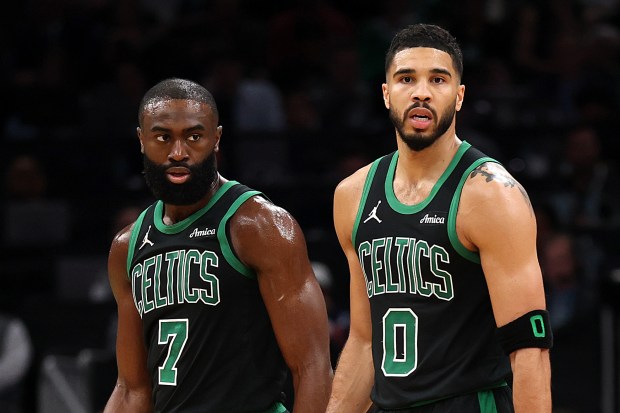 Jayson Tatum #0 of the Boston Celtics and Jaylen Brown #7 look on in Game Five of the Eastern Conference First Round NBA Playoffs against the Orlando Magic at TD Garden on April 29, 2025 in Boston, Massachusetts. (Photo by Maddie Meyer/Getty Images)
Pricey pairs
One transaction earlier this offseason was particularly illuminating as a possible precedent-setter. At the very least, it’s a relevant, if controversial, move for teams like Denver to study.
The Jaylen Brown trade.
Before the Celtics shockingly shipped him off to Philadelphia for Paul George and picks, The Denver Post outlined the uncanny similarities between Brown’s status in Boston and Jamal Murray’s in Denver.
Both were drafted in 2016, four picks apart; they’ve enjoyed arguably the two best pro careers in their draft class. Both were instrumental in their teams’ slow and steady ascents from the basement of the league to its pinnacle. Both demonstrated the qualities of a playoff riser as the No. 2 option on a championship squad nearly a decade into their careers. Both turn 30 next season. Both have three years remaining on their current max contracts (Brown’s is a supermax), with no player or team options.
All the discourse this summer surrounding Brown’s impact on winning, or lack thereof, has existed within the unspoken context of the CBA. The argument against him isn’t that analytics view him as a bad player. It’s that analytics suggest he’s not worth an average annual value of $61.7 million for the next three seasons. It’s a good old-fashioned “Moneyball” case study. Especially with Celtics co-star Jayson Tatum already taking up 35% of the salary cap on his own supermax contract.
“The path looked a little bit more challenging with 70% of our cap and such a high percent of our usage tied into two players,” Boston executive Brad Stevens said in July.
And that’s before considering the contract extension dynamics with an entrenched star like Brown, who might’ve believed he was owed another max offer by Boston as a gesture of respect. Trading him wasn’t only about his salary for the next three years; it was also a clear admission by Stevens that he didn’t want Brown occupying 35% of the cap at 35 years old. Hence Boston’s willingness to take back Paul George in the deal — another bloated salary ($55 million on average for two more years), but one that doesn’t carry the baggage of a 10-year relationship, of expectations for more long-term commitment.
George will be 38 next time he’s a free agent, assuming he picks up his player option next summer. It’s widely understood that if he signs another NBA contract, it will be for much less money.
Two months ago, Murray became eligible for a 35% supermax extension for the first time in his career by making an All-NBA team. (His current max contract is worth 30% of the cap.) Will he expect Denver to offer him that when the time comes, and will the Nuggets want to pay that much for a secondary star in his mid-30s? Will they even want to commit 30% of the cap to him for another chunk of years, with Jokic already on a supermax? The Celtics didn’t.
And the Celtics chose to get out in front of it, knowing the optics and knowing the risk. Stevens candidly acknowledged to reporters that his decision could age poorly.
Even through a short-term lens, the widely respected GM did make a salient point about trying to win with two max players in a restrictive system.
These are the two most expensive salaries on every NBA team entering the 2026-27 season:
Team
Player 1 (2026-27 cap)
Player 2 (2026-27 cap)
Combined cap hit (% of cap)
Warriors
Steph Curry ($62.6 million)
Jimmy Butler ($56.8 million)
$119.4 million (72.4%)
76ers
Joel Embiid ($58 million)
Jaylen Brown ($57.7 million)
$115.7 million (70.2%)
Celtics
Jayson Tatum ($58.5 million)
Paul George ($54.1 million)
$112.6 million (68.3%)
Nuggets
Nikola Jokic ($59 million)
Jamal Murray ($50.1 million)
$109.1 million (66.2%)
Heat
Giannis Antetokounmpo ($58.5 million)
Bam Adebayo ($49.5 million)
$107.9 million (65.4%)
Wizards
Anthony Davis ($58.5 million)
Trae Young ($49.5 million)
$107.9 million (65.4%)
Cavaliers
Donovan Mitchell ($50.1 million)
Evan Mobley ($50.1 million)
$100.2 million (60.7%)
Knicks
Karl-Anthony Towns ($57.1 million)
OG Anunoby ($42.5 million)
$99.6 million (60.4%)
Pacers
Tyrese Haliburton ($48.9 million)
Pascal Siakam ($48.9 million)
$97.8 million (59.3%)
Jazz
Jaren Jackson Jr. ($49 million)
Lauri Markkanen ($46.1 million)
$95.1 million (57.7%)
Kings
Zach LaVine ($49 million)
Domantas Sabonis ($45.5 million)
$94.4 million (57.3%)
Suns
Devin Booker ($57.1 million)
Jalen Green ($36.3 million)
$93.3 million (56.6%)
Raptors
Kawhi Leonard ($50.3 million, pending probe)
Scottie Barnes ($41.8 million)
$92.1 million (55.8%)
Lakers
Luka Doncic ($49.5 million)
Austin Reaves ($41.2 million)
$90.7 million (55%)
Timberwolves
Anthony Edwards ($48.9 million)
LaMelo Ball ($40.8 million)
$89.7 million (54.4%)
Magic
Franz Wagner ($41.8 million)
Paolo Banchero ($41.2 million)
$83 million (50.3%)
Thunder
Chet Holmgren ($41.2 million)
Jalen Williams ($41.2 million)
$82.5 million (50%)
Clippers
Darius Garland ($42.2 million)
Brandon Ingram ($40 million)
$82.2 million (49.8%)
Rockets
Kevin Durant ($43.9 million)
Alperen Sengun ($35.6 million)
$79.5 million (48.2%)
Spurs
De’Aaron Fox ($49.5 million)
Devin Vassell ($27.5 million)
$77 million (46.7%)
Trail Blazers
Ja Morant ($42.2 million)
Jrue Holiday ($34.8 million)
$77 million (46.7%)
Pelicans
Zion Williamson ($42.2 million)
Jordan Poole ($34 million)
$76.2 million (46.2%)
Nets
Michael Porter Jr. ($40.8 million)
Julius Randle ($33.3 million)
$74.1 million (45%)
Pistons
Cade Cunningham ($50.1 million)
John Collins ($17 million)
$67.1 million (40.7%)
Bucks
Tyler Herro ($33 million)
Myles Turner ($26.6 million)
$59.6 million (36.1%)
Mavericks
Kyrie Irving ($39.5 million)
PJ Washington ($19.8 million)
$59.3 million (36%)
Grizzlies
Jerami Grant ($34.2 million)
Kentavious Caldwell-Pope ($17.7 million dead cap)
$55.8 million (33.9%)
Hawks
Jalen Johnson ($30 million)
Dyson Daniels ($25 million)
$55 million (33.4%)
Hornets
Coby White ($26.8 million)
Naz Reid ($23.3 million)
$50.1 million (30.4%)
Bulls
Josh Giddey ($25 million)
Nic Claxton ($23.3 million)
$48.3 million (29.3%)
The last eight teams to reach the NBA Finals did so with their two most expensive players occupying 60% or less of the cap.
2026: Knicks (59.9%) vs. Spurs (41.8%)
2025: Thunder (46.9%) vs. Pacers (60%)
2024: Celtics (54.1%) vs. Mavericks (57.4%)
2023: Nuggets (52.8%) vs. Heat (55%)
 Jamal Murray (27) and Nikola Jokic (15) of the Denver Nuggets shake hands during the second quarter against the Minnesota Timberwolves at the Target Center in Minneapolis, Minnesota on Thursday, April 23, 2026. (Photo by AAron Ontiveroz/The Denver Post)
Can the Nuggets be an outlier?
The defining transaction behind New York’s championship was Jalen Brunson’s decision to sacrifice millions of dollars on his most recent contract; the Knicks were able to build a more complete starting lineup and a deeper bench with their best player earning the third-most in salary
It’s notable that their highest-paid player, Karl-Anthony Towns, is currently extension-eligible but hasn’t signed. Brunson probably isn’t going to give Dolan another bargain on his next extension. The Knicks must now operate under the assumption that Brunson will be playing on a supermax in the next couple of years. Planning accordingly means playing hardball with KAT — or trading him.
The Spurs have similarly capitalized on a mini-window with Victor Wembanyama on his rookie-scale contract. It gets trickier in 2027-28, but even then, Wembanyama gave them a minor discount. He and De’Aaron Fox will make a combined 55.7% that season.
The Thunder won with Chet Holmgren and Jalen Williams both on rookie deals. Now, those two have 25% max extensions taking effect this season, which should suffice as a viable payroll structure for at least one more year. Then in 2027, Shai Gilgeous-Alexander’s supermax kicks in, and the top-heavy cap sheet gets dicey.
Boston won the year before Brown’s supermax took effect (and two years before Tatum’s). Denver won the year before Jokic’s took effect (and three before Murray’s 30% max). The similarities hardly feel coincidental.
By all of this logic, the top eight teams listed above are automatically disqualified from contention for the 2027 championship (including Boston, ironically). That would explain why Stevens was willing to trade a franchise cornerstone to a rival of all teams. Philadelphia already had a supermax player on the books, plus Tyrese Maxey making $40 million. Now the 76ers have the exact payroll structure that Boston seemingly wanted to avoid. The problem is that they also have VJ Edgecombe on a rookie deal and LeBron James for $3.9 million.
The real overarching lesson could be this: If a team is going to pay two players an exorbitant amount of finite money, it had better be supremely confident that those two players are a perfect fit together.
Of all the duos near the top of that 2026-27 chart, Jokic and Murray have proven themselves more worthy of a combined 66% cap hit than anyone else. They’re the only tandem in the top six with more than 60 games played together. Embiid and Brown; Tatum and George; Antetokounmpo and Adebayo; and Davis and Young are all brand-new pairings.
As long as Denver’s front office remains confident that Jokic and Murray’s offensive chemistry transcends their defensive shortcomings, maybe that’ll be enough to buoy their partnership. Maybe the belief will persist in Denver that Murray and Jokic can be an outlier.
Or maybe Stevens’ words will ring true with the Nuggets, and they’ll eventually feel forced to press the red button on their loyal payroll structure.
Want more Nuggets news? Sign up for the Nuggets Insider to get all our NBA analysis.