
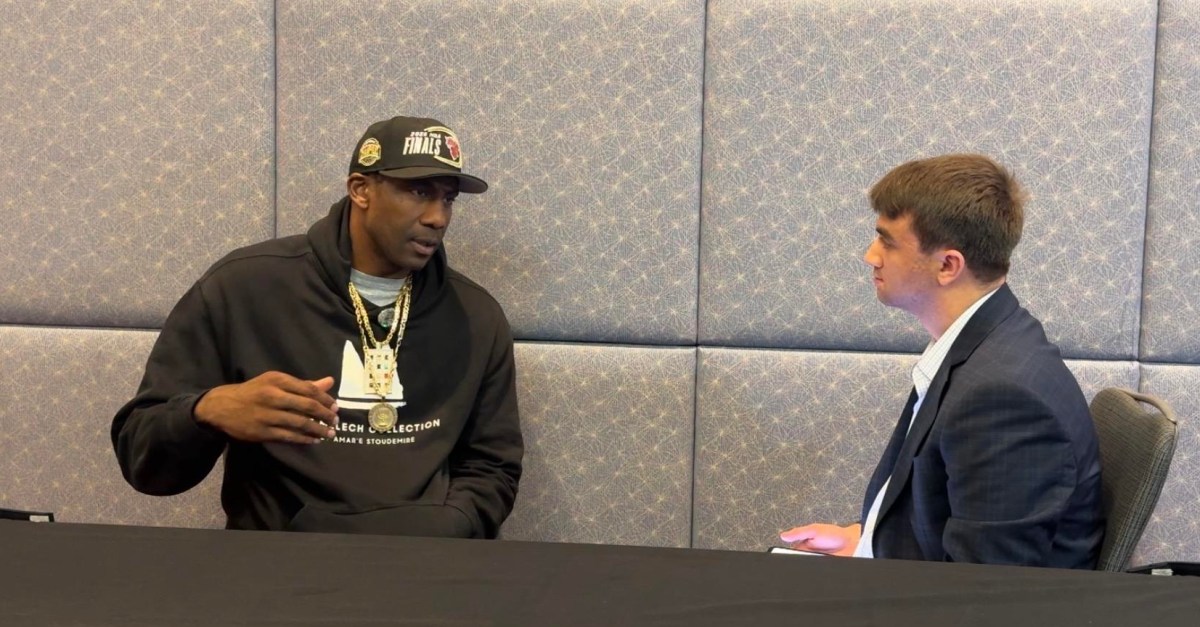
SPRINGFIELD, Mass. — The day before Amar’e Stoudemire was inducted into the Naismith Basketball Hall of Fame, Bright Side sat down with the five-time All-NBA selection and the six-time All-Star for a conversation about his time with the Suns, playing for Mike D’Antoni and what he’s feeling before his big day.
(The following answers have been lightly edited for brevity and clarity.)
You’re about to get inducted into the Hall of Fame. What are you feeling right now?
Amar’e Stoudemire: Tomorrow, I’m gonna feel probably even more ecstatic, right? I’m soaking in the moment. I’m really cherishing the time. I’m walking slowly. I’m enjoying my family. I’m watching their faces, see all the other Hall of Famers that are here, and just really soaking in the moments and really taking my time with that.
When did you realize you were gonna be a Hall of Famer?
AS: Well, you always try to reach for the stars when you’re a player, right? You set goals and you try to accomplish those goals, and it’s never easy to accomplish those goals. So I always had high goals set for myself when I was a kid, and it kept me straight. You know, it kept me focused, man. And I think because of that, I was able to persevere through a lot of things and be able to make it here to the Hall of Fame, so it’s great to be here.
It’s well documented how bad the Suns wanted you. How did that help you buy into the Seven Seconds or Less offense?
AS: I spoke to Coach Mike D’Antoni today, and he was like, “Amar’e, when I first mentioned the new offense to you, you really didn’t care. Like you wasn’t upset about the change that we’re making playing you at center.” And so, I was ready to go, man. I think you know, for us, I always looked at my coaches as leaders, as leadership, and so whatever they feel is the best for the team, but I was always willing to sacrifice or make that happen. So when Coach D’Antoni mentioned we’re going to play this style of basketball, I was like, all right, cool, let’s go. I can adapt to any type of basketball game or play, and so I was ready from the start.
For more on how hard the Suns pursued Amar’e Stoudemire:
How were you able to adapt in your career?
AS: I think for me, I wanted to be a team player. Obviously, I had goals and wanted to be the best and dominate and show the world how good I am. But I also was willing to be a team player, and I think for me as a leader, you want your teammates to be leaders also. I always tell my guys all the time, ‘Hey, I know I’m the franchise guy, but we all must be leaders here’. And so, with that being said, all of us, everyone can play at a high level and play their game and have fun. And that’s how you build the camaraderie. That’s how you build a championship-caliber team. And that’s what we did in Phoenix.
Was there a moment where it felt everything clicked?
AS:In training camp, when we got Steve Nash. When Steve came back to Phoenix and we started training camp, we all were in top shape, ready to go. And from training camp, we saw something special. We saw the style of play and the speed we were playing with. I was at my athleticism peak, and we had Shawn Marion, who was a brilliant floor runner and Swiss Army knife type of player, and Nash was the pass first guy who could get the ball to whoever was hot. So we took that mentality and ran with it. And I think I was surprised by how good we were.
How was having Scott Williams around for your first few seasons help you as a young player?
AS: Scott Williams’ mentorship was brilliant for me because I was a young player. I was 19 years old, and I had a lot of veteran guys around. Scott Williams is one of my veteran guys who I always leaned on and swept with and hung out with the most. Eddie Johnson, who is still doing the color commentator stuff, but EJ was one of the guys who I also spent a lot of time with. We had a security guy by the name of Kevin Tucker, and I call all those guys my “throwbacks”. I gave them the name throwbacks because I hang out with those guys. I was too young to go out to clubs and all these type of things, so I would hang out with those guys, and those guys would always give me positive leadership and information, and that helped stem me on the right path as far as what I needed to do as a player.
How did their mentorship carry with you the rest of your career?
AS: Those guys, man, was there with me. They were holding me down. They would talk to me about certain things. I’d be frustrated about certain games. They would talk about it, and we’d discuss it, and so my throwbacks were key for me.
What did the amount of change you had to deal with growing up teach you about how to adapt quickly?
AS: I grew up in poverty and I had to grow up fast. Had to raise my little brother. I had to do a lot of things far as maturity wise, and so I was able to somewhat figure that part out pretty quickly. I had the goals in mind of being an NBA player, and I also had my faith in God that was always very close to my heart. So with those tangibles that I had within me, allowed me to somewhat grow up fast with a sense of character, with positive character traits, and that helped me propel myself and get ready for the NBA.
Whose a player in the NBA right now that reminds you of yourself in how you needed to make many changes early in your career?
AS: I don’t see it. I mean, for me, I was a high school player who had a fearless attitude and I was just dominant from the start. And so, a lot of players are dominant, and I respect all the guys who are in the NBA because it’s not easy to get there. But I don’t really see that type of player, my style of play, in the league right now. I’m sure some guys have come along and fill that role, but I haven’t seen it yet.
No matter the industry, what is one piece of advice you give to people about the best ways to embrace something new, to be a team player?
The best advice I can give someone is to learn. Whatever it is you get yourself involved in, it’ll take time to be a student and learn, study, read, rehearse, review, and then once you’re ready for that, then you step into that role, ready to go, right? So that’s the most important thing: is being able to study about whatever craft or field you get into.
You can watch the full interview here: