
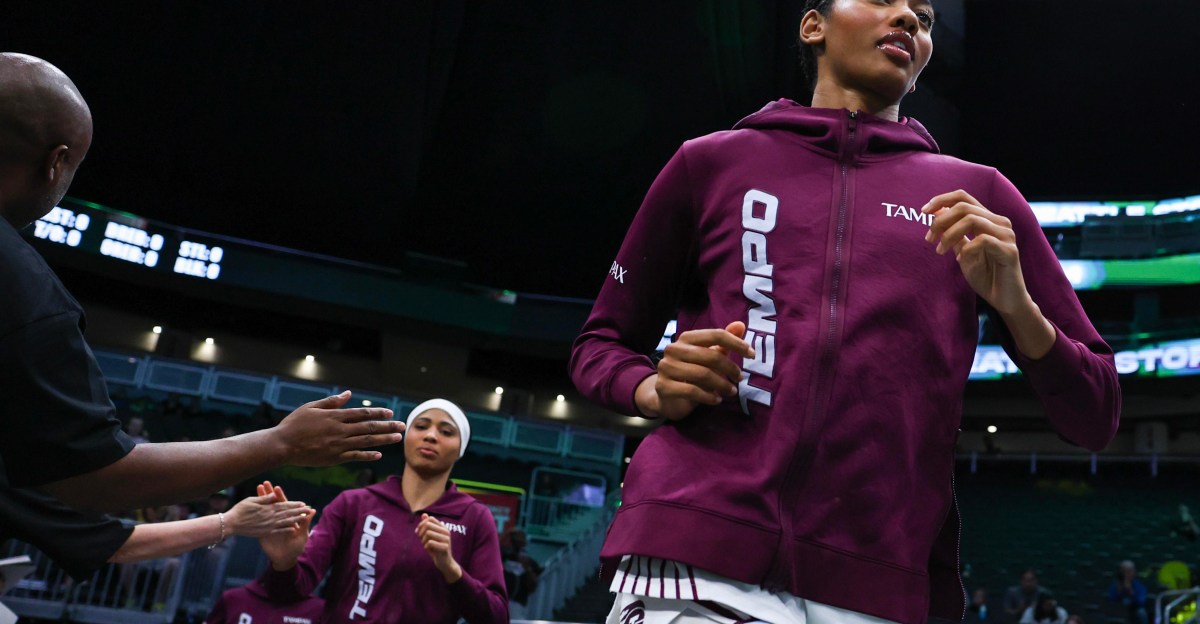
The FIBA Women’s World Cup break is finally here, mercifully so for the last-place Toronto Tempo (11-29). While several players (Julie Allemand – Belgium, Maria Conde – Spain, and Nyara Sabally – Germany) and coaches (head coach Sandy Brondello leads Australia and associate head coach Olaf Lange helms Germany) are off to Germany for the tournament, it’s an opportunity for the rest of the team to regather itself. Assistant coach Brian Lankton will lead team activities for those still in Toronto, per TSN’s Chelsea, Leite, but realistically, the season is just about over.
Toronto looked the part of a last-placed team over the weekend, falling 93-73 to the Las Vegas Aces on Friday night before an even more lacklustre performance in a 101-69 loss to the Phoenix Mercury on Saturday. An expansion team losing both games of a back-to-back against last year’s finalists isn’t necessarily unexpected, but it’s all the more so as Toronto plays without a large chunk of its roster. The Tempo’s injury report is full nightly: the team has missed the third-most games to injury of any franchise this season, per The IX’s injury tracker.
It’s also relatively to be expected since Toronto has an eye toward securing high odds in next season’s draft lottery. As a reminder, four games remain for the Tempo upon the league’s return from the World Cup break on September 17, and losing all four would see Toronto secure at least a share of the top lottery odds and a chance to land presumptive top pick JuJu Watkins. It’s not that the team isn’t trying; it’s just that the team is situationally aware, as it recognizes the trajectory of the season.

Just because it doesn’t benefit the Tempo to win their last four games (home vs. Indiana and New York, away at Chicago and Connecticut) doesn’t mean there aren’t other wins to collect in the last stretch of the season. Chief among these is player development, in which Toronto seems to have found a future star in Kiki Rice and on which the team can focus with the need to win now removed. Developmental players Ornella Bankole and Zaay Green both played real minutes over the weekend, as did extreme hardship signing Kiana Williams (for the Tempo’s purposes, a chance to evaluate her) and second-round pick Teonni Key.
Let’s focus on Key’s offensive development. The 23-year-old Kentucky product, part of the Tempo’s heavily utilized rookie cohort, is one of the roster’s youngest players and also one of its tallest (six-five). Key has been the fourth big on the depth chart behind Sabally, Temi Fagbenle, and Isabelle Harrison.
I suspect that Key’s first appeal to the Tempo was/is her defensive upside: Key’s length and agility for her size offers high upside for a modern defensive big. She’s flashed some of those traits as a rookie: Toronto has been 6.34 points per 100 possessions better defensively with Key on the court than off it, and, in part due to her 92nd-percentile block rate, the defence has conceded at-rim field goals at a 3.5 per cent lower efficiency with Key on the court than off it (pbpstats). There’s room to grow, naturally, from help decision-making and foul rates—normal for young bigs—to simply gaining more experience in the backend of professional pick-and-roll (she can lean into her athleticism to fake-step-and-recover more often).
But Key’s offence is the larger question as she heads to join Georgia Amoore and the WNBL’s Perth Lynx over the offseason. Three-point shooting is one thing: Key is 3/19 (15.8 per cent) with the Tempo after shooting 13/60 (21.7 per cent) in two years at Kentucky (she transferred from North Carolina). Free-throw shooting is another: just 52.6 per cent on 19 attempts in the WNBA after dropping to 69.8 per cent (96 FTA) as a senior from 77.4 per cent (84 FTA) as a junior (her professional 13.8 per cent FT Rate isn’t far from her 15.8 per cent rate at Kentucky).
Any playmaking answers Key provides will be welcomed as a bonus. Her assist and turnovers metrics are actually improvements on two Kentucky years of 0.6 assist-to-turnover ratios, sub-10 per cent assist rates, and ~20 per cent turnover rates. Key’s overall low usage lessens her turnover impact, and there’s a nice fit with Toronto’s handoffs and zoom actions, but general growth as a connector and play-mover (flashed at times with the handoff game) wouldn’t be amiss.
Most important, perhaps, is Key’s overall efficiency, which largely hinges on her two-point finishing. Her college trajectory was positive: she increased her points per possession every year in college, and she shot 66.1 per cent on “close 2s” at Kentucky, per barttorvik. But the trajectory of Key’s 0.68 points per possession (2nd percentile) and two-point shooting (44.6 per cent 2P, 19th-percentile 55 per cent restricted area, per HerHoopStats) will be critical to maximizing her defensive impact as well as her plus offensive rebounding.
I tracked 54 of 56 two-point field goals Key has taken this year to see what might be going on. That positive offensive rebounding (both personal and team impact) has led to points: she’s scoring 1.25 points per shot generated by an offensive rebound. But on other self-created looks, the ball hasn’t found its way to the bucket. Setting aside three midrange jumpers (33 per cent FG), Key is averaging 0.75 points per shot (37.5 per cent FG) on self-created attempts, not including two turnovers, and has struggled especially on drives (0.6 PPS/30 per cent FG).
She’s made some impressive shots, but continuing to be discerning about how—and whom—she attacks in isolation will help. Of her 22 rim makes, 59.1 per cent have been assisted, which ranks 65th among 109 players with 40+ rim FGA, which is the fifth-lowest assist rate among bigs. A higher rate of those could raise her efficiency: on non-self created shots (cuts, rolls, rim attempts originating in the dunker spot, etc.), Key is up to 0.96 PPS (48.1 per cent FG).
Again, the ability is there; the consistency can develop there too. Key ranks 93rd in that same 109-player sample size with a 62.9 per cent unblocked rim FG% (fourth-worst among bigs), meaning that there is low-hanging fruit to capitalize on and thereby easily boost the efficiency numbers. One other thing that might help: playing with a touch more patience. Of the 54 charted attempts, only one showed a semblance of a shot-fake; 12.5 per cent of her rim attempts have been blocked 21st of 109 and 6th-highest among players Key’s height or taller. Short midrange attempts tell the same story: 30.8 per cent blocked, fifth in the 109-player sample size.
The first clip, the could-be fake, at the very least enables Key to absorb contact from a smaller defender before finishing and also enables her to jump off two feet vertically; contrast with two attempts where I (very subjectively!) thought a fake might have been beneficial, either in diverting a shot blocker or in steadying the footwork after jump stops directly leading into the shot attempt.
However Key can get them, fewer blocked attempts and more free throws would be excellent development. That’s the sort of win the Tempo will prioritize to close out the season after the World Cup, and that’s the sort of thing Key can work on over the long offseason to come.