
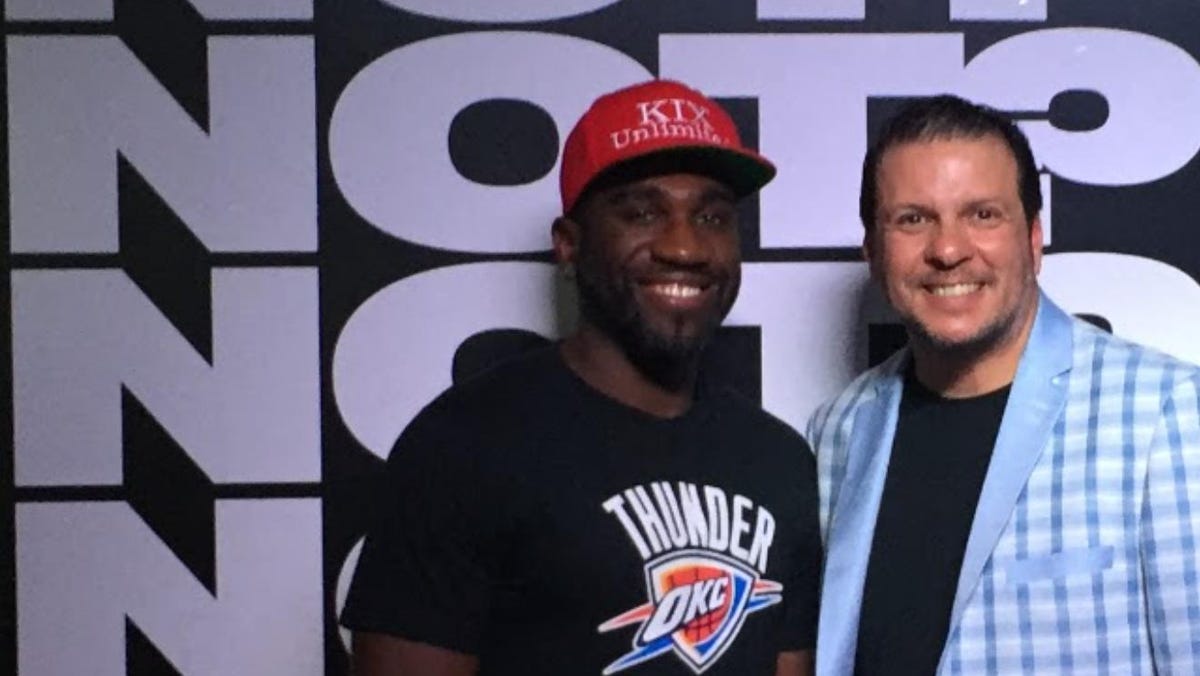
Rob Shahan wants the Thunder to take care of business in the NBA Finals.
But if it needs an extra game or two to do so, he’d be fine with that.
Shahan is known by many as Oklahoma City superfan Thunder Rob, sitting behind the basket near the Thunder bench, wearing a distinctive white fuzzy bucket hat with jewel-encrusted sunglasses and chains. He regularly brings fun signs, too, including one when the Thunder clinched the Western Conference finals alerting his boss that he’d be late for work the next day.
Needless to say, he’s all in on the Thunder.
But he’s all in on helping his friend Dexter Murphy find a new kidney, too.
“He is one of the best guys you’ll ever meet,” Shahan said.
Shahan, who has built a social media following among Thunder fans, has committed to using the hashtag #MyFriendDexterNeedsAKidney at every opportunity. And the longer the Thunder plays, the more opportunities there are to share his friend’s story.
“I’m on a mission,” Shahan said. “I love the guy, I love his family, and I’m going to find him a kidney.”
Dexter Murphy would like nothing more.
He and Shahan became friends when they worked together at Tinker Air Force Base. Even though Murphy changed jobs and left the base, then returned to Tinker in another office, the two remained close.
One of the biggest pieces of connective tissue?
Basketball.
“He’s always been a big Thunder fan, and I’m a big Thunder fan, too,” Murphy said, “so we kind of still connected that way.”
But one day in February, Murphy shared unexpected news with Shahan.
Murphy had gone to the eye doctor for a follow-up appointment after having laser eye surgery, and when they took his blood pressure, the numbers were extremely elevated. They were so high that the doctor told Murphy to go to the hospital immediately.
“And I’m feeling fine,” Murphy said.
He drove himself to the hospital, calling his wife on the way to tell her what was happening.
Once he got to the emergency room and had his blood pressure taken again, the seriousness of the situation began to set in — his systolic number was above 230 while his diastolic number was above 100.
Numbers below 120 and 80 are considered normal.
“You’re about to stroke out,” Murphy remembers being told.
“I am?” he asked, still feeling normal.
“You’re getting admitted right now.”
Murphy had dealt with headaches before, but with his side venture, DM Sports Media Marketing, he does a lot of videography and photography. He always figured the headaches resulted from sitting in front of his computer, staring at the screen for hours on end.
In the end, Murphy was diagnosed with kidney failure and renal disease, the result of high blood pressure and a hereditary issue that damaged his kidney.
Murphy has been in and out of the hospital several times since, and he also started dialysis almost right away.
Right now, he does dialysis three times a week, and while he’s lost 20 or 25 pounds since the start of the year, he continues to work. He does remote work as much as possible and his sports marketing work when he has the energy.
“I just want to stay as normal as possible because, you know, your mind can drift and take you places where you don’t want to go,” Murphy said. “You just want to stay positive and just keep moving.
“I have more better days than worse days.”
Still, he knows more challenges are ahead. A kidney transplant is the long-term solution, and it will be a few more months before he starts going through assessments to evaluate his health and whether he’s a good candidate.
Once he’s on a transplant list, the wait could be six months or more.
But that process could be accelerated if Murphy finds a living donor. Because most humans are born with two kidneys, people can donate and maintain adequate function with only one of the organs.
Finding a compatible match, though, can be difficult.
That’s why Shahan has taken Murphy’s situation public — and why Murphy has been on board with it.
“All you gotta do is get in front of the right person,” Shahan said.
Most people would qualify to donate based on the minimum requirements from the National Kidney Registry: at least 18; in good health; normal kidney function; and no major physical or mental illness.
But first, people must register and go through the initial screening process to know if they’re even a match.
Murphy admitted it’s odd going through his daily routine never realizing if someone he crosses paths with might be a match. A co-worker. A neighbor. A church friend. A cashier at the grocery store.
“You don’t know,” he said.
But for anyone like Murphy who finds a living donor, the benefits go beyond wait times. Outcomes are better. The chance of rejection is lower while the chance of initial function is higher.
Finding a match for Murphy might be a long shot, but Shahan feels he must try.
“He needs a kidney, and I have a little bit of social media influence,” Shahan said. “I’m going to hype up the hashtag #MyFriendDexterNeedsAKidney every day during the playoffs.
“I’m going to find him a kidney.”
Regardless of what happens, it has meant a lot for Murphy to have his story shared.
“It just shows you people that you know really care about you,” he said. “Seeing other people reach out and just showing their love and that they want to help … it helps lift your spirit. It helps you to keep going. It helps you to keep pushing.”
Jenni Carlson: Jenni can be reached at jcarlson@oklahoman.com. Like her at facebook.com/JenniCarlsonOK, follow her at @jennicarlsonok.bsky.social and twitter.com/jennicarlson_ok, and support her work and that of other Oklahoman journalists by purchasing a digital subscription today.