
Getty
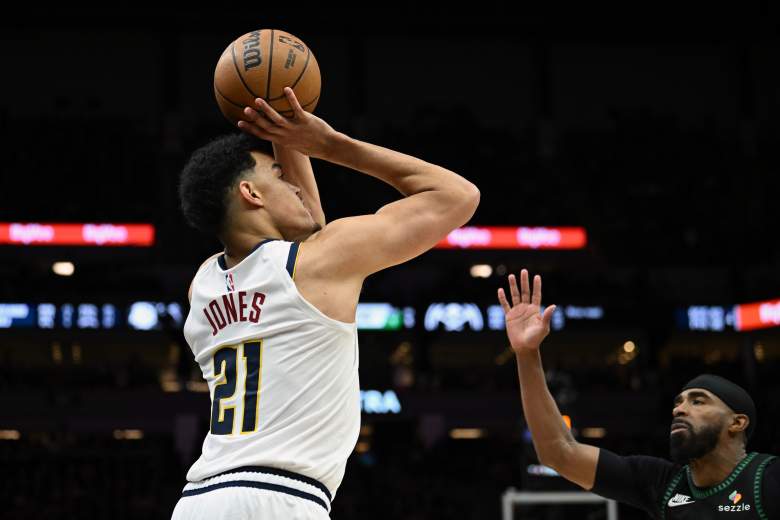
MINNEAPOLIS, MINNESOTA – APRIL 30: Spencer Jones #21 of the Denver Nuggets shoots the ball against the Minnesota Timberwolves during the second quarter of a game in Game Six of the First Round of the NBA Western Conference Playoffs at Target Center on April 30, 2026 in Minneapolis, Minnesota. NOTE TO USER: User expressly acknowledges and agrees that, by downloading and or using this photograph, User is consenting to the terms and conditions of the Getty Images License Agreement. (Photo by Stephen Maturen/Getty Images)
Last month, the Denver Nuggets chose to match the two-year, $12 million offer sheet that the Oklahoma City Thunder had extended to their two-year veteran guard, Spencer Jones.
Jones, previously on a two-way contract, had played his way into that payday, and the Nuggets’ rotation, through a combination of his play over his first two seasons in the NBA, and also through taking advantage of the Nuggets’ depth falling away around him as they drifted out of title contention. As more established vets kept leaving the team, he got more and more opportunities on the court, and yet as his exposure grew, his efficiency markers never wavered.
Last season, Jones shot 50.4% from the field and 39.6% from three-point range on his way to a white-hot .619 true shooting percentage, putting up stat lines like the modern day Bruce Bowen. (Even down to the free throw line misses.) But the most efficient part of Jones’s game is not measured by standard box score metrics. Jones is efficient not only in his shooting, low turnover rate and movement, but in how little he touches the ball – in fact, last season he did so less than anyone else in the NBA.

Usage Rate Like An Offensive Linemen
Per a graphic that Jones himself shared on his LinkedIn page, and from data via Databallr.com, Jones had the lowest on-ball percentage of any player in the NBA last season. As the name suggests, the stat measures the percentage of time a player possesses the ball while on the court, and as is the standard of nature of basketball, the names at the top of the list are all point guards; by way of example, the highest percentage in the league, 48.1%, belongs to T.J. McConnell of the Indiana Pacers.
When McConnell is in the game, though, he should be in possession of the ball, because as a non-shooter or athlete, he has no value off of it. Jones, by contrast, can space the floor, cut to the rim, get out and run, or serve as a half-court decoy. He does not need to touch the ball to be effective in the Cameron Johnson role.

The four players most immediately around him – Adem Bona, Mitchell Robinson, Jaxson Hayes and Karlo Matkovic – are athletic bigs and lob threats who neither seek nor merit much being called for them with the ball in their hands. And yet Jones, despite having more permission and opportunity to drive against a hard close-out or ball reversal, still manages to spend less on the ball than they do. Or indeed any other of the off-ball shooting specialists in the game today. There are a bunch of shooters in the modern NBA who rarely try to create with the ball in the hand, but Jones really does not. And he has found his role by making it as small as possible.
Jones’s Nuggets Career To Date
After five seasons at Stanford, the 6’7 Jones went unselected in the 2024 NBA Draft before joining the Portland Trail Blazers for summer league and subsequently signing a two-way contract with Denver. He appeared in 20 games as a rookie, averaging 1.3 points and 0.9 rebounds in 6.2 minutes per game. Jones’s opportunities were considerably greater with the Nuggets’ affiliate Grand Rapids Gold in the G League, where he averaged 17.5 points and 8.0 rebounds across 11 appearances.
Retained on another two-way deal for 2025-26, Jones as above became a regular member of Denver’s rotation. He played 64 games, starting 37, and averaged 5.5 points, 3.3 rebounds, 0.8 assists, 0.8 steals and 0.5 blocks in 22.1 minutes. As above, he shot 50.4% from the field and 39.6% from three-point range, including a career-high 28 points against the Dallas Mavericks in December. His performances earned him conversion to a standard NBA contract in February, and now the pay bump to being the $6 million man.
Jones subsequently started three of Denver’s six playoff games against the Minnesota Timberwolves, averaging 6.5 points and 2.0 rebounds in 24.2 minutes while shooting an extraordinary 68.4% from the field and 69.2% from three. Through two NBA seasons, he has played 84 regular-season games, averaging 4.5 points and 2.7 rebounds while shooting 48.3% overall. He earned his pay rise.

Mark Deeks I am continuously intrigued by the esoterica and minutiae of all the aspects of building a basketball team. I want to understand how to build the best basketball teams possible. No, I don’t know why, either. More about Mark Deeks