
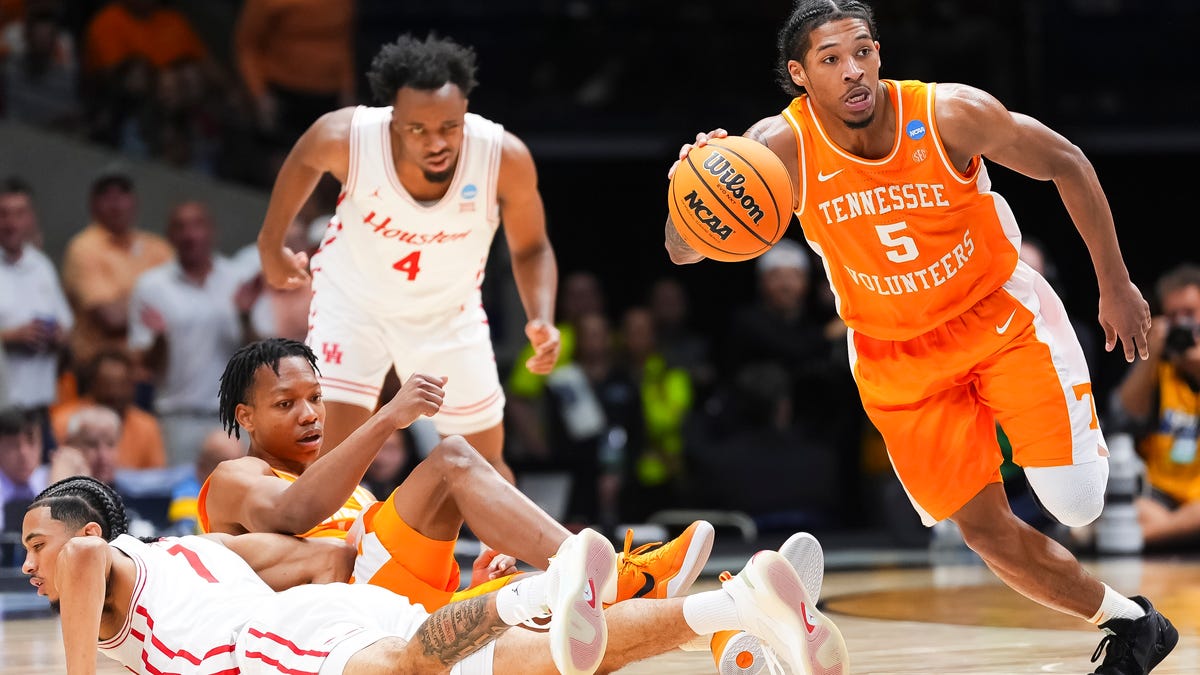
Tennessee basketball star Zakai Zeigler’s lawsuit against the NCAA has drawn an unlikely and formidable double team.
Zeigler filed a federal lawsuit in May arguing the NCAA should allow all student athletes a fifth year of eligibility, not just those who took a redshirt season when they didn’t play.
The NCAA filed a response to Zeigler’s suit June 2, arguing, in essence, Zeigler can’t have his cake and eat it, too. On June 3, the U.S. Department of Justice took the unusual step of weighing in to support the NCAA’s argument.
Zeigler’s lawsuit includes a preliminary injunction request that would allow him to talk to have the opportunity to join a team and add lucrative NIL deals while the lawsuit plays out. A judge will hear those arguments June 6.
Why is Zakai Zeigler suing the NCAA?
Zeigler ran out of NCAA eligibility at the end of UT’s March Madness run. His lawsuit attempts to allow him to return to college basketball in the 2025-26 season, including requesting an immediate temporary ruling on the grounds that he will suffer irreparable harm as schools are finalizing their rosters and settling NIL agreements.
Restricting Zeigler’s eligibility, he argues, is an antitrust violation. His attorneys use arguments that are similar to other successful lawsuits filed against the NCAA.
Zeigler says he could earn up to $4 million if he’s eligible in the 2025-26 season, based on an analysis from Spyre Sports Group.
Essentially, Zeigler’s lawsuit goes after the NCAA’s redshirt rule, which allows an athlete a fifth year of eligibility if they sat out a year of competition. Zeigler did not redshirt but argues he shouldn’t be punished for that decision.
“The lawsuit alleges that the NCAA’s rule permitting only four seasons of competition within the five-year eligibility window is an unlawful restraint of trade under federal and state antitrust laws,” Zeigler’s counsel from the Garza Law Firm and Litson PLLC said in a statement when the lawsuit was filed.
Zeigler’s attorneys previously argued, and argued again in a filing June 3, that the NCAA rules prohibiting a fifth year of play in a five-year-window excludes the players “at the precise moment their value peaks, artificially suppressing compensation for all student athletes while providing no offsetting competitive benefit.”
Zeigler, they said, “does not challenge the NCAA’s five-year eligibility window or argue that he should be able to compete for more than five years. He merely asks for the ability to compete for all five years of the NCAA’s eligibility window.”
NCAA and DOJ pair up
The NCAA argued other athletes who have successfully sued the NCAA, such as Vanderbilt football’s Pavia, sued for eligibility for seasons they weren’t a Division I athlete. Zeigler, however, has been a Division I athlete his entire collegiate career.
Zeigler, the NCAA argued, only got his chance to play at UT because another athletes exhausted their eligibility and opened up a roster spot for him. They called this the “lifecycle of a collegiate athlete.”
The NCAA argued that nothing would stop other athletes from suing the organization if it capped the eligibility at five years. They would sue to play for six years or seven years. It wouldn’t stop, they allege.
“Nevertheless, he asks this court to make him the first student athlete in history to be granted the opportunity to participate in a fifth season of DI competition as a matter of right,” they wrote.
The DOJ’s antitrust division filed a statement of interest in the case June 3. It argued, in essence, that rules governing the NCAA structure are vital and don’t violate antitrust rules, though the filing suggested the courts should not be afraid to use a flexible interpretation of the Sherman Antitrust Act in making a decision on the case.
“If an opposing school does not impose academic obligations on its players, it stands to gain a significant advantage on the field from a team of effectively professional athletes able to devote all of their time and energy solely to athletics,” the DOJ wrote. “Likewise, if a school does not limit the years of participation, it could field more experienced players and obtain advantages over rivals, which would discourage other teams from fielding younger players.”
Knox News reporter Mike Wilson contributed to this report.
Tyler Whetstone is an investigative reporter focused on accountability journalism. Connect with Tyler by emailing him at tyler.whetstone@knoxnews.com. Follow him on X, formerly known as Twitter, @tyler_whetstone.