

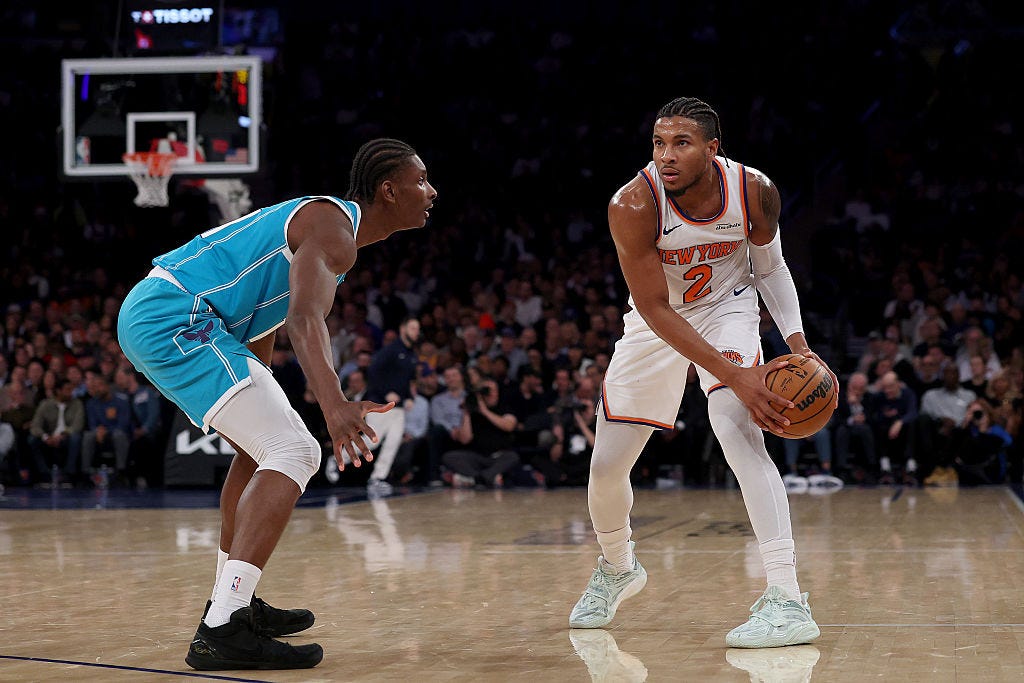
 Deuce McBride earns about $3.96 million this season and is the most tradeable contract on the Knicks roster before Feb. 11. Photo courtesy of Getty.
The New York Knicks need a backup center, and Charlotte’s Moussa Diabaté is the target linked to them most often. In a two-week email negotiation, Hornets writer James Plowright, speaking as Charlotte’s general manager, called Miles McBride plus three second-round picks fair basketball value for Diabaté but said Charlotte values him above market because of his standing with fans, pushing the price toward five or more second-rounders. When offered McBride and five second-round picks, Plowright declined, citing the 19 second-round picks Charlotte already controls over the next seven years and uncertainty about whether McBride would re-sign. He said a deal would require first-round compensation, a player with more contract certainty, or a third team. New York’s 2033 first-round pick was not offered. The NBA trade deadline is Feb. 11, 2027.
Almost every piece of Knicks trade news since July has hinted, no, pointed, at the same trade target. It’s fair to say I, too, am obsessed with the idea of Moussa Diabaté. In fact, as a Knicks fan, he is the only player I would be willing to trade the beloved Deuce McBride for.
A Diabaté for Deuce trade is pretty clean. It fills the backup center hole on the Knicks roster, the one Mitchell Robinson left when he signed with Boston. It also keeps New York under the second apron. I laid out the case two weeks ago, and it holds up as long as the other team doesn’t get a vote.
In the spirit of friendly competition, I gave Charlotte one.
From Sept. 8 to Sept. 21, I traded trade configurations with James Plowright, who covers the Charlotte Hornets for CLTure and Buzz Beat Pod. The rules were simple. I’d speak for the Knicks. He’d speak for the Hornets.
What follows is the exchange, edited for length and clarity.
Buckle up. Things get spicy.
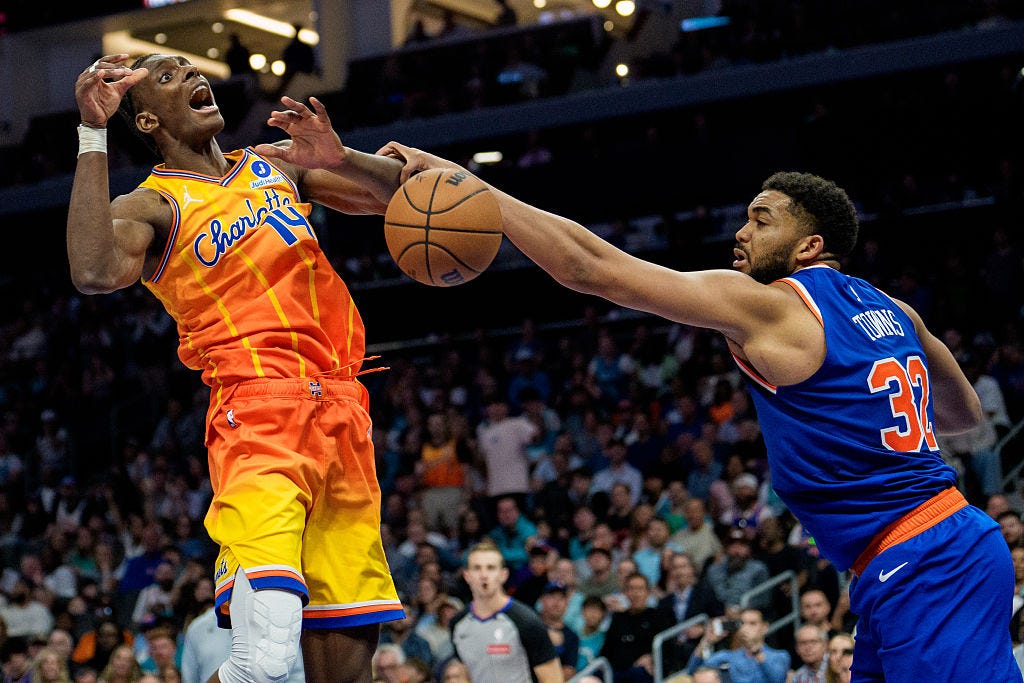 Karl-Anthony Towns and Andre Drummond are the only centers on the Knicks roster since Mitchell Robinson left for Boston. Diabaté would change that. Photo courtesy of Getty.
Lee: Which of your bigs would you realistically put in the “available in the right deal” bucket? Not your franchise center, but someone who could be a rotation-caliber five in New York.
James: Under Jeff Peterson, the Hornets have been one of the league’s more active front offices. They’re not desperately shopping players, but they’re certainly answering the phone. Here’s how I’d rank the bigs by organizational priority.
Hannes Steinbach comes first. The Hornets just spent a lottery pick on him in a deep draft, and he rewarded them with an impressive Summer League. It would take something significant to pry him away.
Moussa Diabaté is next. He was one of Charlotte’s most impactful role players last season, bringing energy, rebounding and defensive versatility that doesn’t always show up in the box score. The complicating factor is that he’s on a bargain deal but could be due for a substantial raise.
Then Ryan Kalkbrenner, a classic low-maintenance center who understands exactly what he is. He protects the rim, finishes around the basket and rarely tries to do too much. On a team-friendly rookie contract, that reliability carries real value.
And don’t overlook two-way big PJ Hall. Go back and watch his games against Chicago and Oklahoma City. He looked every bit like an NBA rotation player.
Lee: The Knicks aren’t asking about Steinbach. But I know they’ve inquired about Diabaté, and he’s my No. 1 target. I don’t want a third-string big. I want a backup five who can eventually start, which is essentially what we had when we signed Isaiah Hartenstein. Give me Diabaté and slide Andre Drummond to third string. Drummond is a good regular-season backup and a terrible playoff one.
Kalkbrenner, from your own description, reads like a third-stringer to me. Low maintenance, doesn’t do too much, understands what he is. Those are compliments for a guy who can play 14 minutes in April but not in May.
James: Doubts about Kalkbrenner’s postseason viability are entirely fair. But the best-case outcome is probably something like Luke Kornet, a highly effective role-playing center who anchors lineups, protects the rim and stays within his limitations. It’s also worth remembering that Charles Lee started Kalkbrenner ahead of Diabaté for the first 30 games last season. You don’t give that opportunity to a player you view as a third center.
Lee: It took Kornet seven seasons to become the player he was on Boston’s championship team. The Knicks don’t have seven seasons. I actually like the Kornet comparison for Kalkbrenner. That’s the problem.
Lee: How do you value Deuce McBride against Tyler Kolek from Charlotte’s side?
James: That’s an easy one for me. McBride. His combination of perimeter shooting and point-of-attack defense makes him valuable on virtually any roster, and Hornets fans know all too well how effective he’s been against Charlotte.
The challenge is his next contract. After signing one of the league’s better value deals in 2024, he’s positioning himself for a major payday. Something in the $10 million to $16 million range feels realistic if his trajectory continues. That’s where it gets complicated, with Brandon Miller’s eventual extension looming.
Kolek presents a different argument. He’s under team control for two more seasons at a lower cost. But he’s still largely unproven as a full-time rotation player, and Charlotte just drafted another undersized guard in Christian Anderson Jr. As the late Jonathan Tjarks used to say at The Ringer, once you have one small guard, you’re out of the small guard business.
Lee: I think you’re overrating the pain on McBride’s next deal. Around $10 to $15 million a year is cheap for a guard who shoots and defends the point of attack, and that price is what keeps him tradeable. Either he stays through your rebuild, or you flip him in two or three years for the piece that gets Charlotte to its next step. The Knicks did that with RJ Barrett and Julius Randle, players we paid who never appeared on the championship roster but who brought back the pieces that did.
James: I think those comparisons miss the mark. Barrett and Randle entered the league as highly regarded prospects and established themselves as starters early. McBride is an undersized guard, albeit one with an exceptional wingspan, in a league that keeps trending toward bigger, more versatile players. There’s also a reasonable argument that Sion James could eventually provide 75% of McBride’s overall impact at a fraction of the cost. The Hornets’ coaching staff values James highly.
Lee: You’re low on Kolek, and I think it’s a miss. He’d be the best pure passer on your roster the day he arrived, and he shoots on the move, off handoffs and staggered screens, not only standing still.
James: I’ve always enjoyed his passing, and there were flashes during the Knicks’ NBA Cup run that made you pay attention. But flashes aren’t the same as production. He would likely hurt Charlotte’s three-point shooting, which is critical to the offense, and defensively he’d become another player opponents could target. The Hornets need more high-level individual defenders, not fewer.
Lee: Has Peterson shown a willingness to discuss younger players, even when a deal never happens? And when talks die, what’s usually the line he won’t cross?
James: I don’t think age itself is the deciding factor. The common thread running through most of his moves has been flexibility. If there’s a line he seems reluctant to cross, it’s committing significant long-term money to players he isn’t convinced are part of Charlotte’s core.
He’s comfortable taking on undesirable salary when draft compensation is attached, but those commitments have generally been short-term. He’s been careful not to clog future cap sheets while the Hornets build around Miller and keep evaluating their younger talent. Charlotte doesn’t have the luxury of operating like New York, where contention and market appeal help retain players.
So the key question in a McBride deal isn’t whether Peterson likes the player. It’s whether he’d be comfortable paying McBride market value on his next contract, and whether he’d be confident McBride wants to be in Charlotte long term. If either answer is uncertain, that’s where negotiations lose momentum.
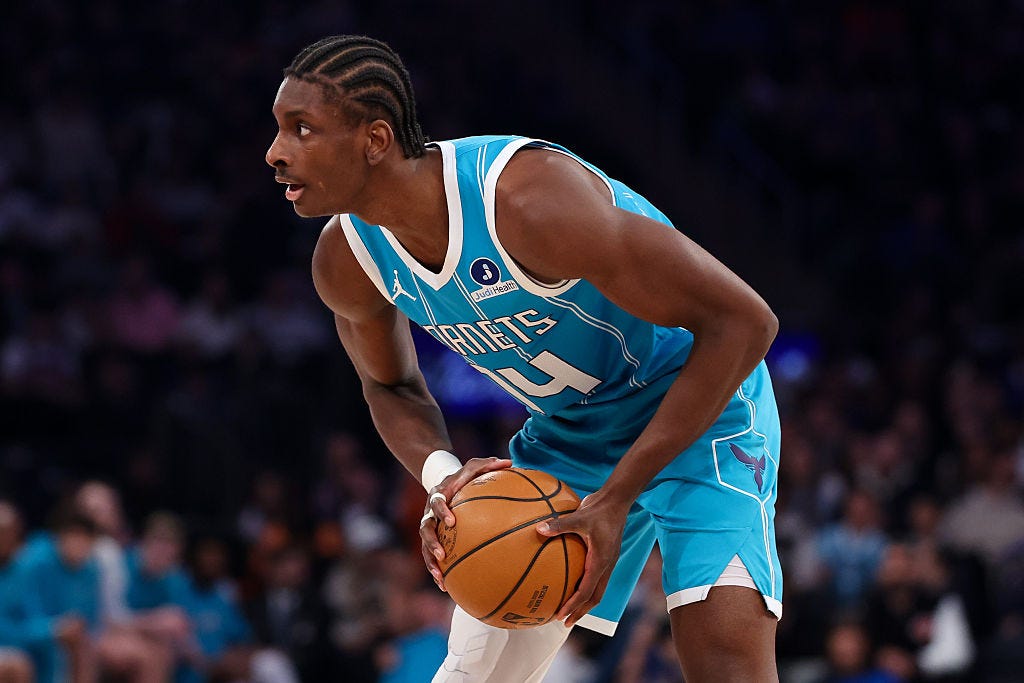 Diabaté averaged 7.9 points and 8.7 rebounds on 63.1% shooting last season, the best numbers of his career. Photo courtesy of Getty.
James: Charlotte is interested in quality of draft capital, not quantity. They already have 31 picks between now and 2033, so a couple of second-rounders isn’t a dial mover. Would the Knicks be open to Charlotte adding assets to get New York’s 2033 first-round pick into the package? Maybe multiple seconds or a swap coming back to give the Knicks more tradable assets in the short term?
Lee: The 2033 first is available, but not to Charlotte. That pick belongs to the post-Brunson era, and trading it would have to bring back a star. Leon Rose has almost always undersold players, with the glaring exception of Mikal Bridges. I don’t think he’d give up a swap or a future first to the Hornets in any realistic trade.
I would, though. I’d give up to four seconds and the 2030 swap. That’s why Leon has the job, and I don’t. I value centers above every other position on the floor because they anchor the defense, and it’s the hardest position to play in the league.
James: Hearing that the 2033 first is completely off the table is disappointing, but not surprising. It’s extremely rare for a team to move its most valuable remaining draft asset for a package built primarily around depth pieces. It was worth exploring.
When you discuss the risk that Diabate is also a FA and could leave, I don’t think the level of risk is the same.
New York is a major market, a historical franchise, and they just won the title. Charlotte is a small market, with no history of even making the playoffs. I think the threat that McBride leaves Charlotte as a free agent is much greater than Diabaté leaving New York for that reason.
Lee: That logic worked before the new CBA. Losing FAs used to be primarily impacted by market size. Now it’s apron-based. Mitchell Robinson in Boston serves as evidence.
James: In some cases, but not all. Markets and championship equity still have pull.
Lee: Again, yes. But the new CBA takes precedence as the main reason free agents leave, especially over market size. IMO, it would be on Charlotte to remain competitive, so players have incentive to stay there. Having the impact of a championship guard like McBride helps everyone’s chance of the team’s young roster staying together.
James: From a strictly basketball perspective, McBride plus three second-round picks, preferably the furthest-out picks possible, feels like fair value for Diabaté.
But his value to Charlotte extends beyond the court. In a fan poll I ran with more than 600 respondents this offseason, he ranked as the Hornets’ third most popular player. He’s become a culture setter, a genuine development success story, and his “Moose” persona has built a real connection with the fan base. Charlotte values him more highly than most outside teams would, so a package at fair market value probably isn’t enough. Without the first, I’m not sure a framework works unless the offer climbs substantially, perhaps to five or more seconds.
Lee: Deuce and three seconds, I’d do in a heartbeat. It’s ironic to hear how Diabaté is revered, because that’s exactly how Deuce is viewed here. When he hits a three, the Garden rains “Deuuuuuce” down on the floor. He’s a homegrown second-round pick we developed into a championship sixth man.
I can’t speak for Rose, but for Diabaté I’d include Deuce and five seconds and wouldn’t blink. With Diabaté, we’re set at the five for the rest of Brunson’s prime, cycling in Drummond-type veterans as third stringers.
James: McBride and five second-round picks is probably fair value on paper and within the range of a reasonable deal. I’m going to decline.
As we’ve discussed, I don’t think second-round picks carry significant value for Charlotte, given they already control 19 of them over the next seven years. Seconds can’t be the centerpiece of a Diabaté trade. McBride also introduces uncertainty. His interest in re-signing with Charlotte is unknown, and if he left in free agency instead of extending, the return would look underwhelming.
In a real trade environment, I could see a third team getting involved if they value McBride more highly, which would let the value gap be bridged with a protected first-round pick instead of multiple seconds. In a straight two-team negotiation, it’s hard for me to get comfortable with any Diabaté deal that doesn’t include some form of first-round compensation, or a player with greater long-term contract certainty who addresses a clearer need for Charlotte.
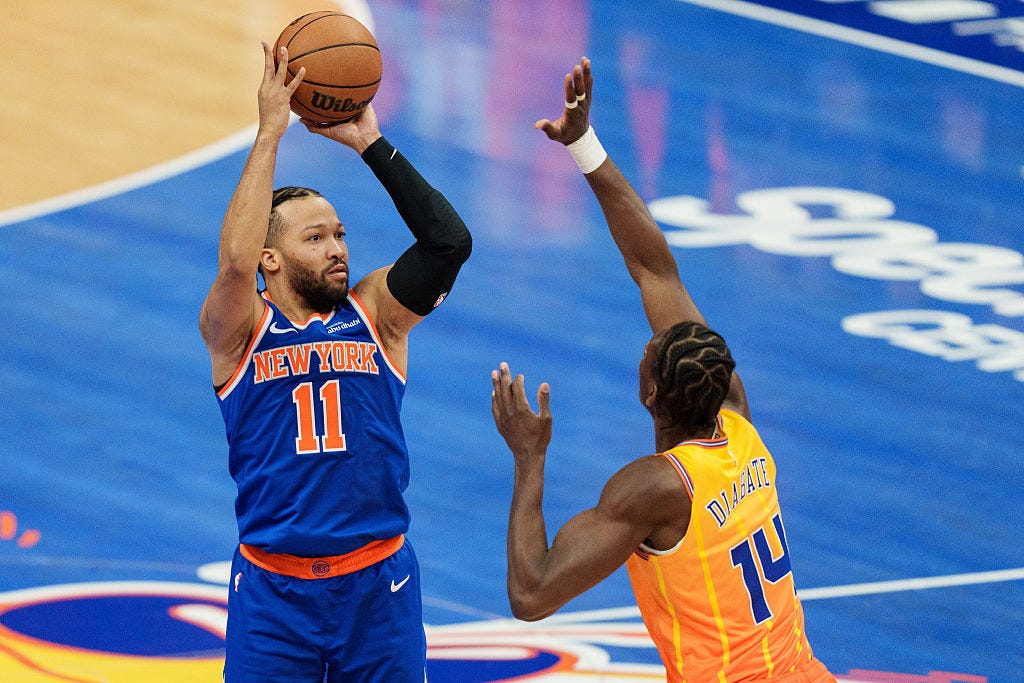 Diabaté ranked as the Hornets’ third most popular player in a fan poll of more than 600 people this offseason. That popularity is part of why Charlotte’s price starts above market. Photo courtesy of Getty.
No deal.
The gap was never McBride against Diabaté as players. James called McBride plus three seconds fair basketball value in his own words. The gap, to him, was currency. New York is sitting on a pile of second-round picks, and exactly one first it won’t spend. Charlotte is sitting on a pile of second-round picks and doesn’t want more. Five seconds didn’t move him any more than three did.
Three things came out of this that I didn’t know two weeks ago.
The real price is a first-round pick or a third team. If Leon Rose wants Moussa Diabaté before Feb. 11, he either spends the 2033 first-round pick or finds a team that values McBride enough to pay a protected first-round pick for him. Charlotte then takes that first for Diabaté. That second path is the kind of three-way puzzle Brock Aller was built to solve. Squaring the money with a player whose rights the Knicks hold is his specialty.
There are contract risks for both teams. James’s biggest worry was that McBride might walk in free agency. Diabaté is on the final guaranteed year of his deal too, with unrestricted free agency coming in 2027. Whoever trades for him is trading for a player they then have to pay, and for New York, that raise lands right on top of the second apron. Charlotte isn’t the only side taking a flier on a contract year.
Popularity has a price tag. I didn’t expect a fan poll to be the thing that moved the number from three seconds to five-plus. But Diabaté is Charlotte’s version of Deuce, a second-round development story the building loves. Teams charge extra for those players. The Knicks would too.
James said something early in our exchange that I keep coming back to. Most trade conversations never make it past the exploratory stage, and front offices spend far more time discussing possibilities than completing deals.
This one made it further than most. It still died where most of them do.
When describing Diabaté’s strengths on defense, James described his biggest strengths within a defensive scheme as his perimeter switchability, rebounding and ability to box out bigger opponents. The areas that can present more of a challenge are coverages that require a traditional center’s size and length, such as drop coverage, tag-and-recover responsibilities, and ice coverages.
How effective he would be ultimately depends on how Mike Brown wants to structure and deploy his defense. However, Diabaté’s skill set is particularly well-suited to a switching scheme, where his mobility and versatility can be maximized, much like it was in Charlotte.
From the Knicks side, from the tape I went through for my July breakdown of every realistic center target.
Diabaté is 24, born in Paris, and moved to the United States at 14 to play basketball. He spent one season at Michigan, went 43rd overall to the Clippers in 2022, and bounced between the NBA and the G League before Charlotte gave him a strong role. He stands 6-foot-10 with a wingspan measured at 7-foot-2½ at the draft combine.
The Moussa Diabaté stats from last season were the best of his career: 7.9 points, 8.7 rebounds and 1.9 assists across 73 games and 47 starts, on 63.1% shooting. He also won the NBA Hustle Award. His cap hit this season is roughly $2.4 million to $2.5 million.
Mike Brown asks his centers to do five things, and Diabaté grades out like this.
Switching is his best tool and the reason he tops my list. When Charlotte started switching everything with him at center, its defense climbed from the bottom third of the league to the middle of the pack. That turnaround came after he replaced Kalkbrenner in the starting lineup, the same move James described from the other side.
Containing a ball handler and recovering to the rim is the hybrid coverage the Knicks’ title run was built on, where the big shows high, forces the guard sideways, and gets back to contest. Diabaté can do both halves of that in the same possession. Robinson was the last Knicks player who could.
Tagging the roller and recovering to a shooter fits him too. He rotates back and contests without losing the play.
Sitting back in drop coverage is where he gets exposed. True bruisers at the five can move him off his spot. That’s a real concern in a conference where Joel Embiid opens the season at the Garden on Oct. 20.
Rebounding is solid overall, but he’s a weaker defensive rebounder than his other tools suggest, and he bites on pump fakes.
On offense, he’d take over Robinson’s old role almost exactly. The Knicks’ playbook has a whole family of actions for centers who can’t shoot, where the five sets a ball screen and dives instead of posting up, then lives along the baseline under the rim as a lob threat and offensive rebounder. A 63% finisher who runs the floor is built for that job.
Moussa Diabaté is the best fit on the board for this Knicks roster. James just showed me what it actually costs.
Over two weeks of email, Hornets writer James Plowright, speaking as Charlotte’s GM, negotiated a hypothetical Miles McBride for Moussa Diabaté trade.
Plowright ranked Charlotte’s bigs by priority as Hannes Steinbach, Diabaté and Ryan Kalkbrenner, and flagged two-way center PJ Hall.
He preferred McBride over Tyler Kolek and projected McBride’s next contract at $10 million to $16 million a year.
Plowright called McBride plus three second-round picks fair basketball value, but said Diabaté’s popularity with Charlotte fans pushes the price to five or more seconds.
He declined McBride plus five seconds, citing the 19 second-round picks Charlotte controls over the next seven years and uncertainty about McBride re-signing.
New York’s 2033 first-round pick was not offered.
Plowright said a realistic deal would require first-round compensation, a player with more contract certainty, or a third team willing to pay a protected first for McBride.
Diabaté averaged 7.9 points and 8.7 rebounds on 63.1% shooting last season and is on the final guaranteed year of his contract.
Who is Moussa Diabaté? A 24-year-old French forward and center for the Charlotte Hornets. Born in Paris, he moved to the United States at 14, played one season at Michigan and was drafted 43rd overall by the Los Angeles Clippers in 2022 before signing with Charlotte in 2024.
How tall is Moussa Diabaté? Six feet 10 inches and 210 pounds, with a 7-foot-2½ wingspan measured at the 2022 NBA Draft Combine.
How old is Moussa Diabaté? Twenty-four. He was born Jan. 21, 2002.
Where did Moussa Diabaté go to college? Michigan, for the 2021-22 season. He averaged 9.0 points and 6.0 rebounds, started 26 of 32 games, made the Big Ten All-Freshman team and helped the Wolverines reach the Sweet 16.
Has Moussa Diabaté won any awards? He won the NBA Hustle Award for the 2025-26 season. He was also a McDonald’s All-American in 2021 and made the All-G League Third Team in 2023.
What are Moussa Diabaté’s strengths and weaknesses? His strengths are switching onto guards on the perimeter, rebounding, finishing at the rim and rotating to contest shots. His weaknesses are getting moved off his spot by stronger centers in drop coverage, biting on pump fakes and a free-throw percentage that has hovered around 60% for his career.
What is Moussa Diabaté’s trade value? In a hypothetical negotiation with Hornets writer James Plowright, Miles McBride plus three second-round picks was called fair basketball value, but Charlotte’s price for an actual deal was first-round compensation or a player with more long-term contract certainty.
What is the Knicks’ style of play under Mike Brown? The offense runs through Karl-Anthony Towns as a passing hub at the elbow, with four or five players spaced around the arc and constant cutting. On defense, Brown asks his centers to switch, show high on ball screens and recover to the rim.
Will the Knicks trade for Moussa Diabaté? Nothing is imminent. In a two-week hypothetical negotiation with Hornets writer James Plowright, a package of Miles McBride and five second-round picks was declined. A deal would likely require a first-round pick or a third team.
What would it cost the Knicks to get Moussa Diabaté? Plowright called McBride plus three second-round picks fair value on basketball terms, but said Charlotte would want first-round compensation or a player with more long-term contract certainty to actually make the trade.
Is Deuce McBride being traded? McBride remains on the Knicks roster. He is widely viewed as New York’s most tradeable contract before the Feb. 11, 2027, deadline, earning about $3.96 million this season.
What are Moussa Diabaté’s stats? He averaged 7.9 points, 8.7 rebounds and 1.9 assists across 73 games and 47 starts in 2025-26, shooting 63.1% from the field.
When is Moussa Diabaté a free agent? He is on the final guaranteed year of a three-year, $5.69 million contract signed in February 2025 and is headed for unrestricted free agency in 2027.
What first-round picks can the Knicks trade? The 2033 first-round pick is the only first-round pick New York can currently trade, and it was not offered in this exercise.
When is the NBA trade deadline? Thursday, Feb. 11, 2027, at 3 p.m. ET.