

Jonah Coleman wants to be a sniper when running.
Coleman learned the phrase from his college running backs coach, Scottie Graham. After Coleman breaks a run past the initial line of defense, he makes a concerted effort to slow down and breathe as the play unfolds.
“A sniper who’s about to take his shot, he’s matching the breath of the person that is his target,” Coleman told The Denver Post. “Any movie you watch, he’s matching the breath. If he’s not breathing like (his target), or some slight distraction hits, then it’s off.”
Graham and Coleman worked constantly on improving his tackle-breaking throughout his college career. Their relationship started in Tucson, where Coleman was Graham’s first recruit as Arizona’s running backs coach before Coleman followed Graham to Washington. Coleman’s a self-described contact seeker, someone whose dad used to tell him to “run through somebody’s face.” Graham didn’t want to change that mentality, just harness it.
“He was a collision back, and I told him self-defense is getting away,” Graham told The Denver Post. “When he first came in, he was a contact magnet, and I’m like, ‘Jonah, let’s make these guys miss.’”
That transformation started with yoga balls. Graham would throw them at Coleman from different angles as he ran through drills, forcing him to try to avoid the hypothetical defender. The strategy worked. Coleman averaged .316 forced missed tackles per carry over the course of his college career, the fourth-highest mark of any collegiate running back since 2014, according to Pro Football Focus.
So, when Coleman declared for the draft, the fit with the Broncos was easy to identify. A short and sturdy build, capable of breaking tackles while also being able to pass protect and catch the ball out of the backfield? Essentially the prototype for a Sean Payton running back.
The Broncos wanted more talented depth in their running back room this offseason. Two games into his rookie year, Coleman has provided the depth and talent that Denver wanted in its running back room after last season. He capped the team’s Week 2 win over the Jaguars with a touchdown run and has already broken two runs for 10 or more yards.
Explosive runs — generally defined as runs of 10 or more yards — are every NFL offense’s dream, but not many teams can do it consistently. There are a lot of things you can teach running backs, Sean Payton said, but breaking the big one is something that’s hard to coach.
“I think you’re finding those traits, and drafting those traits and signing those traits,” Payton said. “The first time I went back to San Diego State as a full-time coach, I was the running back coach and I had Marshall Faulk. I think the best advice I got from (former Indiana State head coach) Dennis Raetz at Indiana State was, ‘It’s a lot easier to find a running back coach than a running back like (Faulk).’”
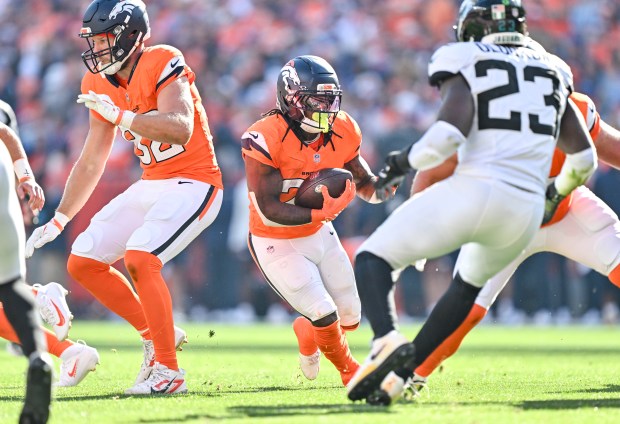 Jonah Coleman (20) of the Denver Broncos looks for space as Foyesade Oluokun (23) of the Jacksonville Jaguars defends during the fourth quarter of the Broncos’ 20-13 win at Empower Field at Mile High in Denver, Colorado on Sunday, September 20, 2026. (Photo by AAron Ontiveroz/The Denver Post)
The message to the Broncos’ running back room this summer was pointed: “The first guy is not going to tackle you.”
Generating big runs was an issue for Denver’s offense after J.K. Dobbins suffered a season-ending injury last year. While the Broncos finished tied for 15th in explosive runs last year, they produced only 2.2 runs per game of 10 or more yards after Dobbins injury. NFL teams averaged around three explosive runs per game last year.
This offseason, Denver running backs coach Lou Ayeni brought the team’s running backs into a meeting room and let the tape do the talking.
Denver’s stable of running backs were forced to watch the flashes of missed potential on the screen. A 5-yard run that could have gone for 25 yards, a touchdown-saving tackle, failed opportunities to break a big play.
“This right here, this can’t be a tackle right here,” Ayeni would tell the backs, Coleman said.
The best running backs at breaking long runs in the NFL — Jahmyr Gibbs, Bijan Robinson, Jonathon Taylor and James Cook — entered the league stamped with the “elusive” tag. Thirteen of the 15 best running backs in the NFL last season at 10 yard-runs were drafted in the first or second round.
So how can you improve on a skill that’s seemingly inherent?
Broncos practice squad running back Cody Schrader started his collegiate career at Truman State, a Division II school in Missouri. During the COVID-19 pandemic, Schrader wasn’t practicing or playing in games, so he worked with a personalized running-backs trainer to stay in shape. The two agreed that for Schrader to achieve his eventual goals in football, he needed to break more tackles. They started with more simulated drills, throwing different scenarios at Schrader and seeing how he reacted. Less running between cones, more game replication, Schrader said.
Schrader even dipped into the depths of YouTube this offseason to try and find hidden tricks. He started watching rugby highlights to better understand how to set up defenders at an angle.
“A lot of these guys have a lot of one-on-one opportunities. They stick one foot, then just go,” Schrader said. “It doesn’t need to be this sitting there, shaking somebody because by that time, you’re getting tackled.”
Coleman tries to stay patient when a defender nears. He focuses on not declaring his move too early so that the defender can anticipate the direction he’s taking. Occasionally, it’s simpler than that.
“When the time comes, sometimes you have to run through somebody’s face,” Coleman said.
Each of the Broncos’ running backs has a similar build. The trio of Dobbins, Harvey and Coleman all stand below 6 feet and weigh between 205 and 220 pounds. Yet they all have stylistic differences in their games, Schrader said.
For example, Schrader admires how Dobbins can sink his entire weight into a cut. He’s impressed by Harvey’s ability to catch the ball out of the backfield and Coleman’s pass-protecting skills as a rookie.
“All of us have different parts of our game, which is really cool because it’s all different,” Schrader said.
The team’s depth is already being tested. Dobbins missed most of the second half against Jacksonville, Harvey was held out with a hamstring injury and Coleman’s status for Week 3 is in doubt. Payton said he’s confident all three can be the team’s “bell-cow” back.
Payton’s offense will likely always be pass-centric. But explosive runs can change the complexion of an offense and Denver’s searching for more of them.
“You can’t block everybody. Just make one guy miss and it’s a go,” Coleman said.
Want more Broncos news? Sign up for the Broncos Insider to get all our NFL analysis.