
Warriors guard Stephen Curry has been planning how to manage his body for the upcoming season, after knee problems cost him two months during the 2025-26 campaign.
Stephen Lam/S.F. Chronicle
Golden State Warriors guard Stephen Curry (30) walks gingerly during the first half of his NBA play-in tournament game against the Phoenix Suns at Mortgage Matchup Center in Phoenix, Ariz., Friday, April 17, 2026.
Stephen Lam/S.F. Chronicle
DONGGUAN, CHINA – SEPTEMBER 12: NBA star Stephen Curry watches the game during the Guangdong City Basketball League All-Star Game on September 12, 2026 in Dongguan, Guangdong Province of China. (Photo by Chen Jimin/China News Service/VCG via Getty Images)
Chen Jimin/China News Service via Getty Images
It was the hobble heard ’round the world. Could you call it a hobble, really? Perhaps a limp. A shuffle. The specific verbiage means something, here, because there are only so many words left to be written in the playing journey of Stephen Curry, and one single 21-second clip earlier this month presented an existential vulnerability the world has not quite seen.
On Sept. 9, Curry clambered out of a black Mercedes-Benz van in Beijing. A couple things were of interest. He wore a pair of what appeared to be Li-Ning Croc-type slippers. He carried an obscenely large waterbottle. And most interesting, absolutely and inarguably, is that he took a few steps as if his knees had locked up.
A video of the scene, naturally, has 6.3 million views on X, and made its way to the screen of 33-year-old teammate Gary Payton II.
Article continues below this ad
“When he had his little limp? He’s just having a hard day!” Payton grinned, speaking with the Chronicle this past Sunday. “Workout day. It’s nothing crazy.”
His happy-go-lucky voice cracked.
Article continues below this ad
Elsewhere, sects of the digital world went straight for the panic button. Curry, after all, missed two months of the 2025-26 season with knee issues that just wouldn’t quite heal quick enough for his liking, and acknowledged such issues were his “new normal.” The widespread term bandied about amid his absence — “runner’s knee” — has been both vague enough to temper immediate concern of any destructive structural issues and undefinable enough to stoke long-term concerns that erupt at any sign of weakness.
One of the closest men to Curry chuckled at all of it. Because really, to trainer Brandon Payne, this clip was only emblematic of a reality that Curry and Payne have been preparing for since he was a babier-faced 23-year-old in 2011.
Stephen Curry works with trainer Brandon Payne, left, in 2019. The two have been preparing for Curry’s body to age since his early days with the Golden State Warriors.
Jun Sato/WireImage/Getty Images
When asked this week for his reaction to the video, Payne responded to this Chronicle reporter: “How old are you?”
Article continues below this ad
“Young man,” Payne said, “enjoy it while you have it. Because in a few years, every morning you get out of bed — that’s how you’re going to look when you get out of bed, whether you like it or not.”
He finished his thoughts, a couple minutes later, with a playful edge to his voice.
“I’ll put it to you this way,” Payne said. “I’ll challenge anybody, over the age of 30, to get on a plane, and leave San Francisco, and fly to China, get off that plane, and then ride around in a car for a while, then get out of that car and walk around, and see how they’re looking.
“It would probably be pretty similar.”
Article continues below this ad
Two weeks after that video was captured, Curry ambled into a media scrum at an Eat. Learn. Play foundation event at Oakland’s Madison Park Primary on Wednesday. The limp was gone.
The knee, still, is “top of mind,” as Curry said.
“Obviously, (it) should be,” Curry told reporters. “But anybody at this age, and amount of miles, you’re managing something. So, it’s kind of part of the longevity aspect of this. And I’m not afraid of it. I know what I need to do to, again, prepare myself to be ready to play.
“And the optimism of me doing what I need to do out there on the court is still there,” he continued. “I should hopefully look like myself, come opening night.”
Article continues below this ad
Stephen Curry talks with students on Wednesday during an event for his Eat. Learn. Play. foundation at Madison Park Academy Primary in Oakland.
Carlos Avila Gonzalez/S.F. Chronicle
The question, though, isn’t what Curry looks like at the start of training camp Tuesday in Hawaii, or when the Warriors tip off their season in Los Angeles Oct. 21. The question is what he looks like in Los Angeles in December, or New York in February, or in any scenario where Golden State can keep the wheels steady enough for a run into April.
Still, Curry’s brilliance lies in his off-ball slipperiness: cutting, screening, leveraging the threat of the most devastating shot in league history. Still, a 37-year-old Curry led Golden State in average miles traveled on offense (1.3) per game last season. He’ll face increasingly complex defensive gantlets for much of the season, given co-star Jimmy Butler’s ongoing ACL rehab.
And Golden State’s staff is well aware, too, that opposing offenses will seek out Curry on the other end of the floor to wear him down, as teams have targeted him defensively for years.
“They don’t hunt him because he can’t guard,” Frank Vogel, the Warriors’ new defensive head on staff, recently told the Chronicle. “He can guard. They hunt him just to tire him out, and draw fouls. That’s what every team in the league is going to (do), target the other team’s best scorer just to tire ‘em out.”
And there is no world in which Curry can simply quick-fix his knee, or rewind the clock on the cartilage and tendon structure.
Stephen Curry was sidelined for two months last season while dealing with patellafemoral pain syndrome and bone bruising, a situation the Warriors star called “frustrating.”
Santiago Mejia/S.F. Chronicle
“It’s a management game,” said Dr. Stephen Valdes, a physical therapist who has long worked with the Knicks’ Josh Hart through Hart’s occasional knee issues. “The way I say it … you get a bad grade on a report card, the bad grade’s always going to show up on the report card. Now, you can do extra stuff, take AP, honors classes to bring up your GPA.
“But you’re always going to have the bad grade on your transcripts.”
Across two months of injury updates, the Warriors reported Curry was dealing with “patella-femoral pain syndrome/bone bruising in his right knee.” Multiple sports medicine experts told the Chronicle that such a condition is actually different than “runner’s knee,” which has been colloquially used to describe Curry’s ailment.
Patellafemoral pain syndrome, on its own, is actually quite manageable: Broadly, it occurs when the kneecap is displaced from its regular tracking motion. Could be due to cartilage degeneration. Could be due to tightness in surrounding muscles. But Curry’s two-month-long absence, from a distance, confused Dr. Jesús Olmo, a sports medicine physician in London who once treated Cristiano Ronaldo’s knee issues as Real Madrid CF’s former head of medical services.
“Normally, in a top athlete, it takes only a few days or weeks at the most to control these kind of things,” Olmo said. “So I don’t know.”
It even seemed a mystery to Curry himself, who told the Chronicle in February the injury’s ambiguity was “frustrating.” But the key here, as Valdes explained, was likely the bone bruising — if Curry’s kneecap wasn’t tracking properly over an already-bruised area, that would delay the natural healing process.
Offseason rest, Valdes said, would fix that issue. And Curry has designed what he dubbed a “prescriptive plan” inside a think-tank of Payne, Warriors medical guru Rick Celebrini and personal director of performance Carl Bergstrom, who Valdes said is well-respected in the sports performance field.
Stephen Curry speaks with Warriors director of sports medicine and performance Rick Celebrini during a game in 2023.
Stephen Lam/S.F. Chronicle
The 31-year-old Hart, a well-known hustler who helped the Knicks to a title in 2025-26, has dealt with on-and-off knee-tendinitis issues for nearly a decade. Their offseason, Valdes said, generally involves strengthening and building mass around the knee to account for natural degradation.
The general thought process with Curry is similar, Payne confirmed. But as he explained, it’s also been a summer of trial-and-error, placing varying degrees of stress on Curry in workouts to determine the necessary recovery on the back end.
The key: None of Curry’s on-court movement patterns or style of play has changed or will change, Payne emphasized.
“Overwhelmingly, this summer, it’s been extremely positive,” Payne said. “I think I’ve read some things where there’s people that have a lot of concern. I think that’s really overblown, quite frankly.”
For 15 years, Payne has used an ever-widening array of gadgets to push one of the best players in history to cognitive overload. Goggles. Tennis balls. Quietly, too, he has long brought an iPad inside their rotation of sweat-laden gyms.
“I just didn’t show it to any of you guys,” Payne cracked, referencing the wider media landscape, “until now.”
His goal in offseason work these days, after 12 All-Star nods and 4,248 threes, is not to get Curry in a rhythm. It’s to snap him out of it. To win, as Payne explains. Every summer brings added wrinkles to carefully designed reaction-time puzzles, in an attempt to hone Curry’s response to the variety of information he processes on any given offensive possession.
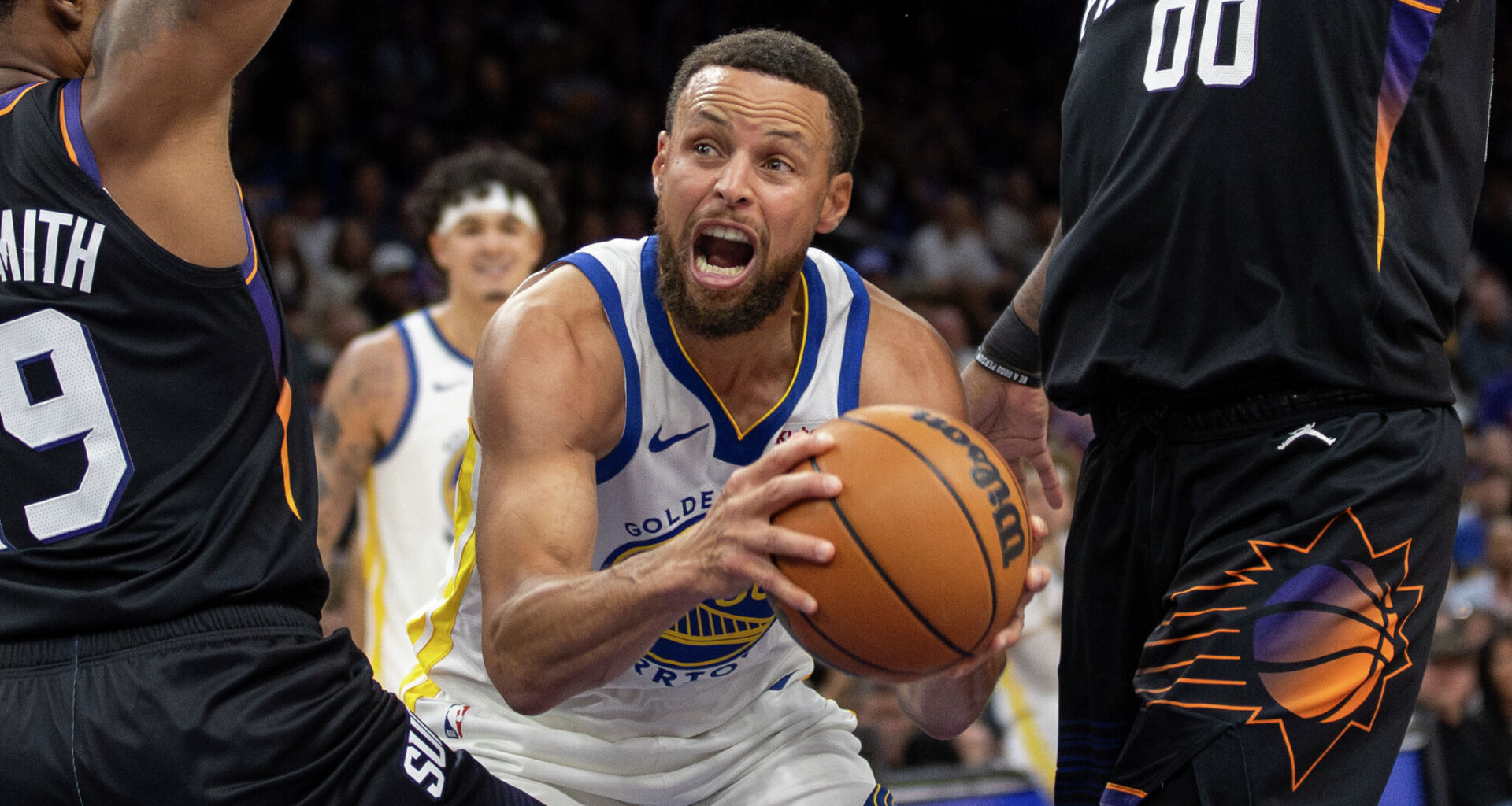
Stephen Curry drives toward the basket against the Phoenix Suns last season. “Everything that we started doing in 2011, ’12, ’13, was aimed at right now,” trainer Brandon Payne says.
Stephen Lam/S.F. Chronicle
Payne, this summer, would flash the iPad at Curry, containing a sequence of three differently colored numbers. Each color represented a particular move, to lead Curry into a shot. Each number represented how many times Curry had to perform that move. He’d have to react and execute that sequence as quickly as possible, and Payne would throw another at him, never with the same number corresponding to the same color.
This has been the most intensive summer of mental work that Payne has ever put Curry through, and Curry would agree, Payne said. The rationale is simple.
“Everything that we started doing in 2011, ’12, ’13, was aimed at right now,” Payne said. “We were aiming at now. So if things changed physically — that you make up the gap by being able to process and make decisions faster. So just now, we’ve added more to it, we’ve added more layers to it, because we have to continue to challenge him.”
If they’ve lightened any physical load — and they sometimes have, solely in number of reps on drills — they’ve “more than taken the ceiling up” on his neuro-cognitive workload, Payne asserted.
“As long as I’ve been doing this, every single workout that I’ve had with Stephen Curry … there has been a workout in every one of those workouts where I’m like, ‘How the hell did he just do that? What am I watching right now? This is incredible,’” Payne said. “And that is still there. There’s still a moment in every workout where I’m like, ‘I don’t even know how that just happened.’ And as long as that keeps happening, I think you’re going to keep seeing the same Stephen Curry.
“And nothing this summer,” Payne continued, “would lead me to believe that’s changed at all.”
Stephen Curry celebrates after hitting a 3-pointer against the Los Angeles Clippers in a play-in tournament game in April. Curry sat out nearly half of the Warriors’ back-to-backs over the past two seasons.
Carlos Avila Gonzalez/S.F. Chronicle
And yet, nobody is “beating Father Time,” as Curry told CNBC in an interview released Thursday. Any specific variation of patellofemoral pain syndrome is more prone to flare up, as Valdes explained, during a particularly intensive game week or a sequence of back-to-backs.
Golden State has sat Curry on either the front or the back-end of 45% of the team’s back-to-back matchups the past two seasons. This will be a vital point for Curry, Celebrini and head coach Steve Kerr to manage in 2027-28; Golden State has 15 different back-to-backs this season, and can hardly afford to load-manage in all 15 with Butler and Moses Moody rehabbing.
“If it was me and it was my client, and he’s 38,” Valdes said, “what’s the purpose of playing back-to-backs?”
A variety of truths await Curry, as soon as the Warriors touch down in paradise this week. He has limited time left, to finish his playing story. He has a “sense of urgency to capitalize on these next two years,” as he told CNBC. He has to play like Stephen Curry for any chance to do that.
But can his body handle it?
“There’s no doubt, and worry,” Payton II told the Chronicle, in mid-September. “We know Captain’s going to take care of Captain. Do what he’s going to do to lead us.”