

Hoops Rumors is checking in on the 2026 offseason for all 30 NBA teams, recapping the summer’s free agent signings, trades, draft picks, departures, and more. We’ll take a look at each team’s offseason moves and consider what might still be coming before the regular season begins. Today, we’re focusing on the New Orleans Pelicans.
Free agent signings
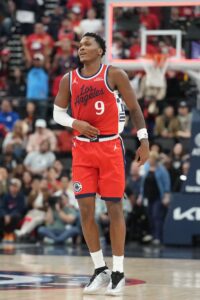 Bennedict Mathurin: Two years, $15,375,000. Second-year player option. Signed using non-taxpayer mid-level exception.
DeAndre Jordan: Two years, minimum salary. Fully guaranteed. Re-signed using minimum salary exception.
Trendon Watford: One year, minimum salary. Partially guaranteed ($250K). Signed using minimum salary exception.
Kobe Bufkin: One year, minimum salary. Non-guaranteed (Exhibit 9). Signed using minimum salary exception.
Caleb Houstan: One year, minimum salary. Non-guaranteed (Exhibit 9). Signed using minimum salary exception.
Christian Koloko: One year, minimum salary. Non-guaranteed (Exhibit 9). Signed using minimum salary exception.
Aziz Bandaogo: One year, minimum salary. Non-guaranteed (Exhibit 9/10). Signed using minimum salary exception.
Dominique Daniels Jr.: One year, minimum salary. Non-guaranteed (Exhibit 9/10). Signed using minimum salary exception.
Markquis Nowell: One year, minimum salary. Non-guaranteed (Exhibit 9/10). Signed using minimum salary exception.
Johnny O’Neil: One year, minimum salary. Non-guaranteed (Exhibit 9/10). Signed using minimum salary exception.
Christian Shumate: One year, minimum salary. Non-guaranteed (Exhibit 9/10). Signed using minimum salary exception.
Solomon Washington: One year, minimum salary. Non-guaranteed (Exhibit 9/10). Signed using minimum salary exception.
Note: Bandaogo, Daniels, Nowell, O’Neil, Shumate, and Washington have since been waived.
Trades
Draft picks
Two-way signings
One year, $91,000 partial guarantee.
One year, $91,000 partial guarantee (will increase to $339,441 at start of regular season).
Departed/unsigned free agents
Other roster moves
Signed Saddiq Bey to a three-year, $55,500,000 veteran contract extension that begins in 2027/28. Fully guaranteed. Trade kicker (lesser of $1MM or 15%).
Exercised team option on Karlo Matkovic ($2,296,271).
Waived Taj Gibson ($148,828 partial guarantee).
Re-signed Hunter Dickinson to a one-year, two-way contract and subsequently waived him.
Salary cap situation
Note: Figures are rounded to one decimal place.
Operating over the cap ($165MM) and below the first tax apron ($209MM).
Hard-capped at first apron.
Team salary: $196.4MM (tax); $203.3MM (apron).
Below luxury tax line by $4.1MM; below hard cap by $5.7MM.
Partial non-taxpayer mid-level exception ($7.5MM) and full bi-annual exception ($5.5MM) available.
Two traded player exceptions available (largest worth $7MM).
The offseason so far
Until they completed a trio of notable transactions in September, it was a very quiet offseason for the Pelicans, in large part because of the moves that executive VP of basketball operations Joe Dumars and senior VP of basketball operations Troy Weaver made a year earlier, during their first few months on the job.
In the midst of the 2025 NBA Finals, the Pelicans traded the Pacers’ top-four protected 2026 first-round pick back to Indiana in order to acquire the No. 23 pick in the 2025 draft. On draft night, they flipped that newly acquired No. 23 selection and their own 2026 first-rounder to Atlanta in order to draft Derik Queen 13th overall. As a result, instead of having two first-round picks in 2026, New Orleans had none, forcing the team to sit out the first night of this year’s draft after winning just 26 games last season.
The Pelicans’ decision to give up that valuable 2026 first-rounder (the most favorable of their own pick and the Bucks’ pick) in order to move up from No. 23 to No. 13 for Queen was widely criticized, but trading that Pacers first-rounder just days before Tyrese Haliburton suffered an Achilles tear that sidelined him for all of 2026/27 arguably turned out to be even more regrettable. Indiana’s pick ended up landing at No. 5 overall, while New Orleans’ was No. 8, but the Pelicans no longer controlled either.
In addition to mostly opting out of the 2026 draft (they did use the No. 58 pick on Jaron Pierre Jr., who signed a two-way contract), the Pelicans didn’t have the ability to be a major player in free agency due to their close proximity to the luxury tax line. Their cap situation stemmed in part from the 2025 offseason trade that sent CJ McCollum and Kelly Olynyk to Washington in exchange for Jordan Poole and Saddiq Bey.
Both McCollum and Olynyk were on expiring contracts at the time, whereas Poole and Bey were on multiyear deals that featured more than $40MM in guaranteed money for 2026/27. Without that salary on their books, the Pelicans would’ve had far more cap flexibility to be active in free agency or on the trade market this summer.
 Poole had a disappointing first season in New Orleans and looks like a potential trade or buyout candidate this season, but Bey was a nice add by the front office. The veteran forward bounced back after missing all of 2024/25 due to an ACL tear and had a career year with the Pelicans, averaging 17.7 points and 5.6 rebounds per game in 72 contests, with a respectable shooting line of .451/.367/.841.
The performance earned Bey a three-year, $55.5MM contract extension earlier this month. That deal, which also includes a small trade kicker, may be a little higher than what he could’ve gotten on the free agent market, but it includes a descending structure that will make it more team-friendly in its later years.
The extension for Bey was one of three major moves the Pelicans completed this month. The other two were linked to one another, as the team traded 2023 lottery pick Jordan Hawkins and 2025 second-rounder Micah Peavy to Memphis along with a future second-round pick and a second-round swap in a cost-cutting move in order to sign former sixth overall pick Bennedict Mathurin without surpassing the luxury tax line.
I had questions about Mathurin’s value as a restricted free agent this summer due to his up-and-down shooting numbers, a poor assist-to-turnover ratio, and inconsistent defense, ranking him 35th on our list of the offseason’s top 50 free agents. But his offensive upside makes him a worthwhile investment at the price the Pelicans paid. They signed Mathurin to a two-year, $15.4MM contract and didn’t even have to compensate the Clippers, who withdrew their qualifying offer to make the 24-year-old an unrestricted free agent.
While it remains to be seen how Mathurin will fit in New Orleans, that contract isn’t going to hurt the Pelicans at all. In fact, it could turn into a bargain if the Canadian swingman takes a step forward in his fifth NBA season, though the second-year player option could make it challenging for New Orleans to keep him next year if he proves he deserves a raise.
Prior to September, the Pelicans’ only real transaction of note was a two-year, minimum-salary contract for veteran center DeAndre Jordan. The decision to give Jordan two years raised some eyebrows around the league, since it will require New Orleans to pay the big man’s full salaries ($3.9MM in year one and $4.1MM in year two). Conversely, a team who signs a veteran to a one-year, minimum-salary contract is compensated by the league and only pays the player $2.45MM of his total salary.
Tacking on that extra $1.45MM to Jordan’s 2026/27 cap hit wasn’t exactly ideal for a team navigating the tax line and the first apron, but the Pelicans privately insisted that the 18-year veteran, highly respected for his locker room leadership, would’ve signed elsewhere if New Orleans hadn’t offered the second year. In the front office’s view, Jordan’s influence on the team’s younger players is valuable enough to make that second year and the increased cap hit(s) worth it.
Up next
The Pelicans are currently carrying 14 players on guaranteed contracts, with offseason addition Trendon Watford on a partially guaranteed minimum-salary deal and three young veterans – guard Kobe Bufkin, big man Christian Koloko, and forward Caleb Houstan – on non-guaranteed Exhibit 9 pacts.
The simplest way to set their 15-man regular season roster would be to roll into opening night with those 14 players on guaranteed deals along with Watford, but the Pelicans don’t necessarily need to take that route. They have enough flexibility below the tax line to waive Watford or recently acquired guard AJ Johnson (a 2024 first-round pick who has yet to show much at the NBA level) and eat a little guaranteed money if they want to hang onto Bufkin, Koloko, or Houstan.
New Orleans also has a two-way slot to fill, with Pierre and undrafted rookie forward Malik Dia currently holding two-way deals for the team. It remains to be seen whether the Pelicans will fill that opening in the next few days before camp begins, or whether they’ll wait until later in the preseason in order to see if an intriguing option shakes loose from another NBA roster.
After extending Bey, the Pelicans are still carrying several extension-eligible veterans on their roster, including Zion Williamson, Dejounte Murray, Poole, and Karlo Matkovic, but I can’t imagine there’s much urgency to get a deal done with any of them before the season begins.
Williamson still has two years left on his current contract and represents a risky investment due to his injury history; Murray was limited to just 14 games last season after returning from an Achilles tear, making his value difficult to assess right now; and Poole is coming off his worst year as a pro.
Matkovic, who has been a pretty regular part of the Pelicans’ frontcourt rotation since entering the NBA two years ago, may actually be the best candidate for a new deal at the moment, but he’ll be eligible for restricted free agency next summer if he doesn’t sign a contract before then.