

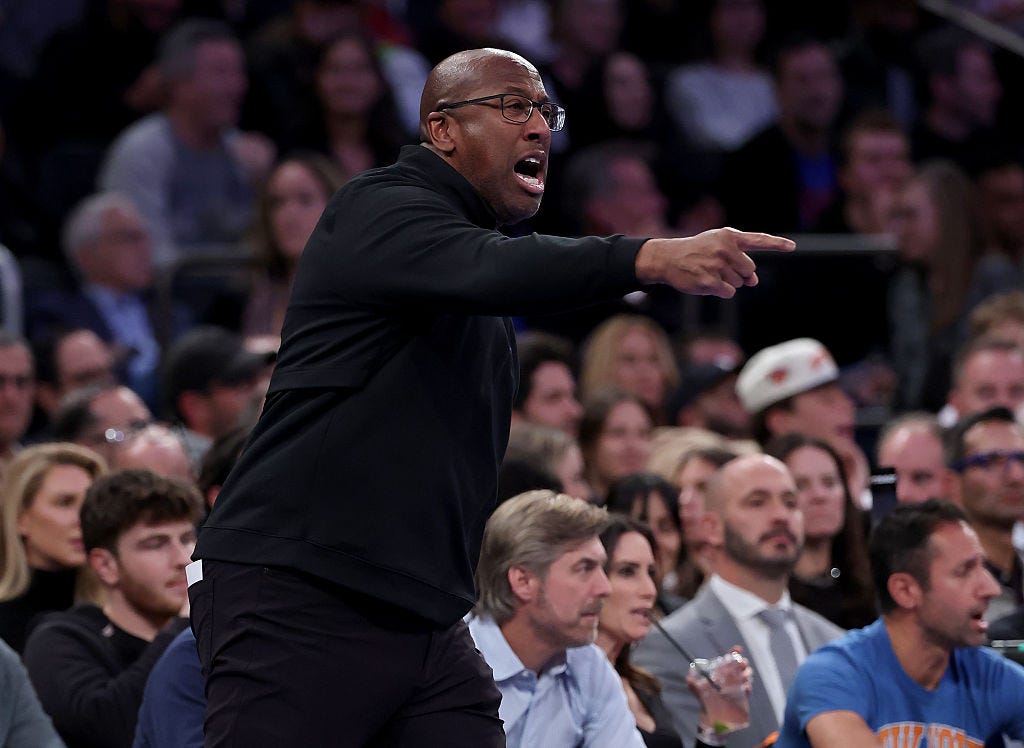
 New York Knicks head coach Mike Brown directs his team from the sideline during action against the San Antonio Spurs in the NBA Finals. (Photo: Getty Images)
New York Knicks training camp opens Sept. 28, and head coach Mike Brown enters his second season with an offense already installed. The system runs on two base alignments, one with four players outside the arc and a fifth along the baseline, and one with all five spread above the break. Both are governed by spacing rules rather than called plays. Karl-Anthony Towns operates as the hub, and the postseason version of that role produced 6.6 assists per game after he had gone 50 straight playoff games without a five-assist performance. The Knicks went 7-0 when he exceeded five assists. Jalen Brunson roughly doubled his screens per game and saw his share of made baskets created on the ball fall from 71% to 56%. The preseason opener is Oct. 5 at Philadelphia.
Ain’t it funny that just a year ago this week, nobody knew what the Knicks’ offense would look like.
Mike Brown had just taken over as head coach in New York. He brought a new system, and the first month of last season was used like a classroom. He taught players rules instead of complicated plays. The coach watched, adjusted, watched again. Everybody remembers Karl-Anthony Towns famously proclaiming about his offensive role, “Honestly, I don’t know—but we’re figuring it out.”
With training camp opening Monday, another offensive remapping awaits. Brown spent last season and a championship run finding out which parts of his offense work with these five guys. He gets to start at the answer.
Most coaches in year two are tinkering at the margins. Brown is doing something closer to skipping ahead, because the offense that won a title in June barely existed in December. The offensive actions that produced the insane offensive engine were added after Game 3 of the first round. Not to mention, the sharpest version didn’t show up until the second round of the playoffs.
The roster it’s built around has been upgraded. So let’s go through what that will change.
So what will this look like in October?
Buckle up.
Last year’s offense was very dribble-handoff-heavy and deliberately simple. As the season went on, Brown layered in set plays, especially in the Emirates NBA Cup, to get specific players specific shots. By midseason, the offense leaned freelance. In practice, that means a ball screen for Jalen Brunson and let ‘em cook.
The Knicks run two base alignments. The first puts four players outside the three-point line, two in the corners and two in the slots above the break, with a fifth stationed in the little pocket along the baseline underneath the rim. The second spreads all five players above the arc entirely, with the center at the top of the key.
Everything changed in March. Brown and his staff started building actions specifically to get Towns the ball, and the next phase came after Atlanta smothered them in the first round and forced a full rebuild of the hub sets during the playoffs.
That’s a lot of churn for a team that won 53 games and a title.
I wrote in July that the best version of this offense hadn’t happened yet. So what will the offense look like in October?
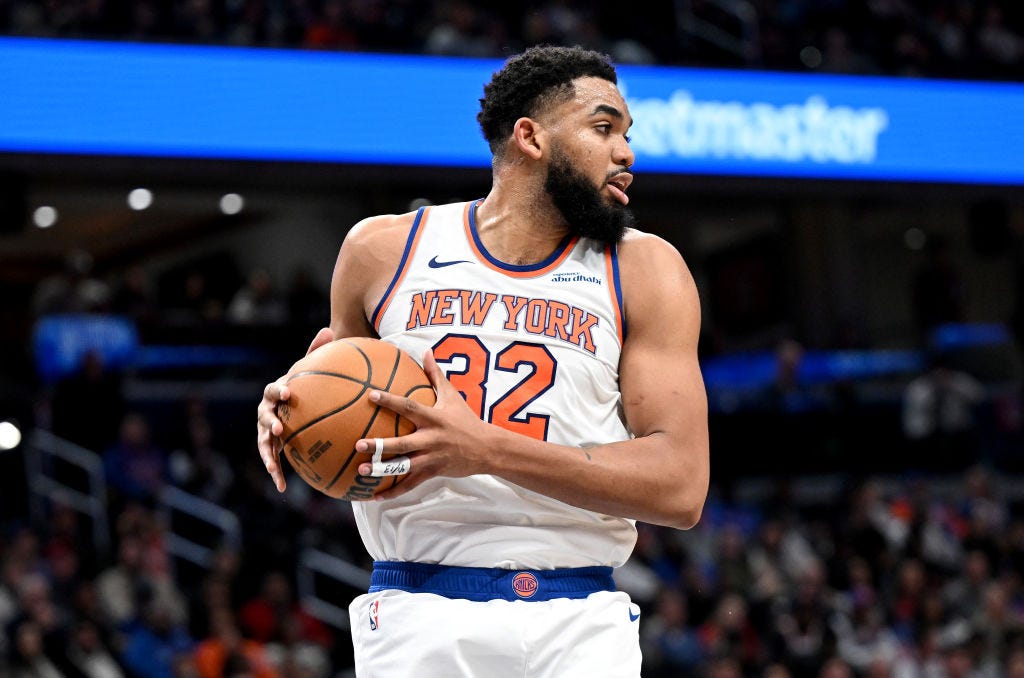 New York Knicks center Karl-Anthony Towns (32) holds the ball and scans the floor during an NBA game. (Photo: Getty Images)
Here’s the single biggest thing to expect this season, and it starts with a concept the playbook calls the simplest version of everything: Toss the ball to the center above the arc.
Towns 27 feet from the rim makes the opposing center close out hard. Now that opossing center is nowhere near the paint. Now he’s moving backward, and he’s got a player behind him who can shoot over him or drive past him.
From that catch, the offense branches like the tree in Loki Season 2. He can attack himself. He can hand off to a guard sprinting at him. He can hit the cutter clearing through the lane. He can wait while two teammates screen for a third and hit whoever comes open.
Or, a guard or wing can set a ball screen for the center, so the big man can attack downhill with four shooters spaced around him. The little guy screens for the big guy. It’s in the book.
Fred Katz tracked Towns’ touches at 83 per 100 possessions during the regular season. Against Philadelphia in the playoffs, it jumped to 103 and stayed near 98 the rest of the way. One series doesn’t make a trend. A 20-touch jump that holds for two months does, and Brown will make that call from game one this year. They installed that in March. Brown now has an entire training camp and 82 games to expand it.
It works because Towns is the highest-volume trailing three-point shooter among stretch bigs in the league. Put him 27 feet from the rim with the ball and a center has to close out hard. That center is now nowhere near the paint, and the lane opens for everybody else.