

Myles Turner has spent the majority of his offseason building.
From making a $1 million commitment to help fight food insecurity and advocating for animals to traveling to Morocco with the NBPA to broaden his worldview, the common denominator is the same: Turner doesn’t want to just lead by example, he wants to build something that lasts.
While Turner has long been committed to making an impact beyond basketball, this particular season of growth follows a season of transition on the court.
After spending the first 10 seasons of his NBA career with the Indiana Pacers, Turner signed with the Central Division rival Bucks last summer, beginning a new chapter in Milwaukee.
While the first season didn’t go as he hoped, it’s no surprise that Turner’s offseason pursuits mirror the mindset he’s bringing into the season ahead.
“It’s funny, I think people want to call it a rebuild, but I just call it building,” Turner told NBC Sports’ Mary Omatiga.
“We’re building towards something, and I think we’re all excited just to kind of roll the ball out and get going.”
In the conversation below, the newly elected Vice President of the NBPA opens up about why community work is important to him and the example he wants to set both on and off the court. Turner also reflects on his first season in Milwaukee, his reaction to Giannis Antetokounmpo’s departure, and more.
*This interview has been edited for length and clarity.
Mary Omatiga: Myles, congrats on your new role! Vice President of the NBPA Executive Committee. What does it mean to you to have been elected by your peers?
Myles Turner: First off, thank you so much. It means everything to me. Just to have the respect of my peers, and just being around as long as I have been, for them to put that trust and faith in me to be the voice for the 450 and PLYRS UNTD over the next three years is a huge honor for me and not something that I take lightly.
You’ve had quite a busy off-season. In June, I know you went to Morocco with PLYRS UNTD. What was that experience like?
Turner: It was formerly called One Court, and I had some experience with the NBPA in the past. I joined them in Milan a couple of years ago, and that was my first time really just immersing myself in the Players Association.
I had been to a few of the meetings. I had listened in, but they offer so many things off the floor for us as players to really advance our careers. Obviously, what we do on the court is amazing. The money that we make in this league is unbelievable, but the opportunities that they present are real.
I wanted to join them in Africa this summer just to see what else I could take in, and I’m glad I did. We got to be a part of some investment summits. We did our own little version of like a Shark Tank out there, where we got to help people with their own startups, get their pitch off. With that, you kind of see what it takes to do it on your own.
The cultural experience was unreal. That was my first time really being in an Arab state, and it was actually really cool. They were super friendly. We had some of the best accommodation! Man, I can go on and on and on. But I definitely suggest it for our brothers in this league to take advantage of the PLYRS UNTD opportunities.

How did that experience change your perspective on life?
Turner: I think for me personally, it’s funny how Africa gets depicted. I had been to Tanzania before in the past. I did some work with Malcolm Brogdon and his Clean Water Initiative, but there are so many different parts of the continent.
When I got there, I just think that culturally, even with the religion, it’s so amazing just how dedicated they are. I feel like things move so fast here in the States, but they take time out of the day, every single day, to make sure that they pray, to make sure that they’re with their families, and to make sure they’re together.
What may seem so small and minuscule to some people, to me, left a big impression. Just the fact that the entire nation itself just kind of abides by a certain set of rules, it was really cool.


You’ve also been making an impact a little bit closer to home. Your foundation recently made a $1 million commitment to help fight food insecurity. Why now and why this cause?
Turner: The cause is called Empowering the Masses, and it was founded by Ms. Tammy Johnson. I have some ties to it back in the past. To make a long story short, a few years ago, I had a not-so-great game, and a fan had kind of trolled me on Twitter. He reached out to me and asked for, like $100 on Venmo.
I’m a little petty too, so you know I sent him a penny, and I said, “Here’s a penny for your thoughts.” He kind of took that and got salty about it. But then, after that, fans started Venmoing me pennies. The next person Venmoed me two cents, like, “Here’s your two cents.”
The two cents turned to $1, $1 turned to $10, and I basically said, “Any fan that Venmos me, I’m going to match it.” At the time, Texas went through a very bad freeze back in 2021. It left a lot of people without resources. Because you know, down South, we’re not really used to the cold weather.
I was able to raise close to $100,000, and I gave to Empowering the Masses back then. I just wanted to continue my relationship with them because I love the stuff they’re doing. It is a million dollars, but it’s also a long-term investment. It’s a million dollars over the next 10 years. They create opportunities, and they’re giving people tangible tools and resources within the South Dallas community.

Courtesy of Operation W.A.R.M
I feel like some people don’t lack ambition; they just lack access and opportunity. So that’s what this million dollars will be able to do — give to this food pantry.
They’re more than just a food pantry. It’ll also give opportunity to essential workers, and they have phlebotomy classes. They have volunteers come in and actually build up their resumes. I think it’s about teaching people to fish, not just necessarily giving them a fish. So I just like that this is a long-term pledge as opposed to just a one-time donation.
You and your fiancée — congrats on the engagement, by the way — started the Casper Foundation to advocate for animals. What made you guys want to get involved in that?
Turner: My entire life, believe it or not, I’ve always been a cat guy. I’m essentially trying to give a voice to the voiceless when it comes to cats.
We are an animal foundation; I just shed a little more light on cats. You look at adoption numbers, and dogs are usually the ones that are taken first.
I have such a unique platform being in the NBA and having the social media reach that I have. I have an opportunity to get a lot of these shelters off the ground. They may be doing the work, but they may not always have the reach or the social media platform that they need to get these animals adopted. So that’s essentially where we come in.

Courtesy of The Casper Foundation
Courtesy of The Casper Foundation
Last year we did a tunnel walk with our teams. We had dogs and cats that were up for adoption go down our tunnel like it was an NBA pre-game fit walk. We were also able to have our wives and girlfriends come out and have events at certain [local] shelters.
Today, we literally just got back, and I was able to get a partnership with Purina and Friskies. They donated a thousand pounds of food, so we’re going to share that at about three different shelters in the Wisconsin area. Little things like that are important to me to give a platform to these animals that can’t speak for themselves.
It seems like this off-season you really invested a lot of time into social impact and philanthropy. Why are these responsibilities important to you at this stage of your career?
Turner: One of the first things I did when I got in the league was create my 501(c)(3) nonprofit, called W.A.R.M. It stands for “Workers and Role Models, ” and I essentially try to live out exactly what I’m trying to get communities to do.
I’ve been doing a lot of community work back when I was in Indiana. I was there for 10 years, and we did great impact work there because that’s where I called home for so long. But I wanted to stretch that further than just my playing market. I wanted to give back to my hometown. I wanted to get back to my current market, and eventually take it nationwide.
The money I’ve been able to amass, it’s amazing, but it’s also about giving back to the people that helped you get that money in the first place. I never wanted to turn my back on the people that helped me [get here].
It’s also about being a role model. These younger guys coming into the league, they’re trying to get their things off the ground as well. I want to make sure I provide an example of what it’s supposed to look like and how you’re supposed to not just give dollar amounts, but you live by what you’re doing.
That’s what W.A.R.M. stands for — going out there being about the things you say you’re about.

Courtesy of Operation W.A.R.M.
I was listening to a podcast where you talked about NBA players having face value. You guys aren’t under helmets or hats. People know you, and you can build off of that.
How do you want your face value to translate off the court?
Turner: When people actually see me in person, it’s so different. You see us athletes play on TV as these “larger-than-life” people, but when you actually get to meet us, a lot of us are dope individuals, man. What I’m just trying to get out there is that the fact that, yeah, my job is cool, but at the same time, I’m a human being as well. I want people to realize that.
When I am out there, and people do see me in person, I think it’s important just to have that human connection. We’re not just always talking hoops. We’re talking about life, our goals, our dreams, and how we build things. That’s why I think the face value is important… it just speaks volumes to just watching us on the television screen.
NBA athletes, to your point, do have that advantage. We don’t wear hats. We don’t wear helmets. People get to see us for who we are at all times. That’s amazing, not only for philanthropic things, but for branding or letting grandma see you back at home, you know, whatever it may be.
We’ve talked a lot about your growth in the offseason, but I know that this year was also a year of transition for you. What did your first season in Milwaukee teach you about yourself?
Turner: Resiliency. I think that no matter what happened last year, I was always a constant professional. I try to carry myself as such, win, lose, good day, bad day. I mean, there are no bad days in the league. It’s all a matter of perspective. What we do is amazing, the money that we get to make, the child’s game that we get to play every day.
I don’t ever consider days as necessarily bad days, but [I’ll say] down days. You work through everything, and I think that’s what I was able to do. That’s what I was most proud of, being able to kind of keep my head through what people would describe as dark times. But again, I think it’s always just a matter of perspective.
There are people out here who are really suffering and if me suffering is losing a basketball game, then you know I’m living a pretty damn good life.
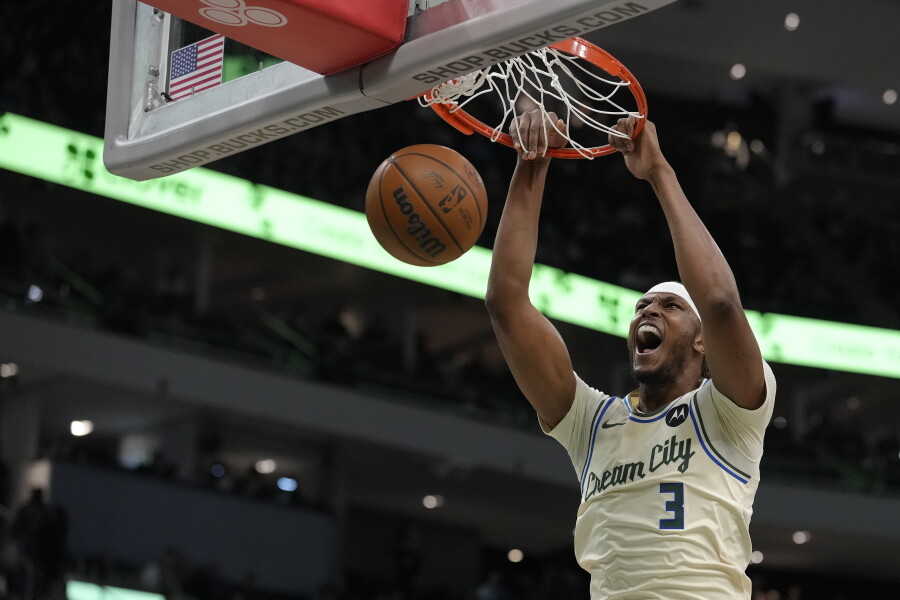
MILWAUKEE, WISCONSIN – APRIL 10: Myles Turner #3 of the Milwaukee Bucks dunks the ball against the Brooklyn Nets during the first quarter at Fiserv Forum on April 10, 2026 in Milwaukee, Wisconsin. NOTE TO USER: User expressly acknowledges and agrees that, by downloading and or using this photograph, User is consenting to the terms and conditions of the Getty Images License Agreement. (Photo by Patrick McDermott/Getty Images)
You said others would describe it as “dark times”. How would you sum up your first year?
Turner: You said it, just a year of transition. I wanted to embrace being uncomfortable. Imagine you’re doing your job. You’re in the same exact place for 10 years straight. You know what’s going to happen every single year. I’ve had the same medical staff. I had the same strength coach. I’ve had the same front office. Everything was consistent.
Then, just to shake something up, out of nowhere, I mean, of course, there’s going to be struggles that come with it. As tumultuous as it may have seemed, I enjoyed the mental growth that I was able to have going through it from a different side and perspective. It’s always crazy making a decision to go to my division rival, but you get to see things from both perspectives.
I think there were a lot of things that I learned, but more than anything, I was just happy that I chose myself and I made a decision for myself.
A big reason for coming to the Bucks was because you wanted to remain competitive, and obviously, Giannis [Antetokuonmpo] was a big part of that.
Now that he’s been traded, how does that change for you?
Turner: It doesn’t change my competitive mindset whatsoever. I think that, coming into the situation, obviously, the initial pairing was to be with Giannis, but this is a business. At the end of the day, that man has to take care of his family. That man has to do what’s best for him. All I can worry about is the future, and that’s exactly where we’re at.
So you know, take things day by day, keep continuing to compete, and the best things happen after that.

CLEVELAND, OHIO – NOVEMBER 17: Giannis Antetokounmpo #34 and Myles Turner #3 of the Milwaukee Bucks celebrate during the first half against the Cleveland Cavaliers at Rocket Arena on November 17, 2025 in Cleveland, Ohio. NOTE TO USER: User expressly acknowledges and agrees that, by downloading and or using this photograph, User is consenting to the terms and conditions of the Getty Images License Agreement. (Photo by Nick Cammett/Getty Images)
Where were you when you found out he got traded?
Turner: I was in Switzerland, actually. I was in Geneva, and it was funny. I guess it happened like late at night here, and it was only like 2 or 3 p.m. over there. Obviously, it set the internet on fire and whatnot. But yeah, I was [out of] the country.
You said it best: basketball is a business; people come and go, but the one thing that hasn’t changed for you is your desire to remain competitive.
You’ve talked about how getting to Game 7 and getting to that grand stage in the NBA Finals has really changed your perspective on basketball itself. Do you still think about the finals?
Turner: Oh yeah, there’s not a day that goes by that I don’t. To get that close to accomplishing your biggest goal and your biggest dreams and having it all crumble right before your very eyes, of course, it leaves a lasting impression on you. But at the same time, it also keeps that fire burning.
I feel like, you know, in that moment, when you do win a championship, at times people get complacent. They feel like they’ve done it all. They did everything they were supposed to do.
For me, getting that close and not being able to accomplish the ultimate goal just leaves the door open for me to get back.
I know I’ll be back in the finals. It’s one of those things that I manifest, and I speak out loud, and I just want to continue to work to get there. But it’s not just going to be given to me; at the end of the day, there’s going to be trials and tribulations to get there, and I’m ready for it all.
What moment specifically comes back to you from the Finals?
Turner: I don’t know if it’s a specific moment. Obviously, you know, when Tyrese [Haliburton] went down, that was the biggest moment for everybody. But for me personally, it was just going into halftime with the lead and having an actual chance to win the game. It’s not like we were getting blown out. It’s not like we were down and out. We had a real opportunity, and things just didn’t go our way.
I think there’s a combination of things that it takes to win the NBA Finals. Part of it, is that you have to get lucky. Unfortunately, we just got a little bit unlucky.
How is that experience still fueling you?
Turner: It’s just that desire to get back. There’s no greater stage in basketball than the NBA Finals. You’re the only show on TV. Overseas hoops, for the most part, are done. Everybody’s watching you, especially in a Game 7 [setting]. So, just to get back to that moment, to have that adrenaline rush, to be able to play in front of your friends and family, and a lot of people who may have been doubting you in the past — it’s a beautiful moment. There’s nothing more poetic about being in a moment like that.

INDIANAPOLIS, IN – JUNE 19: Myles Turner #33 of the Indiana Pacers dribbles the ball during the game against Jaylin Williams #6 of the Oklahoma City Thunder during Game Six of the 2025 NBA Finals on June 19, 2025 at Gainbridge Fieldhouse in Indianapolis, Indiana. NOTE TO USER: User expressly acknowledges and agrees that, by downloading and or using this Photograph, user is consenting to the terms and conditions of the Getty Images License Agreement. Mandatory Copyright Notice: Copyright 2025 NBAE (Photo by A.J. Mast/NBAE via Getty Images)

OKLAHOMA CITY, OK – JUNE 22: Shai Gilgeous-Alexander #2 of the Oklahoma City Thunder handles the ball during the game against the Indiana Pacers during Game Seven of the 2025 NBA Finals on June 22, 2025 at Paycom Center in Oklahoma City, Oklahoma. NOTE TO USER: User expressly acknowledges and agrees that, by downloading and or using this photograph, User is consenting to the terms and conditions of the Getty Images License Agreement. Mandatory Copyright Notice: Copyright 2025 NBAE(Photo by Nathaniel S. Butler/NBAE via Getty Images)

INDIANAPOLIS, IN – JUNE 19: Myles Turner #33 of the Indiana Pacers dunks the ball during the game against the Oklahoma City Thunder during Game Six of the 2025 NBA Finals on June 19, 2025 at Gainbridge Fieldhouse in Indianapolis, Indiana. NOTE TO USER: User expressly acknowledges and agrees that, by downloading and or using this Photograph, user is consenting to the terms and conditions of the Getty Images License Agreement. Mandatory Copyright Notice: Copyright 2025 NBAE (Photo by Jesse D. Garrabrant/NBAE via Getty Images)
After everything you’ve gone through over the last year, what does this upcoming season represent for you?
Turner: It’s funny, I think people want to call it a rebuild, but I just call it building. I think that for me personally, you have a bunch of guys with a chip on their shoulder coming together, and everybody kind of feels like they have something to prove. You get a whole bunch of competitive guys under one roof, man, who knows what’ll happen?
We’re building towards something, and I think we’re all excited just to kind of roll the ball out and get going. It’s a beautiful thing when people are kind of counting you out. So when you actually go out there and start kicking ass, then you know, it’s like, “Oh, where did this come from?”
Do you feel like you personally have anything to prove?
Turner: The only thing I have to prove is to just keep proving things to myself. I’ve made it this far in my career. I’m 30 years old, still in my prime, and I’m really just working on my leadership. I want to continue to keep proving that I can lead a group, lead a team, and hold myself high through any situation.