

Minnesota opens its season Wednesday in Miami. And with the microscopic, largely inconsequential preseason sample size in hand, there’s no better time to make bold proclamations regarding what’s to come over the next six-to-eight months.
But first, here are last season’s bold predictions and how they fared
2025-26 prediction: The Timberwolves will tout the NBA’s best record a month into the season (specifically predicting a 14-3 or better start to the year)
Result: The Wolves sputtered out of the gates yet again, opening the season 10-8.
2025-26 prediction: Julius Randle is an all-star
Result: It’s difficult to remember it this way now, but Randle was excellent over the first month-plus of the campaign, and was a legitimate all-star snub. Still, that makes this another miss.
2025-26 prediction: Mike Conley is leaned on more, not less
Result: Conley’s minutes and production dipped in a big way in his final season in Minnesota.
2025-26 prediction: Anthony Edwards’ 3-point production dips
Result: Did not get them all wrong! Edwards 3-point attempts per game dipped from 10.3 two seasons ago to 8.4 last year.
2025-26 prediction: The defense drops again (but remains in the top 10)
Result: Minnesota’s defensive rating went from the sixth best in 2024-25 to the eighth best last season while allowing almost two more points per 100 possessions.
2025-26 prediction: Minnesota wins 53 games and falls to Denver in the second round of the playoffs
Result: The Wolves won 49 games, then housed Denver in Round 1 of the playoffs. But the second round was indeed their season end point, as they were waxed by San Antonio.
So … 2.5 out of six?
Now, onto this year’s bold projections:
Minnesota sports a top-three offense in the NBA
This would require a massive leap from a year ago, when the Wolves finished 13th in offensive net rating. But Minnesota finally has a true drink-stirrer on the offensive end in LaMelo Ball, who can help the pieces all fit into place and maximize the offensive potential of everyone from Anthony Edwards to Jaden McDaniels and Rudy Gobert.
There should be fewer rip-your-hair out segments of games in which the ball doesn’t move and the needlessly difficult shots don’t fall. Ball orchestrated the NBA’s best offense last year in Charlotte; there’s no reason to expect less this year in Minneapolis.
LaMelo Ball leads the NBA in assists per game
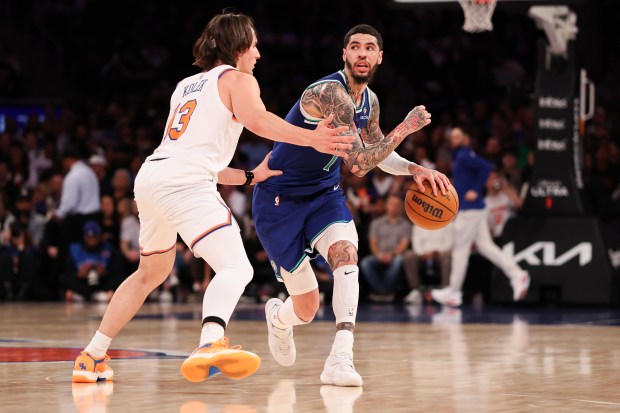 Timberwolves guard LaMelo Ball looks for a teammate while being guarded by the Knicks’ Tyler Kolek in the second quarter of an exhibition at Madison Square Garden on Oct. 12, 2026, in New York City. (Ishika Samant / Getty Images)
Ball is one of the best passers in the NBA, but he has never averaged more than 8.4 assists a game in a season, and averaged 7.1 last season, well behind the league-leader, cenver center Nikola Jokic at 10.7.
But the suppressed average was partially due to a sub-30 minute load. Ball averaged 9.2 assists per 36 minutes last season; the guess here is he plays roughly 34 minutes a night in Minnesota.
He averaged 10.7 assists per 36 minutes in the preseason and really seemed to prioritize sparking ball movement and setting up his teammates — many of whom are talented scorers — over hunting for his own offense.
Rudy Gobert touts the best net rating among all non-Spurs and Thunder players
 Timberwolves center Rudy Gobert drives to the basket in front of San Antonio center Victor Wembanyama in Game 6 of the Second Round of the NBA Western Conference Playoffs at Target Center on May 15, 2026. (David Berding / Getty Images)
Net rating tracks how well your team does relative to your opponent while you’re on the floor. So, if the Thunder and Spurs each win 60-plus games this season, their players will occupy the spots atop the leaderboard.
But the Wolves’ center may not be far behind. Gobert has long been a monster in this category, because he impacts winning.
Frequently, that impact is most noticeable on the defensive end. That will again be true this season, as he’s tasked with anchoring a unit that features a couple of question marks. But Gobert’s offense also figures to improve as he receives more lobs from Ball for easy dunks and gets to run more pick-and-rolls, the an area where he’s most comfortable.
With little frontcourt depth behind Gobert, Minnesota’s best basketball will always come with its center on the floor.
Minnesota finishes outside the top 10 in pace
Yes, the Wolves are flush with athletes and just added one of the NBA’s premier point guards. That should be a recipe for running teams out of the gym, especially considering the Wolves were 10th in pace last season.
But Ball’s Charlotte team was one of the NBA’s slowest. And Minnesota’s second unit figures to struggle to grab the rebounds necessary to get out in transition at a high rate. The Wolves won’t be a slow team, but don’t expect them to consistently put opponents into unwanted track meet.
The Wolves are a better regular-season team than a playoff team
The opposite has been true each of the past two seasons, as Minnesota stumbled to the No. 6 seed in consecutive campaigns, only to make subsequent postseason runs.
This year, Minnesota figures to tout the offensive firepower to have its way throughout the regular season in the open-floor game. But when physicality ratchets up and defensive game plans tighten, will the Wolves be able to match the size, force and attention to detail of their opponents?
It’s not the same resounding “Yes” with this roster that it was in recent years.
Minnesota wins 52 games to grab the No. 3 seed in the West, but falls to the Thunder in Round 2
For the record, that would be an outstanding season. But there are currently too many questions about the Wolves’ size, Ball’s ability to excel in the playoffs and Minnesota’s bench to foresee them seriously challenging Oklahoma City and San Antonio at the top of the conference this season.
 LaMelo Ball #1 of the Minnesota Timberwolves dribbles the ball against the Milwaukee Bucks in the first quarter during the preseason NBA game at Fiserv Forum on October 05, 2026 in Milwaukee, Wisconsin. (Photo by Patrick McDermott/Getty Images)