
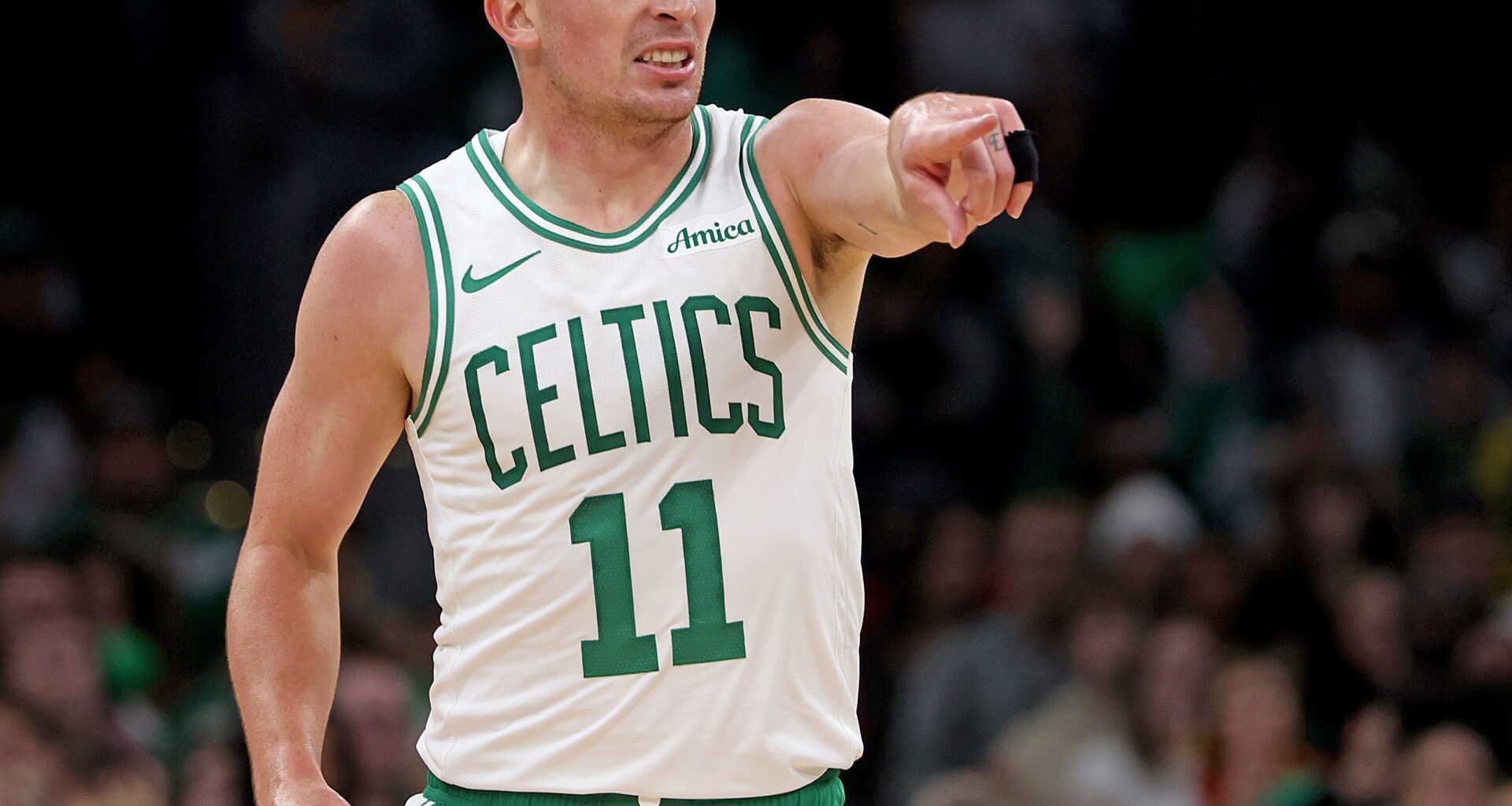
When he became extension-eligible on Oct. 1, Payton Pritchard had a decision to make.
Should he opt for the guaranteed money and security a new deal would provide, knowing its maximum value would be capped by the terms of the NBA’s collective bargaining agreement? Or should he wait, bet on himself and shoot for a heftier payday a year or two from now?
Ultimately, Pritchard chose Option 1: a two-year, $44.2 million contract that includes a mutual option for the 2029-30 season.
According to him, it wasn’t an especially difficult decision.
“I feel like $22 million a year is quite a lot of money, especially going from making about 8,” Pritchard said Sunday in his first public comments since the team announced his extension. “So I thought it was — I don’t know, sometimes I like to just take that, and then you can always work for the next one. Stay hungry, and maybe go get after the next one, be a better player. Three years down the road, maybe I’m a better player, and then hopefully I can get rewarded like that again.”
Pritchard’s value to the Celtics far outpaced his previous contract — a four-year, $30 million pact widely viewed as one of the NBA’s biggest bargains. When he signed that deal in October 2023, he was coming off a season in which he appeared in just 48 games and became so frustrated with his lack of playing time that he requested a trade.
“At the time, I wasn’t playing,” Pritchard recalled. “I’ve talked about this before, but it was probably a little delusional confidence that I have. But it’s from my work, the hours I put in. But I believed I could help this team win and at a high level. Now, many people didn’t believe it at the time or thought I was crazy, but I truly believed that. Obviously, things opened up for me and it worked out and I took advantage of it, and hopefully I continue to take advantage of it.”
Sticking around proved fruitful for both Pritchard and the team.
The following season, the undersized guard reemerged as a core rotation player, saw action in all 82 games and hit some of the biggest shots in Boston’s 2024 playoff run, including his iconic halfcourt buzzer-beater in Game 5 of the NBA Finals. A year later, he was the NBA’s Sixth Man of the Year. Last season, he was the Celtics’ second-leading scorer behind Jaylen Brown despite shifting from the starting lineup back to the bench in February.
“He’s just built like a competitive person,” head coach Joe Mazzulla said. “I think that’s just kind of who he is in general. But I think it’s a really good template (for) how difficult it is. You take a look at his career. He played, and then he didn’t play, and then we brought in other guys in his position, but he still played. He just maintained a level of toughness, a level of resilience, but I think a level of open-mindedness to (say), ‘I’m just going to do whatever needs to be done to get on the floor and impact winning.’
“It’s looked different at every stage of his career, and I think that’s a (lesson to) younger players and new players coming in. They’re so used to having it done a certain type of way, or ‘This is my game,’ whereas he was just like, ‘I don’t really have a game. I’m just going to do what I need to do.’ I think that competitiveness, but also that open-mindedness is kind of what makes him who he is.”
In a statement Saturday, Celtics president of basketball operations Brad Stevens called Pritchard “a very good player” and “just a flat-out winner” with an “elite” work ethic.
“We’re thrilled he’s chosen to extend with the C’s,” Stevens said.
The feeling was mutual.
“It means a lot from, obviously, Brad and the organization, (team owner) Bill (Chisholm) and all them, to offer that,” Pritchard said. “So I’m definitely grateful for it and just happy to have signed another two years on it to be in Boston, and I love it here. I like competing for the city and competing for the organization, and so I feel very honored.”