

MEXICO CITY — Eduardo Najera wrangled all the talent he could convince to make the trip. It was the summer of 2005, and the Michael Jordan of Mexico was assembling his Dream Team of sorts. Not in pursuit of a gold medal or a championship ring. For something closer to Najera’s heart.
“There are a lot of kids that don’t have the means to travel to an NBA game,” he remembers thinking. “So I tried to put up as close as I could to an NBA type of game with a bunch of players.”
He gathered a handful of Nuggets teammates and Denver connections for the inaugural event — a charity all-star game in his hometown, Chihuahua. NBA slam dunk contest champion Jason Richardson was the headliner. Over the next couple of years, Marcus Camby, Kenyon Martin and JR Smith joined. Najera started facilitating similar exhibitions elsewhere in Mexico, featuring stars such as Kevin Love, DeAndre Jordan and DeMar DeRozan.
Back in 2005, only one regular-season NBA game had been played in Mexico. Preseason games were a growing trend in the country, but there was no guarantee that teams would play their starters in that setting. That’s why it was important to Najera to bring the NBA home in his own way.
“When I was growing up, we had this huge (satellite) dish on the roof that you had to move around manually to watch the games,” he said. “Nowadays, all the fans in Mexico, they have access to it. There’s more excitement from the younger generations.”
More than 20 years after that first charity game, the Nuggets were in Mexico City on official business this weekend, facing the Indiana Pacers. Neutral site showdowns are the norm in North America’s largest city now — this is the 15th regular-season game played there since 2015. Najera, the first and only Mexican-born player drafted in the NBA until this year, has been beaming with pride to see one of his favorite teams in Mexico City for a second consecutive year. His Mavericks visited in 2025.
 Eduardo Najera #21 of the Denver Nuggets warms up before play against the San Antonio Spurs in Game three of the Western Conference Quarterfinals during the 2005 NBA Playoffs at the Pepsi Center on April 30, 2005 in Denver, Colorado. (Photo by Brian Bahr/Getty Images)
Najera lives in Playa del Carmen now on Mexico’s east coast, working for the Mavs as an ambassador to Mexico. But in his 12-year playing career, he appeared in more games as a Nugget (243) than with any other team.
“I gave my whole body, my soul to those two franchises,” he said. “… I do identify myself with the Nuggets. I see a lot of Nuggets jerseys with my name and 21 around the country.”
In Denver, Najera was a hard-nosed role player during the Carmelo Anthony era, a contributor on four playoff teams from 2005-08. In Mexico, he’s Jordan, even 15 years after his retirement. Camby used to call him “the king of Mexico” when they were teammates in Denver, Najera remembers.
He’s not entirely comfortable with the label, partly out of respect for past generations of Mexican hoopers unknown to NBA audiences, and partly because he’s been anxiously waiting to be dethroned. The next great hope is rookie Karim Lopez, who was drafted 16th by Memphis this year.
“I think he’s gonna be the best player our country has ever seen,” Najera said. “He’s got it. Mentally, he’s got the tools. He’s got the size. He’s got the length. He’s got the athleticism. But mentally, that’s where I kind of question players. … Based on what I’m hearing, he’s got that fire and that motor within that most players lack.”
Basketball was a tertiary sport when Najera was growing up in Chihuahua. He played on a beat-up neighborhood court with no net on the rim. At first, he planned to pursue baseball more seriously, following in his father’s footsteps. But when he tried out for the high school team as a freshman, his coach told him he was too tall — and that he should try basketball instead. Najera took the advice. He was a natural.
 Kobe Bryant #24 of the Los Angeles Lakers gets off a shot between Kenyon Martin #4 and Eduardo Najera #21 of the Denver Nuggets during first half action in Game Three of the Western Conference Quarterfinals during the 2008 NBA Playoffs at the Pepsi Center on April 26, 2008 in Denver, Colorado. (Photo by Doug Pensinger/Getty Images)
“I want to say at 17, I was already dominating. My talent, per se — not necessarily my skill level — my talent was dominating the basketball (competition) in the country. I already was so far ahead that I was already competing with pro guys.”
He had to leave Mexico to take the next step as a prospect. He moved to San Antonio as an exchange student and captured the attention of prominent NCAA coaches. It eventually enabled him to develop into a more polished, pro-ready player. His reluctance to anoint himself as Mexico’s GOAT stems from that experience; Najera has no way of knowing whether the great talents before him might’ve found long-term success in the NBA if they’d had the same opportunities.
“This is why I really understand Michael Jordan’s point of view,” he said. “Because there are some other players here in Mexico, old-school — Arturo Guerrero, who I never got to watch play, but I think he’s better than me. (Manuel) Raga, I think he was better than me. I think Horacio Llamas was better than me. … I just had a better career. That’s all there is to it. They had more talent, and again in Mexico, you might not have the same tools as the U.S., or you might be stuck here in Mexico. … I made that sacrifice and (went) to the U.S. and kind of acclimated myself to U.S. basketball, then it was easier for me to get to the NBA. These guys would have done the same thing.
“Maybe I just got lucky.”
Nuggets memories
Still, Najera seized the opportunity when it presented itself. He was drafted 38th overall in 2000. After four years in Dallas and half a season with Golden State, the Nuggets traded Nikoloz Tskitishvili and Rodney White for him (among other pieces) in 2005.
Najera’s lasting relationship with Denver is tied to a few effects it had on his life — most notably the reminders of home. “Chihuahua is very similar to Denver,” he said. “It’s surrounded by mountains. It’s about a mile high in altitude. … K-Mart was telling me (in Chihuahua), this actually feels like Denver.” Najera still visits Aspen on vacation from time to time, though he has some reservations about how expensive the famous ski town has become.
Not long after arriving in Denver, he also realized how meaningful his status as a Nugget was for his exposure back in Mexico. Suddenly, he was surrounded by hugely popular names, from Anthony to Allen Iverson.
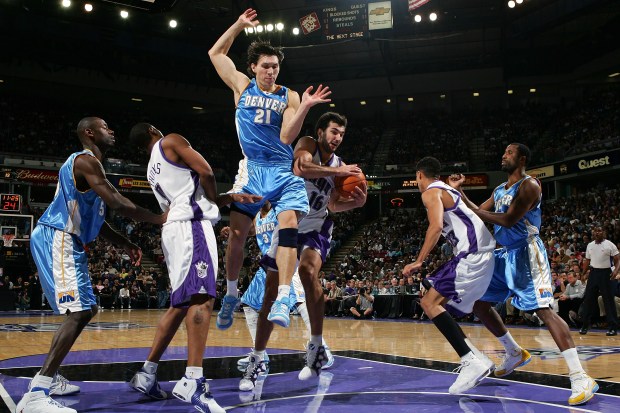 Eduardo Najera #21 of the Denver Nuggets and Peja Stojakovic #16 of the Sacramento Kings battle for a rebound during an NBA game at Arco Arena on Nov. 11, 2005 in Sacramento, California. (Photo by Jed Jacobsohn/Getty Images)
“It seemed like my level of recognition in Mexico went to another level,” Najera said.
His most resonant memory as a Nugget is almost 20 years old to the date: the notorious brawl that broke out between his team and the Knicks at Madison Square Garden, where Anthony threw a punch and got suspended for 15 games by the league.
What happened next is what Najera remembers fondly, though. The Nuggets traded for Iverson a few days after the fight. Their season suddenly felt on the brink, even though it was only December.
“I don’t think Melo understood the severity of what he did. … That was a year we were supposed to go all the way, and that event took a lot out of everybody,” Najera said. “It could have deflated us and gone the other way, but at the end of the day, we kind of came together as a strong unit. Melo came back and did what he does best. … We made the playoffs. Even though we did not make it very far, we at least, we saved the season. It took a lot of energy, a lot of mental toughness and emotional intelligence. … Otherwise, we would have been crucified by the media.”
He’ll never forget Iverson’s simple power during a game late that season. The Nuggets needed a win. Their playoff hopes hung in the balance. They trailed by almost 20 in the first half. Najera, Iverson and Martin were on the floor together, and Iverson huddled them to plead for intensity. “Guys, we’re better than this.” The message wasn’t anything out of the ordinary, but it reverberated through Najera’s mind and soul — maybe for no other reason than whose voice it was. The Nuggets rallied to win. They snuck into the playoffs.
But they could never win once they got there. Not until after Najera was gone. His four years in Denver were characterized by first-round losses and a cumulative 3-16 playoff record.
Najera’s dream had been to win a championship. It didn’t come true. He left Denver in free agency in 2008, signing a four-year deal with the Nets. “I did try to give the Nuggets an opportunity,” he said, “but I couldn’t ignore that the offer was pretty good.” The Nuggets didn’t care to compete with it. They finally made a run to the Western Conference Finals the following season.
Najera harbored no hard feelings as the rest of his career played out. He says he rooted for the 2009 team from afar.
But he was always a little haunted by his lack of playoff success in Denver, too. He wondered how he might’ve been able to contribute to that 2009 run, which ended two wins short of the NBA Finals. Najera developed a serviceable 3-point shot toward the end of his time in Denver after coach George Karl challenged his lack of spacing. With a new weapon in his arsenal, Najera wonders, maybe he could’ve helped against Kobe Bryant’s Lakers.
“Sometimes I regret it when I think about my career there, my four years — we were so good,” Najera said. “And we had Carmelo really young. At the end of the day, we were like, on paper, the roster was (supposed) to win a championship. We just couldn’t get even through the first round. Up until, obviously, I left.”
Mexico City ‘ready’ for an NBA franchise
Denver’s trip south of the border coincides with an ongoing NBA expansion saga that has involved some flirting with Mexico City. The metropolis appears to be on the outside looking in, with Las Vegas and Seattle considered distant frontrunners to land the 31st and 32nd teams. But according to ESPN’s Brian Windhorst, commissioner Adam Silver reintroduced Mexico City at the board of governors meeting in September, perhaps as a leverage play to elicit higher bids for a Seattle franchise.
Najera is biased, but he doesn’t see it with Seattle. He likes the dark horse more. He’s been trying to get a team in Mexico for more than a decade. He remembers attempting to convince a wealthy Mexican acquaintance to bid for the Sacramento Kings before they ultimately went to Vivek Ranadive’s ownership group in 2013.
“They thought that I was crazy because basketball was not as big as it is now (in Mexico),” Najera said. “Obviously, they didn’t think that it would be a good business deal. Now they’re kicking their own head because they should’ve done it. … Mexico City, or the country, is ready for an NBA team. It has been ready for quite some time. We just need to get somebody to pull the trigger and really commit to it.”
Najera will likely have to settle for more of these regular-season games against tourist teams, like Denver and Indiana this weekend. Even that might’ve felt unimaginable to him two decades ago, when he was gathering as many Nuggets as possible for a charity exhibition.
“When I went and migrated toward basketball, I saw the lack of platforms for the youth,” he said. “Ultimately, I think this is a great thing for boys and girls.”
Want more Nuggets news? Sign up for the Nuggets Insider to get all our NBA analysis.