
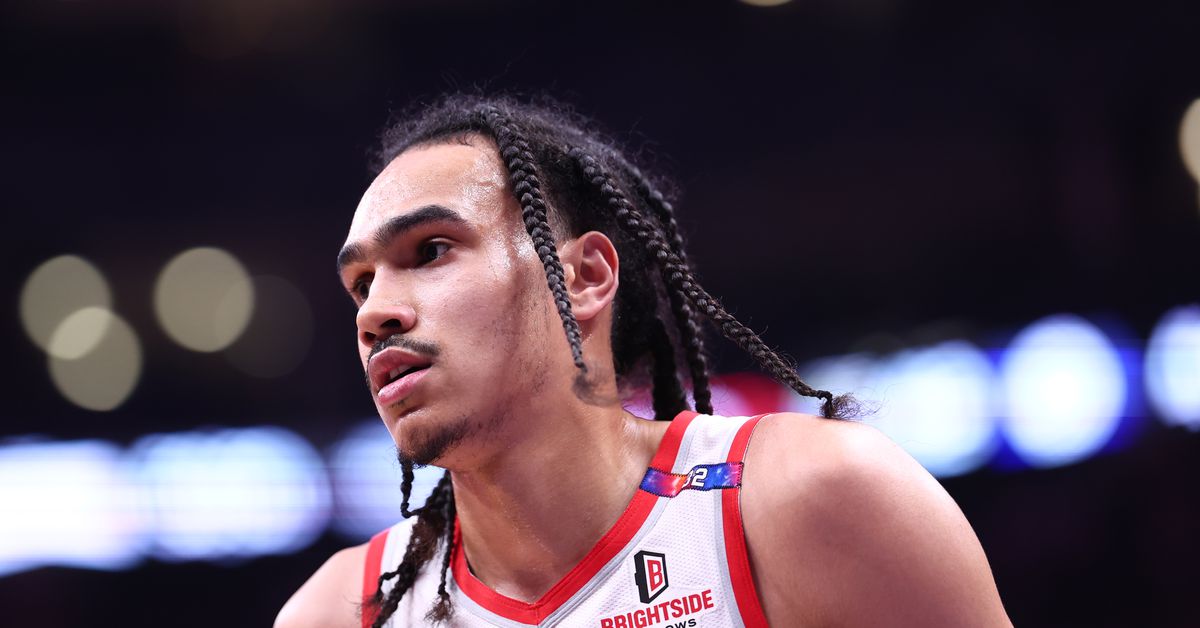
The Portland Trail Blazers snagged Dalano Banton from the Boston Celtics for the price of a heavily protected second round pick 18 months ago. In real terms, they paid nothing for a still-young athletic wing who was yet to get a real opportunity on the court.
The 25-year-old has just finished the second year of a two-year, $4.2 million deal, entering a free agency where he should improve his fiscal position after a decent showing this season.
If the Blazers hope to re-sign him, they’re restricted to Early Bird Rights, given the two-year length of his expiring deal. While restrictive, the rights still allow the Blazers to bring him back, even if they are likely to remain above the salary cap.
But the Blazers are also poised to make serious changes to the roster with multiple veterans on the precipice of contract seasons. Today we ask whether the Canadian comes back next season, independent of the uncertainty that surrounds the rest of the roster.
Banton’s game
After failing to stick with his hometown Toronto Raptors and then the Celtics, Banton landed in Portland where opportunity was laid out before him on a rebuilding team. With the Blazers, the 6’9 Banton established himself as a tall, long and athletic guard/wing with ability on both sides of the ball.
Banton’s control and movement with the ball in hand were instantly noticeable, particularly given his length. He has an ability to get to the rim and either kick out or finish, using size to gather over guards and the agility and length to sneak in between big men under the rim. His three-point shooting can be best described as streaky but he’s far from awful, and on rare occasions, has proved game changing.
The midrange is almost non-existent, with Banton taking only 30 percent of his shots between three and 23 feet. He can pass, as we’ll discuss later, but he’s also not afraid to create for himself — perhaps a result of the lack of shooting on the current roster.
On the other side of the ball, Banton is an average defender, able to navigate pick and rolls admirably and generally knowing where to be. His size does allow him to guard multiple roles but unfortunately that physical prowess still isn’t enough to make him a lock down defender.
Ultimately, Banton is average in most facets of the game, using a combination of guard skills and forward length to serve his team across the gamut of basketball categories.
This season
Banton has carved out a role as Portland’s third-string point guard who can serve as a microwave scorer off the bench. He has been promoted up the rotation when injuries have hampered the Blazers backcourt. But I’d be reluctant to play him consistently given his below-average shooting.
This season, the Canadian averaged 8.3 points on 32.4 percent three-point shooting, 39.1 percent from the field, 2.0 rebounds, 2.4 assists, 0.6 steals and 0.5 blocks in 16.7 minutes. Among wings, he ranked ninth in assist rate, diming on 21.1 percent of teammate makes and fifth in block rate swatting 1.6 percent of opponent attempts.
His size has given Chauncey Billups choice, playing him as a guard in ultra big lineups or as a frontcourt body when they go small. Earlier in the season he was also used as a fourth quarter specialist, highlighted by his November 4 performance against the New Orleans Pelicans. At three-quarter time that night, the Blazers were down 79-82. Banton was called on in the fourth and delivered. He scored 20 points on 2 of 3 from three, 1 assist and 2 steals, finishing with a +21 and leading the Blazers to a convincing 118-100 win.
The exclusive late-game contribution proved not be sustainable, but it was an interesting lever the coaching staff pulled to change the trajectory of a game. If anything, this season proved the Banton belongs in the NBA, even if he see the bench more than the court.
His value
If the Blazers decide to bring Banton back, I doubt it’s on another minimum deal. I think he’s done enough to at least register some interest from other teams. But rest assured, he’s not worth of superstar money. Banton has the game and body type to help most teams, regardless of its postseason ambitions.
The Blazers hold Banton’s Early Bird Rights, which means their maximum offer could be 105% of the 2024-25 average salary, roughly $12.5 million. So while the Blazers don’t need to use an exception to re-sign him, let’s use next season’s projected free agent exception levels to gauge what he could get on the market.
He’s probably not worth the Non-taxpayer ($14.1 million), Room ($8.8 million) or Taxpayer Mid-Level Exceptions ($5.7 million). But I could definitely see another franchise offering him the Bi-annual amount of $5.1 million.
If the Blazers still want him around, I’d advise them not to offer more than $5 million. Ideally, you give him three years in order to secure those full Bird rights, perhaps with a team option or a non-guarantee on the final season.
In the modern NBA, a three-year, $15 million deal seems reasonable for a 10th or 11th guy who can actively help a team to two-or-three wins a season.
Conclusion
While flawed, Banton is still young, skilled, versatile and long. Amazingly, he’s about to embark on his third NBA contact, just four years after being selected with the 46th pick out of Nebraska in 2021. While he’s been able to carve out a role with the Blazers, it’d be a stretch to suggest that he’s the type of player worthy of a deal that pays him more than $6 million a year.
Regardless of what General Manager Joe Cronin decides to do, I think there’s an argument to suggest he should re-sign Banton as an end-of-the-bench facilitator. A break-glass-if-necessary option who can be called upon to create a little offense, get to the rim, shoot and defend multiple positions.
We have no idea what the front office has planned over the next three months, but if Banton is back on the roster at an acceptable number, I’d have no qualms.