
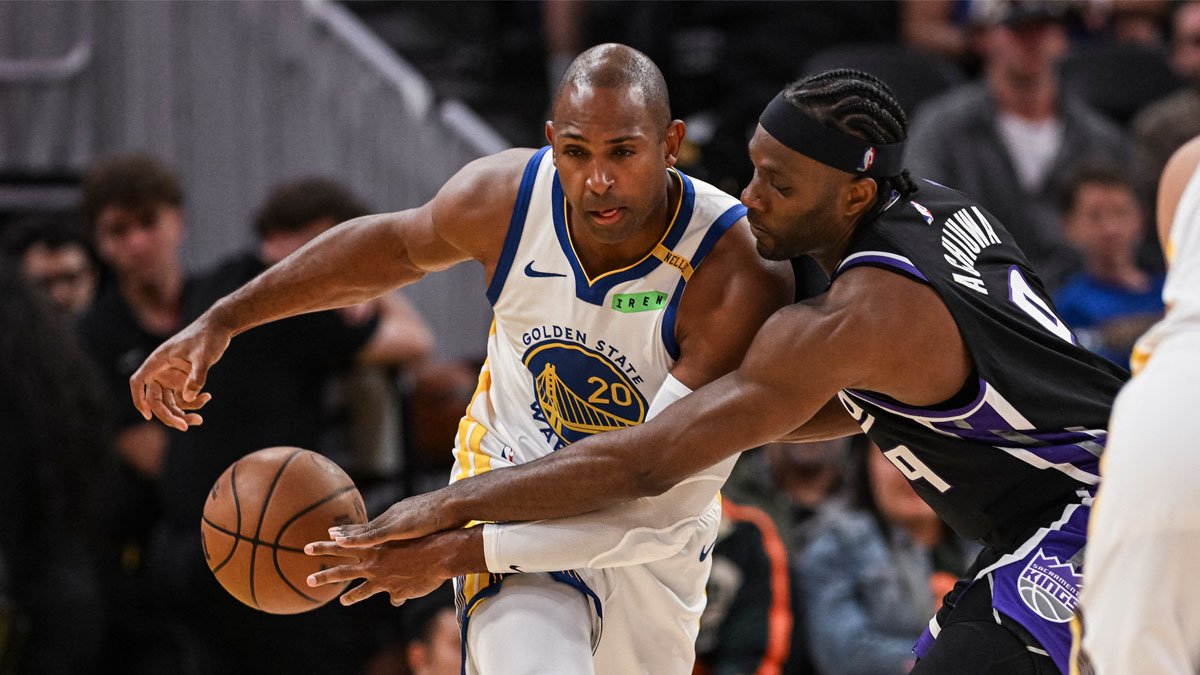
Al Horford has etched his name in history, becoming only the 13th player to play in 20 NBA seasons, joining an exclusive list that includes LeBron James, Vince Carter, Dirk Nowitzki, Kobe Bryant and others.
Horford is grateful to be in this position and sat down with NBC Sports Bay Area’s Bonta Hill and Dalton Johnson on “Dubs Talk” to reflect on his achievement and discuss being in rarefied air.
“Surreal,” Horford told Hill and Johnson. “It feels surreal, but it’s pretty special and I’m grateful for it. It doesn’t feel like it’s 20 [seasons]. It has been a lot of basketball, a lot going on, but I really enjoy this and being a part of a team and getting to do this for a living.”
Horford played three seasons of college basketball at the University of Florida, reaching the pinnacle of his career up to that point when he helped guide the program to two straight national championships in 2006 and 2007.
Horford figured that he would get a shot in the NBA after a stellar Florida tenure, but didn’t realize the magnitude that his career as a pro would reach.
“When I declared for the draft, Billy Donovan, my coach at Florida back then, sat myself, Joakim [Noah] and Corey [Brewer] down and he was like, ‘Hey, you guys are going to be great NBA players,’ ” Horford said. “He looked at me, like, ‘You’re going to play 10 to 12 years, it’s going to be a good career, you’ll make a couple All-Star teams, good contract,’ like that’s kind of that. So my mindset, looking at players when I came into the league, you were a vet when you were 30-31.
“That’s how it was so I was like, ‘Oh, I’m going to play 10 to 12 years and then maybe in my last year or two I would go overseas and play in Spain or Italy or something like that, and just ride it out. Like Dominique Wilkins, a lot of guys used to do that back then. So that was my mindset, and then the league just started going, and I just continued to play. I feel like the NBA as a whole really invested a lot in the performance and the taking care of the body, and I was always very conscious of that.”
Horford comes from a basketball family with his dad, Tito Horford, also playing in the NBA. Watching how he prepared inspired him to do the same thing, and he credits the lessons he learned from his dad as being pivotal to his career longevity.
“I think it’s because of my dad,” Horford added. “My dad being a professional player, he was always trying to take care of his body, take care of himself, and every opportunity that I got, I always looked for that. Even from the beginning, even for my rookie year, I was getting treatment like a vet. There was really no reason for it, but I just wanted to build that base, and then time just kind of flew and here we are. Probably when I was like in year 14, I was like ‘well, I think it’s going to be a couple more’ and then I keep telling my agent I’m going to keep playing, I’m going to keep it going. My body feels good, I feel good. So it’s been a big blessing.”
Horford has seen the league change considerably since he was a rookie and he has adapted to the game’s growth. That is why he views his 20th season as a badge of honor, acknowledging how much work it took for him to stay relevant in a sport that stopped catering to his original style of play.
“It’s special for me because the game has changed a lot,” Horford said. “When I stepped into the league, I wasn’t shooting beyond 15 feet. It was all paint, it was mid-range at most. I never imagined shooting threes. I started to be challenged as a player, like ‘hey, the league is changing.’ I had a GM with the Hawks, Rick Sund and after my first major injury, I tore my pectoral muscle. He was like ‘listen, you’re a physical player, you want to play down low but you’re not going to make it playing like that, like these guys are bigger than you.’ They’re stronger, you have to start expanding your game, you have to start shooting the ball.’
“It was hard for me to understand, but I was like I’m going to start trying it, practicing it, and it felt really unnatural shooting the three-ball. I started with the corners, and progressed from there, went from there. It’s just the evolution of the game. I was like, ‘If I’m going to survive in this league, and I’m going to continue to play and be relevant, I have to be able to shoot the three really well.’ I have to be able to guard one through five. There’s different things that you have to do because if not, even if you’re a great player, you won’t make it. For me, I just don’t want to be on a team, I want to help. I want to be an impact player and be able to play and not just say that I’m there. That was always the goal of mine, and that’s why I prepare the way that I do so I can be in that position to help the team.”
Horford endured an injury-rattled debut season in Golden State last year but re-signed on a two-year, $14 million contract in the offseason. Averaging 4.5 points, 4.3 rebounds and 1.0 assist in four games off the bench this season, his veteran leadership is key for a team hungry to return to the playoffs after a one-season absence.
Download and follow the Dubs Talk Podcast