
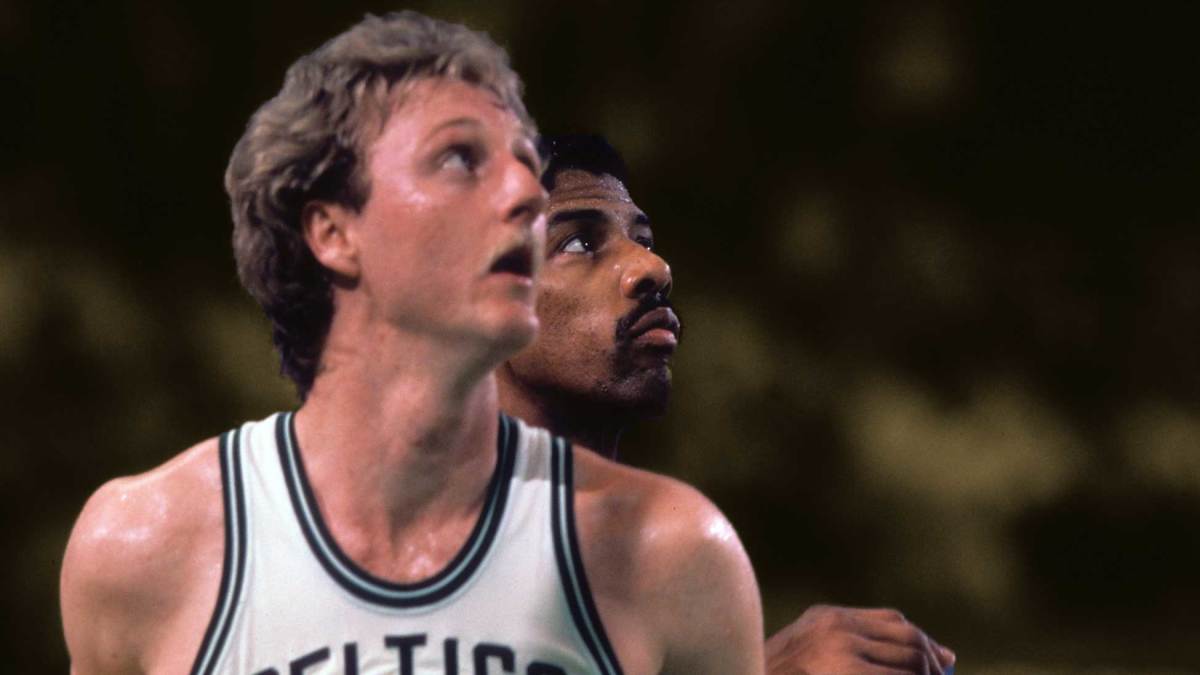
“Larry Bird said, ‘If Robert doesn’t want to be here, trade his a—'” – Robert Parish admits he didn’t take Bird’s side in his fight with Julius Erving originally appeared on Basketball Network.
Larry Bird and Julius Erving were two players rarely associated with in-game violence. They were intense, competitive and brutally skilled but not the type to swing first.
Advertisement
And yet, in November 1984, at the height of their powers and amid one of the NBA’s most volatile rivalries, both legends locked horns in a moment that brought chaos to Boston Garden.
The Philadelphia 76ers were in town. The Boston Celtics were firing. And suddenly, Bird and Erving were at each other’s throats. It became one of the most talked-about fights in NBA history, not because of how long it lasted, but because of who was involved.
Parish didn’t help
Players from both sides flooded the floor, trying to break things up, but Celtics center Robert Parish stood still.
His inaction that night raised eyebrows. But behind the championships and chemistry was a real history between Parish and Bird that many never knew existed — until Cedric Maxwell, who played for the Celtics from 1977 to 1985, opened the curtain on a simmering grudge.
Advertisement
“I didn’t help Larry Bird, and it was a reason why,” Maxwell said, recounting what Parish told him years later. “Because when I was trying to negotiate my contract about three or four years before … There was a title that Larry Bird said, ‘If Robert doesn’t want to be here, then hey, trade his a— and we’ll play with who we got.’ I never forgot that.”
Parish, who averaged 16.2 points and 9.5 rebounds per game over 14 seasons with Boston, had been a constant through battles, bruises and banners. But even legends have long memories and when the 1984 brawl erupted, he didn’t forget Bird’s words years earlier.
The 1984-85 Celtics were stacked — Bird, Kevin McHale, Dennis Johnson, Danny Ainge and anchoring the paint, Parish. By then, the center had already carved out its space in the trio that defined the decade for Boston: the Big Three.
When he arrived in 1980 via a trade from the Golden State Warriors, Boston became a different beast. His defense, rebounding and soft-touch midrange turned the frontcourt into a fortress and with McHale and Bird beside him, the Celtics’ front line bullied the league.
Advertisement
So while fists flew and jerseys got tugged, Parish stayed rooted, perhaps in quiet protest, perhaps in reflection. The same quiet temperament that earned Parish his nickname “The Chief” seemed to double as a silent statement that night.
Bird and Erving’s scuffle
It was an unusual scene from the onset. Bird, the stone-faced assassin from French Lick, and Erving, the smooth glider with a doctorate in cool, descended into a full-blown scuffle that saw punches thrown, players sprinting from both benches and referees trying to restore order to something that had spun well past control.
Advertisement
The fight itself lasted only seconds, but its impact echoed for seasons. Midway through the third quarter, with Boston up big, tensions boiled. Bird had already dropped 42 on the Sixers and was visibly jawing at Erving. There was a hard foul. Then, a shove. Then, both men locked up — and then came the haymakers.
What made it even more surreal was the cast of players who jumped in. Charles Barkley held Bird from behind, Erving got in two clean shots and chaos swallowed the hardwood. That was the night one could see the NBA’s polished veneer give way to raw emotion and unresolved tension.
“I sat right there and watched. I didn’t even try to [help],” Maxwell recalled.
Larry and Julius were both fined $7,500 for the fight — the largest fine ever given to a player for an on-court altercation at the time. These weren’t just two stars, they were symbols of cities, franchises and basketball philosophies.
Advertisement
Bird represented the gritty, grind-it-out Celtics tradition. Erving was the face of the flashy, fierce Sixers. And when their teams collided, sparks were guaranteed. But on that night, a fire broke out.
It’s one of those moments frozen in NBA lore — not just for what happened, but for what it revealed. A grudge from years prior, a silence that spoke volumes and a glimpse into how even the closest locker rooms can carry fractures that don’t heal with titles.
This story was originally reported by Basketball Network on Jun 10, 2025, where it first appeared.