
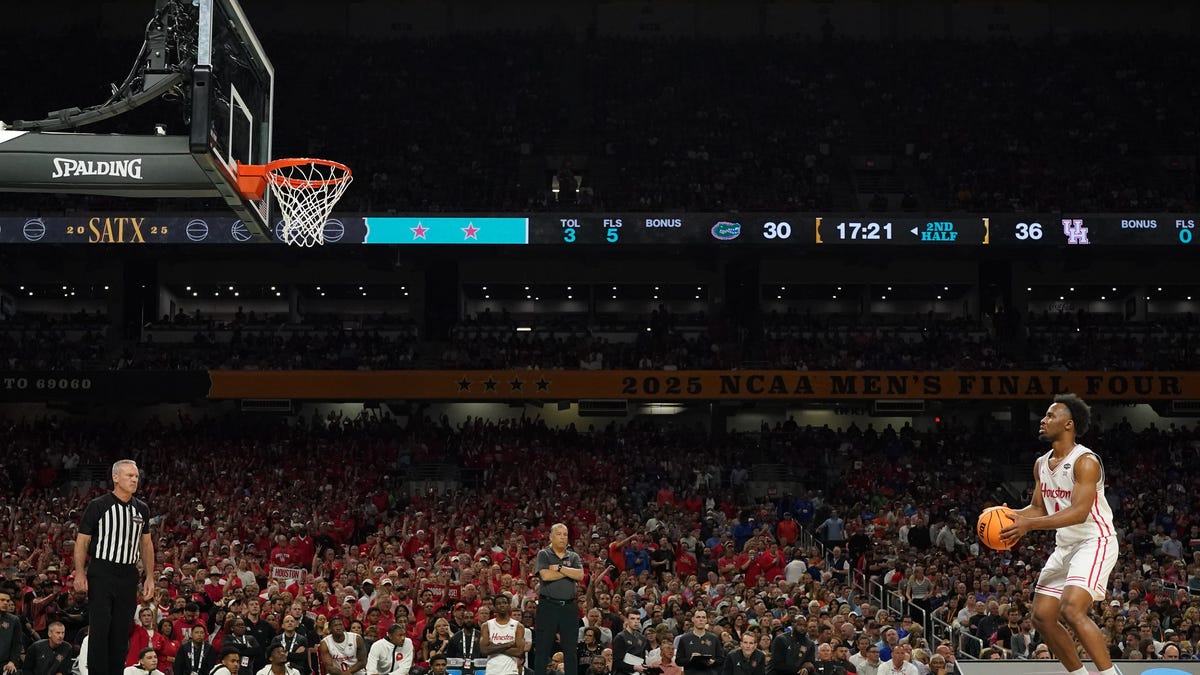
The landscape of NCAA men’s basketball is set to look a little bit different in the 2025-26 season. Earlier this week, the NCAA Playing Rules Oversight Panel approved several rule changes aimed at enhancing the pace, fairness, and precision of men’s college basketball.
The changes include the addition of a coach’s challenge system and updates to how officials call continuous motion and fouls. The most critical change being the updated coach’s challenge system, a first in the history of Division I men’s basketball. This will now allow coaches to trigger video reviews on key calls. In addition, tweaks to continuous motion, foul classifications, and review protocols are all changes that will be made in effort to keep the game moving.
Coach’s Challenge Introduced
For the first time in NCAA men’s basketball, coaches will be allowed to challenge specific calls by utilizing video review. The challenge can be used at any point during the game, provided that the team has a timeout available.
Coaches can challenge the following:
Out-of-bounds callsBasket interference/goaltendingRestricted-area arc calls involving secondary defenders
If the challenge is successful, then the team will be granted one more challenge for the rest of the game, which includes overtime. However, if the challenge is not successful, there will be no further challenges allowed.
Game officials will still be permitted to initiate reviews of basket interference/goaltending and restricted arc calls in the final two minutes of regulation and during overtime. However, out-of-bounds reviews will now be limited to coaches’ challenges only, unless occurring in the final two minutes. This new system does not interfere at all with the officials’ current discretion to review other scenarios such as shot clock violations, timing errors, flagrant fouls, or two-point vs. three-point determinations.
Game Flow
To continue with the improvement of pace of game, the NCAA outlined new points of emphasis for officials in the 2025-26 season, including:
Cracking down on delay-of-game tacticsLimiting excessive monitor reviewsStreamlining game administrationReducing excessive physicalityNew Interpretation on Continuous Motion
The Rules Committee also clarified the continuous motion rule, which currently states that only awards free throws if a shot is already in motion at the time of a foul. Starting next season, a player on the offense who ends his dribble and is headed towards the rim may now pivot or complete his current step after absorbing contact will still be awarded a shooting foul.
Additional Rule Adjustments
Groin Contact: Officials may now call a Flagrant 1 foul for groin contact, allowing for two free throws and a possession. Previously, this could only be ruled as a common foul or a Flagrant 2, resulting in ejection.
Rim Use Violation: Players using the rim to gain an advantage will now be called for a basket interference, going forward.
Shot Clock Malfunction Protocol: If one basket’s shot clock has a malfunction, the other will now remain on. Under the previous rules, both were turned off until the one was fixed.
Future Changes?
There are still conversations around a potential shift from halves to quarters in men’s college basketball. This would align with the women’s college basketball format as well as international play. However, the committee said that there are challenges to this, especially regarding the media time-out that is currently in place, structured for television. The Committee has asked the Division I conferences to form a joint working group to provide feedback and opinions before the next rules cycle.
As the game continues to evolve in men’s college basketball, the NCAA is creating a commitment to balancing entertainment value while ensuring competitive integrity. The coach’s challenge and other rule adjustments reflect the Committee’s desire to modernize without compromising the heart of college basketball.
Contact/Follow @College_Wire on X and @College_Wires on Threads. Like our page on Facebook to follow ongoing coverage of college sports news, notes, and opinions.