
I know, we are still a long way from the 2025-26 men’s college basketball season—144 days, to be exact, but what sicko would be counting down, right?!? The days feel long, but it’s the calm before the storm.
That said, we are less than two weeks away from the 2025 NBA Draft, where the Mountain West will have at least one surefire first-round pick in Colorado State’s Nique Clifford. He would be the conference’s first draft pick since 2022, when the Memphis Grizzlies took another former Ram, David Roddy, No. 23 overall.
However, the conference could net two draft picks for the first time since 2020, when four total MW players were plucked, led by Malachi Flynn. Could that occur? Let’s examine!
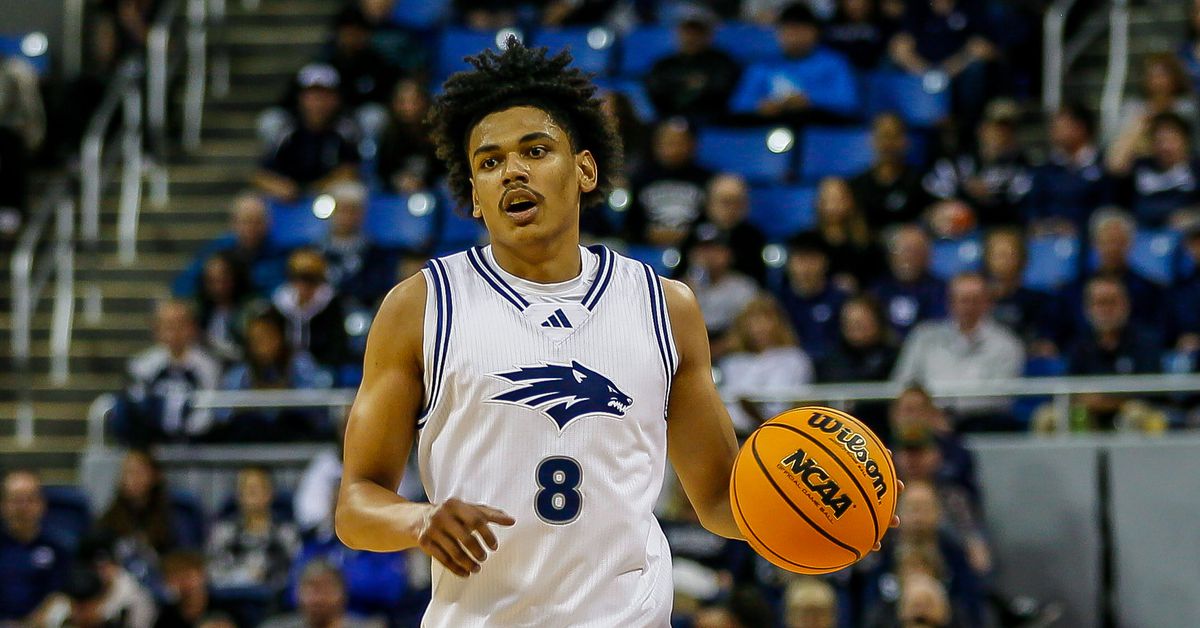
Could Nevada’s Kobe Sanders get drafted?
I won’t lie to you that the middle of the NBA draft was either gutted by players taking their name out of the hat … or refusing to walk the trail entirely. In most years, the draft had 200-plus early entrants; this year, that number was 106, with 50 of those players withdrawing before the May 29 deadline.
One of those players was San Diego State’s Myles Byrd, who climbed up draft boards leading into January before a disappointing stretch of basketball in conference play. He impressed during the combine, but that wasn’t enough to sway him into a (guaranteed) territory that his camp must have preferred.
The only other Mountain West prospect partaking in the 2025 combine was Nevada’s Kobe Sanders, who’s risen up boards throughout the pre-draft process, even though he wasn’t able to showcase himself during combine scrimmages.
Sanders, who will be 23-years-old on draft night, averaged 15.8 points, 3.9 rebounds, 4.5 assists and 1.1 steals on 46.0 percent shooting, 34.2 percent from 3-point range and 79.5 percent from the free-throw line.
Sanders is currently viewed as a consensus fringe top-60 prospect; Rookie Scale’s consensus big board has him No. 58 while NBA Draft Network’s consensus board has him No. 55.
The case against Sanders would be that consensus boards from pundits do not equal what organizations believe. We aren’t privy to those conversations, but certain organizations value, and will target different traits and positions come draft night.
However, the case for him is, like I mentioned above, the board has thinned to fewer prospects than we’ve ever seen in recent memory. We can all thank NIL (and the transfer portal) for that; players are now making the conscious decision to return to school for financial gain. And that’s OK! Players who aren’t first-round picks aren’t automatically granted a guaranteed first contract.
Sanders, like Clifford, ran out eligibility, so he didn’t have that option, like Byrd. But he’s one of the best pull-up jump shooters you can find late in the second round. While he doesn’t have vertical pop, he has excellent positional size, adequate ballhandling and playmaking ability (for his size) and was an effective finisher around the rim.
There have only been seven times since the start of the 2012-13 season that at least two Mountain West draftees have been selected in the NBA Draft. That’s only happened twice since 2016, when UNLV’s Patrick McCaw and Stephen Zimmerman heard their names called. The conference has done an excellent job producing high-level basketball teams—at least four teams have made the NCAA Tournament each of the last three seasons—but it’s just as refreshing to see them succeed at the NBA level when the time calls.
Getting drafted doesn’t automatically grant success—plenty of players don’t, unfortunately; everyone succeeding is far from reality—but it’s the cleanest way to set yourself up for future success if you land in an optimal situation.
Do you think we will see two players drafted come June 25? Let us know your thoughts in the comments!